

 By Emmanuel Fletcher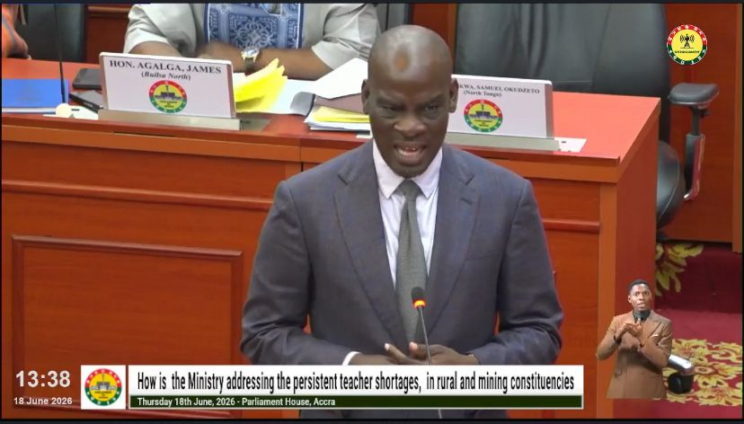
The administrative infrastructure governing public schools has hit a massive financial bottleneck. Education Minister Haruna Iddrisu revealed to lawmakers that the country is currently battling a severe teacher deficit ranging between 50,000 and 90,000 personnel.
Addressing Parliament on Thursday June 18 2026, the sector minister explained that while local classrooms desperately require tens of thousands of fresh educators, strict national budgetary constraints continue to block large scale recruitment efforts.
The critical personnel deficit comes at a time when nationwide instructional systems are undergoing deep structural transformations. Recent national education reforms have significantly broadened state staffing obligations across multiple sectors.
Logic dictates that an expanding national school system cannot comfortably improve its literacy metrics if the state lacks the liquid capital to pay for its frontline staff. Under current structural configurations, the ministry must distribute its scarce workforce allocations between the Ghana Education Service and the Commission for Technical and Vocational Education and Training.
Iddrisu explicitly detailed the painful discrepancy between practical human resource needs and hard financial approvals, stating that while the systemic vacancy sits near 90,000, his office received financial clearance to employ only 7,000 new teachers. This deep gap has triggered massive public anxiety among thousands of qualified but unemployed graduates from various national colleges of education who are eager to fill empty rural classrooms.
The ministry maintains that state employment quotas must strictly match available treasury revenues to prevent destabilizing public sector payroll budgets.
Hoping that public education standards will magically skyrocket while leaving a massive deficit of 90,000 teachers unaddressed is a severe logical error. While graduate teachers are entirely right to feel frustrated about limited job openings, the rigid laws of public finance mean the state cannot safely spend money it simply does not have.
True institutional progress relies on securing long term sustainable funding rather than pushing through unfunded public sector hiring sprees. By carefully managing the current 7,000 approved slots, the ministry is using cold fiscal logic to protect macro economic stability while trying to keep vital TVET and basic school classrooms functional under immense financial pressure.
Also Read: Ghana’s Education Workforce Expansion: Government Recruiting 7,000 Teachers and 3,000 Lecturers