
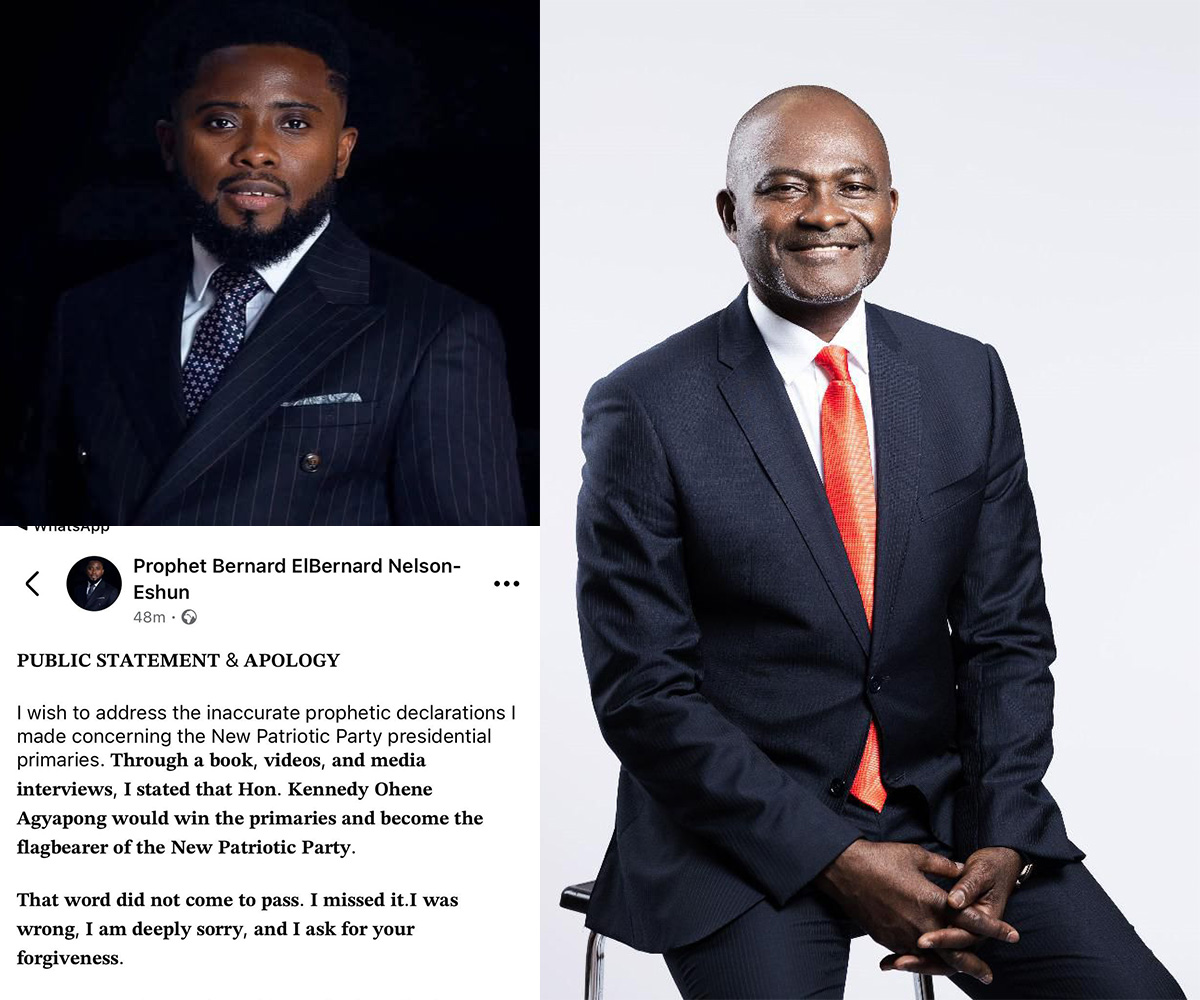
A man of God who earlier prophesied that Kennedy Ohene Agyapong would win the NPP presidential primaries has quickly come out to apologize to Ghanaians and supporters of Kennedy Agyapong, admitting that the prophecy has failed to materialize. What has shocked many people is the timing.
At the moment of his apology, the Ghana Electoral Commission had not yet released the official results. Yet the prophet stated clearly that he had already “seen” that Kennedy Agyapong had lost the race.
Not long after, Kennedy Agyapong himself confirmed what many had begun to suspect.
Kennedy Speaks: “Let’s Come Together as One”
At his campaign office, Kennedy Agyapong addressed supporters with calm words, not anger. He admitted defeat. “There is no need for confusion,” he said, urging NPP members to unite. Then he added a line that quickly spread across social media: “God will take care of you. Go inside, eat and drink champagne.” To some, it sounded humorous. To others, it sounded like closure. But it sealed the matter.
Prophet’s Apology: “I Am Human”
In a Facebook statement that has since gone viral, 𝐏𝐫𝐨𝐩𝐡𝐞𝐭 𝐁𝐞𝐫𝐧𝐚𝐫𝐝 𝐄𝐥𝐛𝐞𝐫𝐧𝐚𝐫𝐝 𝐍𝐞𝐥𝐬𝐨𝐧-𝐄𝐬𝐡𝐮𝐧 who is behind the prophecy admitted fault. He apologised directly to:
- Ghanaians
- Followers of Kennedy Agyapong
- Members of his own congregation
In parts of the statement, he acknowledged that not every spiritual declaration comes to pass, admitting that he spoke based on what he believed at the time, not what ultimately happened.
“I apologise to everyone who believed,” he wrote, adding that he takes responsibility for the disappointment caused.
That admission, however, has reopened an old wound in Ghanaian society.
Fake Prophecies
This is not the first time a political prophecy has collapsed publicly in Ghana. And that is exactly why many Ghanaians are tired.
Each election cycle, prophecies multiply. Some prophets pick winners. Others predict doom. Many gain attention. Few take responsibility when they are wrong. This time, the apology came quickly but the damage, critics say, is already done.
Some supporters admitted they took comfort in the prophecy. Others say it influenced emotions, expectations, and even behaviour around the primaries.
“This thing is becoming too common,” one party supporter said. “Today NPP, tomorrow NDC, next time doom.”
As the incident continues to trend, some voices are now calling on national security and regulatory bodies to step in.
Not to police faith but to curb deliberate political prophecies used for fame, influence, or relevance.
People argue that when spiritual declarations start shaping political emotions, tensions can rise unnecessarily. And when prophecies fail, trust collapses not just in prophets, but in institutions and processes.
For Kennedy Agyapong, the chapter appears closed. He has accepted defeat and called for unity. For the prophet, an apology has been issued. But for Ghana, the bigger question remains unanswered:
How many more elections will be clouded by unverified prophecies before boundaries are drawn?
When the two collide without responsibility, the fallout is always public. And this time, everyone saw it coming except the prophecy.

Also Read: Ghana’s Anti-Corruption Fight at Risk Without Urgent Reforms – OSP