
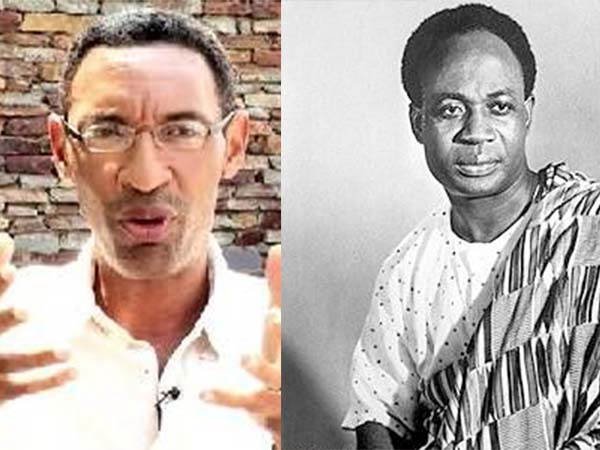
Sekou Nkrumah, son of Ghana’s first president, Osagyefo Dr Kwame Nkrumah, has finally said something many people whisper about but rarely hear from inside the family.
And it wasn’t light. He openly admitted that the long-running Bawku problem didn’t just drop from the sky or start because of tradition alone. According to him, politics entered the matter from day one, and his own father played a role in how things went left.
Speaking in a very calm but heavy tone on radio, Sekou made it clear that what people now call the Mamprusi–Kusasi conflict was not originally some endless traditional fight. In his view, Bawku was relatively calm back in the day. There was structure, there was clarity, and everybody more or less knew who was who. Things only started getting complicated when politics stepped in wearing traditional cloth.
He explained that after independence, the new government at the time decided to change how chieftaincy was handled in some areas, Bawku included. The old system, which was already recognised even during colonial times, was pulled apart and something new was forced into place. Not because tradition demanded it, but because politics needed it.
Sekou didn’t mince words. He said a parallel authority was created, meaning two sides suddenly had reason to claim the same stool. From there, confusion entered, tension grew, and suspicion became normal. What used to be one clear line of authority turned into a struggle that has refused to die till today.
Also Read: Eric Opoku emerges best Performing Minister 2025 – Feedback Africa
According to him, once politics touches chieftaincy, the problem doesn’t end easily. It sinks deep. He said that decision alone destabilised Bawku permanently and planted a seed that has grown into today’s violence and mistrust.
But even though he criticised the move, Sekou also tried to explain the thinking behind it. He said his father was a deep political thinker who studied elections seriously. From the early 1950s, Nkrumah knew which areas and groups supported his vision and which ones didn’t. And in that environment, power was not only about votes, it was also about influence on the ground.
Traditional rulers, according to Sekou, became part of the political chessboard. Those seen as friendly to the ruling party were protected or elevated. Those suspected to be leaning towards opposition were weakened, sidelined, or replaced. It wasn’t personal, he said, it was strategy.
Bawku, especially areas linked to the Mamprusi Kingdom, fell into the category of places the CPP did not fully trust. Politically, the area wasn’t solid for the government, so decisions were taken to tilt the balance. That move, Sekou said, hardened ethnic lines and mixed politics with identity in a dangerous way.
He reminded listeners of a famous warning often attributed to his father, where chiefs were told clearly that loyalty would be rewarded and opposition would come at a cost. That statement, according to Sekou, summed up the political climate of the time. Nobody pretended neutrality existed.
He also pointed out that elections in the 1950s deepened the divide. One group leaned towards one party, the other stood with another. Over time, political rivalry became ethnic tension, and ethnic tension became chieftaincy violence.
Also Read: Military Overthrows Mamprusi Chief Seidu Abagre from Bawku After Otumfuo’s Intervention
What surprised many listeners was Sekou’s insistence that his father’s overthrow did not end the problem. Instead, new governments came and continued playing the same game. Different uniforms, same tactics. Military regimes, civilian governments, all found the situation useful in one way or another.
He said the uncomfortable truth is that the conflict survives because it benefits politics. Fixing it would mean losing certain advantages, and very few governments are ready to make that sacrifice. So the issue is managed, not solved.
In Sekou’s final words, Bawku today is not burning because tradition failed. It is burning because politics keeps feeding the fire. And until leaders are ready to step back and allow genuine traditional solutions without manipulation, the problem will keep returning, generation after generation.
Hard words. But sometimes, truth no dey sweet.
