
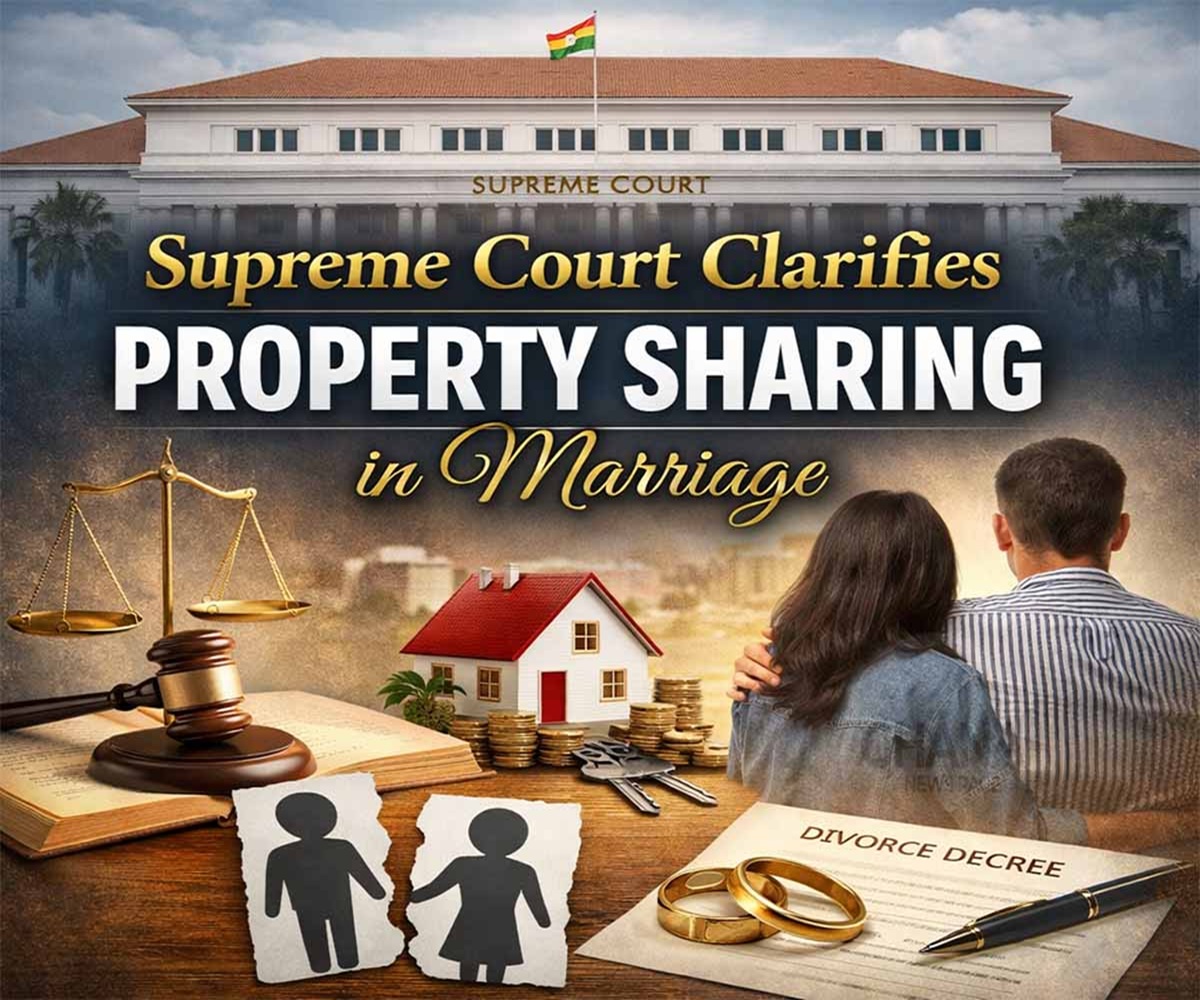
The Supreme Court of Ghana has dropped a clarification that is already changing how many couples think about marriage, property, and divorce. For years, many people believed that once a marriage breaks down, all property acquired during the marriage is shared 50%–50%, no questions asked. That belief is now being seriously corrected.
According to the latest position from the Supreme Court, property sharing after divorce is not automatic. In simple terms, if you did not contribute to building the family or acquiring property during the marriage, you may walk away with nothing when separation or divorce happens.
This ruling has sparked conversations across homes, churches, chop bars, and law offices.
What the Supreme Court Is Saying in Plain Language
The court’s position is clear: marriage alone does not give you automatic ownership of property. Contribution now matters more than assumption.
Contribution can come in two main forms:
- Financial contribution (money, loans, investments)
- Non-financial contribution (services such as supporting a business, managing the home in a way that directly enables wealth creation, or helping build the property)
The court’s message is simple and blunt:
“No contribution, no chop.”
Article 22 of the Constitution Explained Simply
What Article 22 Really Means
Article 22 of Ghana’s Constitution talks about property rights in marriage. However, the Supreme Court has clarified that this article does not guarantee a 50/50 split of all property acquired during marriage.
What it means is:
- Property distribution must be fair, not automatically equal.
- Fairness depends on evidence of contribution, not emotions or assumptions.
In legal terms, the court looks at:
- Who paid for the property
- Who supported the acquisition
- Whether the property was intended to be jointly owned
Why Property Documents Now Matter More Than Ever
Joint Property Must Be Clearly Stated
One major takeaway from the ruling is the importance of property documentation.
If a property document reads:
- “Mr. and Mrs.” → This clearly shows joint ownership
- Only one name appears → Ownership is presumed to belong to that person alone
Unless there is clear proof that both parties agreed to make the property joint, the court will not assume it.
This means couples must now be intentional. If you want a house, land, or business to belong to both husband and wife, it must be clearly stated in writing.
What Happens to Property Acquired Before Marriage?
Before Marriage Is Before Marriage
The Supreme Court has also reinforced another principle many people overlook.
Any property acquired before marriage belongs solely to the person who acquired it.
That property does not automatically become marital property after marriage.
The only exception is when:
- The other spouse can prove contribution (financial or service-based)
- There is clear evidence, not just verbal claims
Courts rely on proof, not promises or emotional arguments.
How the Courts Will Decide Property Cases Now
Legal Terms, Explained Simply
In court, judges will apply principles such as:
- Burden of proof – You must prove you contributed
- Equitable distribution – Fair sharing, not equal sharing
- Intent of the parties – What both spouses agreed to at the time
This means divorce cases may now involve:
- Bank records
- Receipts
- Witness testimony
- Property documents
- Evidence of services rendered
Judges will weigh everything and decide what is fair based on facts, not assumptions.
Why This Supreme Court Position Matters
This ruling changes the mindset around marriage and property in Ghana.
For men, it removes the fear that everything they own will automatically be divided in half.
For women, it highlights the importance of documenting contributions and agreements.
For couples, it sends one strong message: talk about property early.
Marriage is no longer just about love and trust. It now also requires clarity, records, and understanding of the law.
What Couples Should Start Doing Immediately
Practical Advice for Ghanaians
- Discuss property ownership openly
- Put agreements in writing
- Ensure both names appear on joint properties
- Keep records of contributions
- Seek legal advice when acquiring major assets
This is not about mistrust. It is about protection.
Final Thoughts: Marriage Is Love, Law Is Law
The Supreme Court has spoken, and the message is firm. Marriage does not erase ownership, and divorce does not guarantee entitlement.
In Ghana today, contribution is king.
No contribution, no entitlement.
No evidence, no share.
Understanding this now can save years of heartbreak, courtroom battles, and disappointment later.

Also Read: Ned Nwoko Says Regina Daniels’ Claims Are Misleading, Cites Court Ruling and Child Welfare Concerns