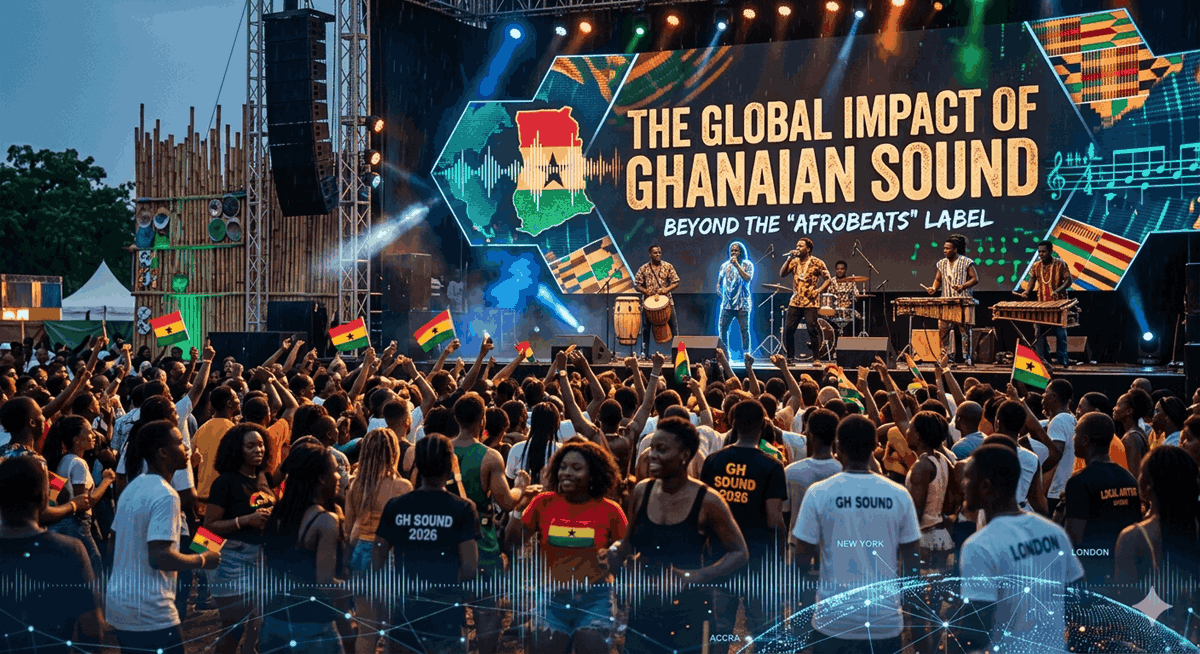
Ghanaian music has never been just about rhythm or entertainment. It has always been a living archive of identity, struggle, celebration, and resilience. Long before global audiences began paying attention to African music through the lens of Afrobeats, Ghana had already built a deep and influential musical tradition that shaped not only West Africa but the wider global soundscape.
Table of Contents
Today, as African music dominates international charts, festivals, and streaming platforms, Ghana’s contribution is often acknowledged but not always fully understood. The tendency to group everything under “Afrobeats” has blurred important distinctions. Ghanaian music carries its own lineage, its own philosophy, and its own sonic identity.
To truly understand its global impact, you have to trace its journey from Highlife to Hiplife, through to Asakaa, while recognizing the cultural depth that ties it all together.
The Foundation: Highlife as Ghana’s Musical Identity
The story of Ghanaian music begins with Highlife, a genre that emerged along the coastal towns during the colonial era. It was born out of cultural interaction, blending indigenous rhythms with Western instruments such as brass, guitars, and pianos.
But Highlife was never just about sound. It was about storytelling. It reflected everyday life, captured social realities, and became a unifying force during Ghana’s journey toward independence.
Artists like E.T. Mensah helped project Highlife beyond Ghana’s borders, making it one of Africa’s earliest internationally recognized genres. Alongside figures such as King Bruce and Nana Ampadu, Highlife evolved into a sophisticated form of musical storytelling.
Highlife was deeply political without always sounding political. It celebrated life, but it also challenged society. It addressed inequality, love, betrayal, morality, and national identity. For many Ghanaians, it became the soundtrack of independence and pride.
Music as a Source of Strength and Identity
For earlier generations, music in Ghana was not something you simply listened to. It was something you experienced collectively. It played at naming ceremonies, funerals, festivals, and community gatherings.
During difficult periods, whether economic hardship or political instability, music became a source of emotional survival. Highlife songs often carried messages of hope, discipline, and perseverance.
This emotional depth is one of the defining characteristics of Ghanaian music. It is why the music connects so easily with people across cultures. It speaks to human experience in a way that feels honest and unfiltered.
Even today, that tradition remains intact. Ghanaian artists still create music that blends personal stories with broader social meaning. That authenticity is what keeps the music relevant globally.
Ghana and Nigeria: A Shared History, Not a Competition
Any serious discussion about African music must address the relationship between Ghana and Nigeria. This is often framed as a rivalry, but historically, it has been more of a collaboration than a competition.
There is no attempt here to diminish Nigeria’s achievements. Nigerian artists have played a massive role in pushing African music onto the global stage. But history must be told with clarity.
Even Fela Kuti, the pioneer of Afrobeat, had early musical exposure in Ghana. That experience influenced his understanding of rhythm, structure, and band arrangement before he returned to Nigeria to develop his revolutionary sound.
In the 1970s and 1980s, Ghanaian Highlife musicians were already globally respected. Many Nigerian bands at the time drew heavily from Ghanaian instrumentalists, engineers, and musical arrangements.
By the 1990s, the exchange had evolved further. Ghana was pioneering Hiplife, blending local languages with hip-hop, while Nigeria was still experimenting with Western rap formats.
There are real stories behind this. At studios in Accra, including Keys Frequency, Nigerian artists recorded and collaborated with Ghanaian producers. Groups like Plantashun Boiz, with members such as Blackface and 2Baba, were part of this cultural exchange. Artists like Tony Tetuila also engaged with Ghanaian creatives.
This was not a one-sided influence. It was a shared evolution. Ghana influenced Nigeria, and Nigeria influenced Ghana. The relationship has always been rooted in mutual respect.
The key point is simple. Ghana’s Highlife played a foundational role in shaping the sound that later evolved into Afrobeat and Afrobeats. Recognizing that strengthens the shared African music story.
Evolution and Reinvention: From Highlife to Hiplife
By the mid-1990s, Ghanaian music entered a new phase. The younger generation wanted something that reflected both their cultural identity and global influences. This gave birth to Hiplife.
At the center of this movement was Reggie Rockstone, widely regarded as the originator of Hiplife. He introduced rap in local languages, making the genre relatable to Ghanaian youth.
Artists like Obrafour elevated the genre with lyrical depth and authenticity.
Soon, a wave of artists expanded the movement. Names like Lord Kenya, Tic, and the duo Akyeame helped cement Hiplife in mainstream culture.
The early 2000s saw another surge with artists such as VIP, Buk Bak, and 4×4 dominating the airwaves.
At the same time, the Highlife side continued evolving with artists like Ofori Amponsah and his musical circle, blending melody with modern production.
Hiplife did not just entertain. It redefined identity. It gave young Ghanaians a voice and positioned Ghana as a creative hub in West Africa.
Crunk Influence and Commercial Expansion
As global music trends shifted, Ghanaian music also adapted. The introduction of crunk-inspired beats in the mid-2000s changed the sonic direction of Hiplife.
This era brought a more energetic, club-oriented sound through Hammer of the Late Two Artists like Sarkodie, Edem, and Kwaw Kese helped bridge the gap between lyrical rap and commercial appeal.
This transition period is often misunderstood. It was not the decline of Hiplife. It was its evolution into something broader that would later connect seamlessly with Afrobeats.
Ghana’s Influence on the Afrobeats Movement
As African music gained global attention in the 2010s, Afrobeats emerged as a dominant force. While Nigeria became the commercial center, Ghana’s influence remained embedded in the sound.
The rhythmic patterns, melodic structures, and storytelling approaches in Afrobeats are deeply rooted in Highlife and Hiplife traditions. Even indigenous sounds like Kpanlogo rhythms contributed to the DNA of modern African pop.
Artists like R2Bees and Fuse ODG played key roles in exporting African music to global markets, particularly in Europe.
Their success proved that Ghanaian music could travel without losing its identity.
Asakaa and the Rise of Ghanaian Drill
In the 2020s, Ghanaian music entered another transformative phase with the rise of Asakaa. Originating from Kumasi, Asakaa redefined drill music through a Ghanaian cultural lens.
The movement is built around the Asakaa Boys collective, including O’Kenneth, Jay Bahd, Kawabanga, Reggie, and Kwaku DMC, alongside others within Life Living Records.
They localized drill by infusing it with Ghanaian language, street culture, and lived experiences.
Artists like Black Sherif expanded this sound globally, blending drill with emotional storytelling and Highlife influence.
Meanwhile, Kweku Smoke plays a strong collaborative role within the Asakaa ecosystem, contributing to its reach without being part of the original core group.
Emerging artists like Riq Garna show how the next generation continues to evolve the sound.
Ghanaian Music Quality and Global Appeal
One of Ghana’s greatest strengths is consistency in quality. Ghanaian artists are intentional about their craft.
The melodies are structured. The production is layered. The lyrics carry meaning.
This attention to detail allows Ghanaian music to compete globally while maintaining authenticity.
The Role of the Ghana Music Awards
The Ghana Music Awards played a major role in professionalizing the industry.
It created recognition, encouraged competition, and pushed artists to improve their craft.
While questions about credibility exist today, its historical impact in shaping Ghana’s music industry remains undeniable.
The New Generation Carrying Ghana to the World
Today, Ghanaian music is being pushed globally by a new generation of artists who understand both local culture and international markets.
Artists like Sarkodie, Shatta Wale, and Stonebwoy have already built strong international presence.
Newer voices including King Promise, KiDi, Kuami Eugene, Wendy Shay, Medikal, OliveTheBoy, Arathejay, and Moliy and more continue to expand Ghana’s global footprint.
Each of them represents a different layer of Ghanaian sound, from Afrobeats to alternative music.
Why This Story Matters
This conversation is not about pride or competition. It is about accuracy.
When the roots of music are acknowledged, the entire industry benefits. Ghana and Nigeria both contributed to African music’s global rise.
But Ghana’s role, especially through Highlife, is foundational.
The Future of Ghanaian Music
The future of Ghanaian music lies in its ability to remain authentic while adapting to global trends.
Streaming platforms, social media, and digital distribution have removed barriers. Ghanaian artists now have direct access to global audiences.
The next phase will depend on how well the industry protects its identity while expanding its reach.
A Legacy That Cannot Be Ignored
Ghanaian music is not just part of the global conversation. It helped shape it.
From Highlife to Hiplife to Asakaa and Afrobeats, the influence is undeniable.
The world may call it Afrobeats, but beneath that label lies a deeper story. A story of culture, resilience, creativity, and identity.
And at the center of that story is Ghana.