
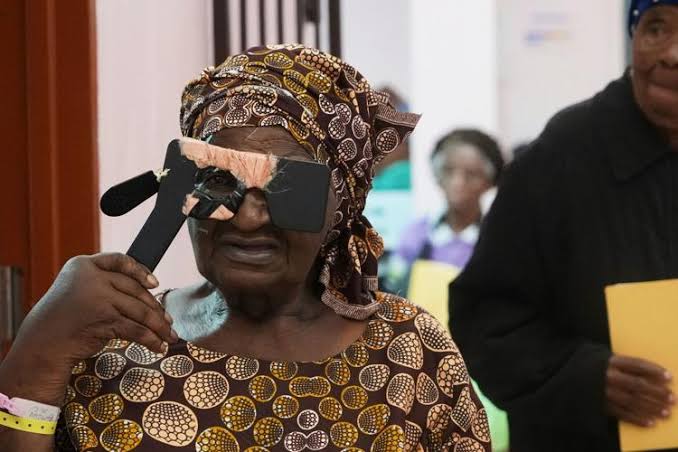
In a heart-warming moment that brought tears to many eyes, 84-year-old Gladys Khoza sat quietly as a nurse gently peeled back the bandage from her right eye. For the first time in nearly a year, the world came back into sharp focus. “Wow,” she whispered in delight.
When the nurse asked if she could see her, Gladys broke into a big grin and replied, “Very well.”Gladys was one of 133 lucky South Africans whose sight was restored during a special cataract surgery “marathon” held at two regional hospitals near Johannesburg over two weekends in late March 2026.
The free operations, performed by a team of volunteer doctors, have given dozens of people their lives back – many of whom had been stuck on public hospital waiting lists for years.For Gladys, the simple procedure was nothing short of life-changing.
She had lost sight in one eye completely and was struggling badly with the other. “I just wanted to be able to see,” she told The Associated Press afterwards. Now she can do the things she loves most again – clearly recognising family members, reading her beloved Bible, and enjoying her favourite daytime soap operas.
Cataracts – a clouding of the eye’s lens that usually comes with age – are one of the most common causes of vision loss worldwide. The surgery is straightforward: doctors make tiny incisions, remove the cloudy lens and replace it with a clear artificial one. But in South Africa’s public health system, patients can wait years for the operation.
Some of those helped in this marathon had been on the list since 2019.Dr Tebogo Fakude, one of the volunteer surgeons, knows exactly why these operations matter so much. His own mother is blind, and he says the work gives him deep fulfilment.
“We love to do what we do – to give sight,” he explained. “It’s a small organ in the body, but it affects humongous things in the human lifestyle.”During the three-day marathon at Pholosong Regional Hospital, a new patient was wheeled into theatre almost every hour.
Soothing gospel music played in the background to keep the doctors’ spirits high as they worked under microscopes with incredible precision.The impact goes far beyond the 133 patients treated. Across South Africa, more than 240,000 people are still waiting for cataract surgery. The country diagnoses around 300,000 new cases every year, and the backlog is especially heavy in Gauteng province, where over 35,000 people suffer from cataract-related blindness. In Africa as a whole, up to 75% of people who need the operation still cannot get it, according to recent studies.
The World Health Organization estimates that at least 2.2 billion people globally live with some form of vision impairment – and one billion of those cases could have been prevented or are still waiting for treatment.
For people like Gladys Khoza, this weekend marathon was more than just medical help – it was a chance to live fully again in her later years. Many of the patients left the hospital smiling, hugging family members they could now see clearly for the first time in a long while.
Health officials hope initiatives like this will become more common as they work to clear the huge backlog in public hospitals. For now, though, the focus is on the quiet joy in wards across Tsakane and Pholosong – and on stories like Gladys Khoza’s, where one simple operation has brought colour, clarity and happiness back into everyday life.
In a country where public healthcare often faces long waits, this eye surgery marathon has shown what is possible when doctors, hospitals and communities come together. One by one, patients are stepping out of the darkness and back into the light.