

 By Ghana News
The National Petroleum Authority (NPA) has issued an immediate, mandatory directive to all Oil Marketing Companies (OMCs), fuel station operators, dealers, and transporters to enforce strict safety measures at facilities affected by recent flooding.
The regulator strongly warned that any operator failing to comply with these emergency rules will face severe regulatory sanctions and criminal prosecution.
The directive comes on the back of recent heavy rainfalls across parts of the country, which have significantly raised the risks of underground fuel contamination, electrical fires, forecourt explosions, and toxic environmental pollution.
Critical Public Safety Warning
The NPA is strongly urging motorists and residents to avoid entering, driving through, or gathering near flooded fuel stations.
Floodwaters surrounding these facilities are highly likely to contain toxic petroleum products, hazardous contaminants, or invisible fuel sheens. If you smell unusual fuel odors or notice fuel leaks in your area, report them immediately to the Ghana National Fire Service (GNFS) or the nearest NPA office.
Immediate Emergency Protocols for Operators
In a public notice, the NPA instructed operators of any fuel station experiencing inundation on their forecourts, tank areas, or underground storage facilities to execute the following immediate actions:
- Suspend All Operations: Stop all fuel dispensing, loading, and offloading activities immediately.
- Cut Electrical Power: Disconnect power supplies to all fuel pumps, dispensers, canopy lighting, and general forecourt equipment—provided it is safe to do so.
- Evacuate the Premises: Safely clear out all station staff, customers, and vehicles from the affected zone.
- Enforce an Exclusion Zone: Establish a strict safety exclusion zone of at least 100 meters around the impacted station. Within this zone, smoking, naked flames, welding, or any spark-generating activities are strictly prohibited.
- Notify Authorities: Immediately report the incident to your respective OMC, the NPA Regional Office, the Ghana National Fire Service (GNFS), and the Environmental Protection Agency (EPA).
Strict Conditions Set for Resuming Operations
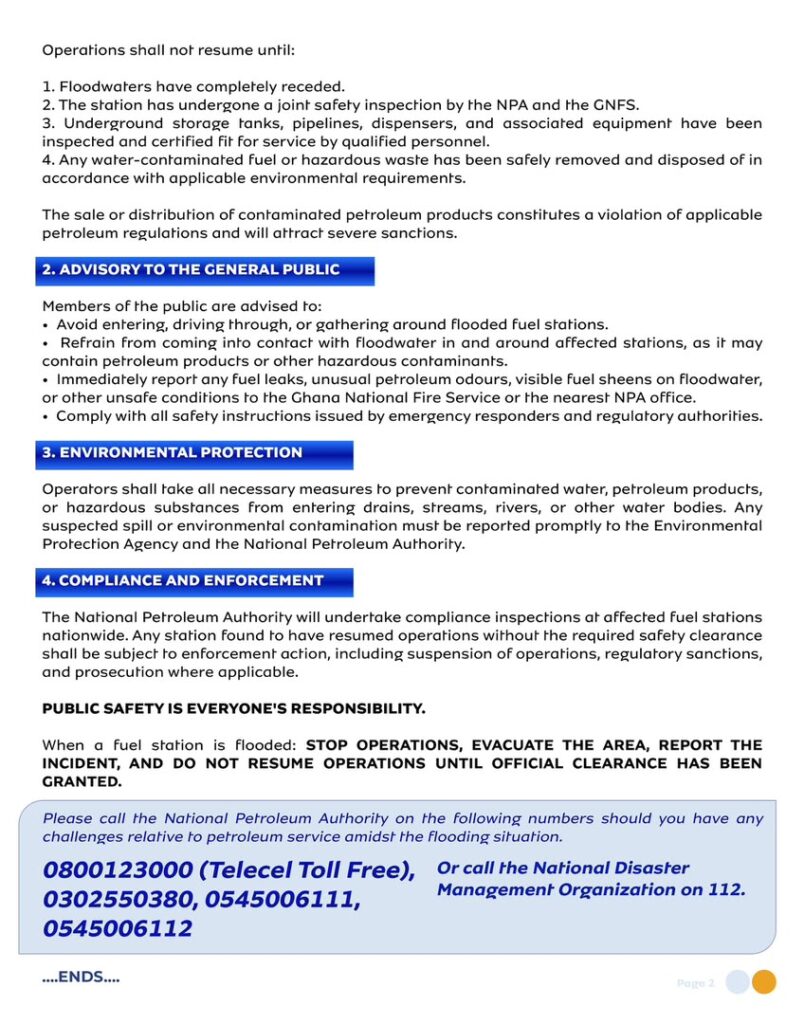
The NPA made it clear that flooded stations will not be allowed to switch their pumps back on simply because the rain has stopped. To legally resume operations, stations must fulfill a rigid multi-step clearance process:
1.Complete Recession of Floodwaters:Prerequisite.
Wait for all standing floodwaters to completely recede from the forecourt, pump bays, and underground tank areas.
2.Hazardous Waste Removal:Environmental Safety.
Safely extract and legally dispose of any water-contaminated fuel or hazardous runoff in strict accordance with EPA regulations. Selling or distributing water-logged fuel is a severe regulatory breach.
3.Technical & Pipeline Certification:Equipment Verification.
Secure official certification from qualified engineering personnel proving that underground storage tanks, pipelines, and fuel dispensers are structurally sound and safe to carry fuel.
4.Joint Multi-Agency Inspection:Final Sign-off.
Pass a mandatory, physical safety joint-inspection conducted on-site by both the NPA and the Ghana National Fire Service.
Also Read: Fuel Price Reductions Expected to Continue as Global Market Pressures Ease