

 By Collins Sarkodieh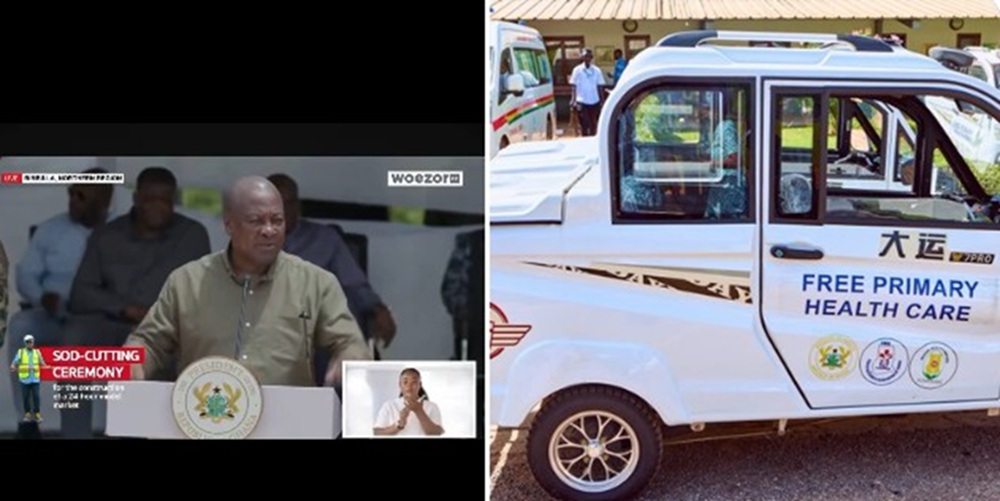
The rollout of Ghana’s Free Primary Healthcare initiative has triggered public debate after images of newly distributed tricycles circulated widely on social media, with many assuming they were intended to function as ambulances. President John Dramani Mahama has now stepped in to clarify their actual purpose, addressing growing confusion and managing expectations around the programme’s logistics strategy.
According to the President, the tricycles are not emergency response vehicles and were never designed to replace ambulances within the national health system. Instead, they form part of a last mile delivery mechanism aimed at strengthening community level healthcare outreach, particularly in rural and hard to reach areas where road access remains a challenge.
The Ghana Health Service has also reinforced this clarification, explaining that the vehicles are primarily intended for transporting medicines, medical supplies and health personnel as part of preventive and outreach healthcare delivery. This includes immunisation campaigns, community screenings and routine visits by health workers to remote settlements.
The distinction is important because it speaks directly to how primary healthcare is structured in Ghana. Emergency medical transport such as ambulances is designed for rapid response and patient stabilization. In contrast, the tricycles introduced under this programme serve a logistical function, bridging the gap between health facilities and communities that are often underserved due to distance and infrastructure limitations.
This clarification matters in the context of public health communication, where misinterpretation of government interventions can quickly shape public expectations. In this case, the viral assumption that tricycles were meant to function as ambulances reflects a broader misunderstanding of how primary healthcare systems operate, particularly in resource constrained environments.
From a policy perspective, the introduction of these tricycles highlights a shift toward decentralized healthcare delivery. Rather than relying solely on fixed health facilities, the system is increasingly adopting mobile and community based models that allow health workers to reach populations directly. This approach has been widely used in global public health strategies, especially in immunisation drives and maternal health outreach programmes.
Experts in health systems design note that last mile logistics often determine the success or failure of primary healthcare delivery. Even when medicines and personnel are available, the inability to physically reach communities can significantly reduce service effectiveness. In that sense, transport solutions like tricycles play a critical enabling role, even if they are not medically classified as emergency vehicles.
The clarification also helps to manage policy perception risk. When public expectations are misaligned with programme design, it can create pressure on implementation agencies and distort evaluation of government performance. Clear communication of function and limitation is therefore essential for maintaining trust in health interventions.
Looking forward, the success of the Free Primary Healthcare programme will depend not just on the distribution of equipment, but on how effectively these logistics tools are integrated into broader service delivery systems. If properly managed, community based transport solutions can improve coverage rates, reduce response delays for non emergency care, and strengthen preventive health outcomes.
However, it also highlights a structural challenge in Ghana’s healthcare communication ecosystem. As new interventions are introduced, ensuring that the public understands their purpose is as important as the rollout itself. Without that alignment, even well designed policies risk being misinterpreted, which can undermine their perceived effectiveness.
In this case, the tricycles are not a replacement for ambulances but a support mechanism for outreach and supply chain movement. The distinction is central to understanding how Ghana is attempting to expand healthcare access at the community level under the Free Primary Healthcare agenda.
Also Read: Tatale SHS Storekeeper Accused of Trying to Steal School Food