
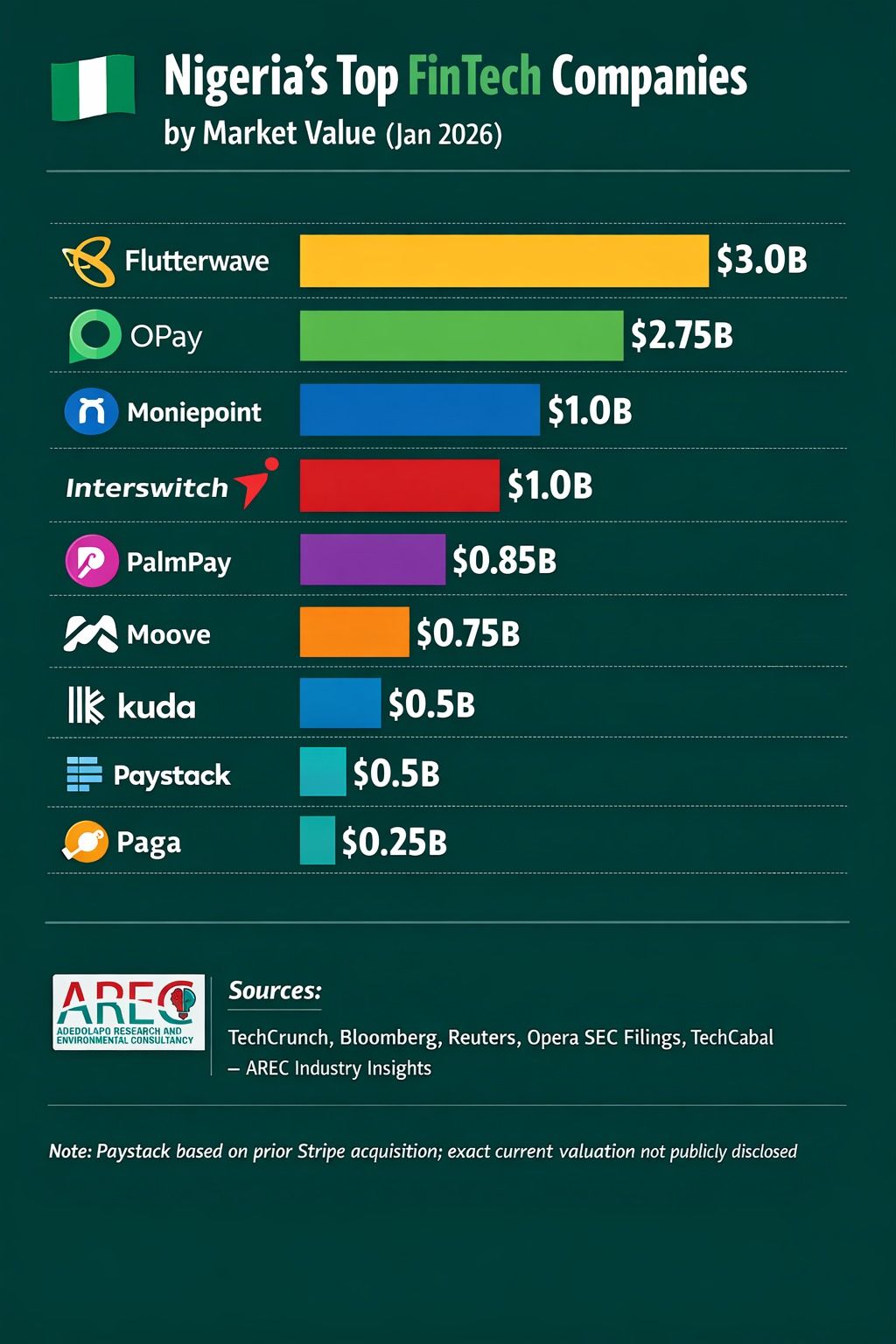
Nigeria’s fintech ecosystem keeps expanding, but not every company sits at the same level. At the bottom of the public valuation ladder is Paga, one of the oldest mobile money adopters in the country.
Although its valuation is modest compared with some peers, Paga’s long-term role in bringing mobile payments to everyday users gives it a foundational place in the market. It remains a major player despite its lower estimated market value relative to newer giants in the space.
Next up are digital banking innovators like Kuda and payment infrastructure firm Paystack, each carrying valuations around the $0.5 billion mark. Kuda’s digital-only banking model continues to attract retail customers, and Paystack’s trajectory has been shaped by its strategic acquisition by Stripe — a deal that underlined Nigeria’s relevance in global fintech conversations.
Moving into the mid-tier, Moove and PalmPay show how fintech is branching into niche markets beyond straightforward payments. Moove, which focuses on vehicle financing for gig workers and mobility entrepreneurs, sits near a $0.75 billion valuation, illustrating investor interest in tech-enabled asset finance. PalmPay, a mobile wallet with strong consumer uptake and incentive-driven growth, is estimated near $0.8 billion to $0.9 billion.
A major threshold in Nigeria’s fintech hierarchy is the $1 billion mark. Companies like Moniepoint and Interswitch have crossed that line, recognised as unicorns whose platforms are deeply embedded in the country’s digital payments infrastructure. Moniepoint’s SME-focused banking and payment services and Interswitch’s foundational role in digital payments processing signal why both hold valuations at or above this level.
Above the pack sits OPay, valued in the ballpark of $2.7 billion to $3 billion depending on the report. OPay’s super-app approach — combining payments, merchant services, savings and loans — has driven rapid user adoption, with tens of millions of downloads and daily active users across Nigeria and beyond.
At the very top remains Flutterwave, widely reported at around $3 billion. Flutterwave’s focus on cross-border payments and enterprise-grade APIs has positioned it as one of the most valuable fintech firms in Africa. Its infrastructure spans dozens of African markets and links local businesses to global commerce in ways few competitors have matched.
The picture that emerges is one of a steep top-heavy market where a few deep-pocketed players dominate the financial technology landscape, while mid- and lower-tier companies build specialisations and carve niches. These valuations reflect not only current investor sentiment but also where growth is expected to continue — from mobile wallets and digital banking to payments rails and embedded finance services.
For industry watchers, this hierarchy reveals something deeper than dollar figures. It shows where Nigeria’s digital economy is maturing and which business models are commanding confidence. Whether through consumer scale, specialised lending, or infrastructure provision, each tier in the fintech valuation spectrum tells a story about competition, innovation and the future of finance in West Africa.

Also Read: GoldBod–Gold Coast Refinery Deal Signals New Direction for Ghana’s Gold Value Chain