
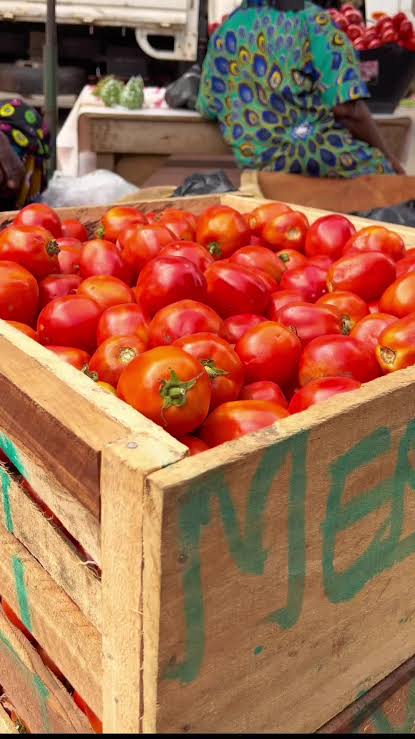
Ghana is literally pouring hundreds of millions of dollars into foreign tomato fields while local farmers struggle to sell theirs.
That’s the strong message coming from the Chamber of Agribusiness, which is urging the government to immediately halt imports of certain agricultural products – especially tomatoes – to give made-in-Ghana produce a real fighting chance.
Speaking on Channel One Newsroom on Saturday, April 4, 2026, the Chamber’s Chief Executive Officer, Anthony Morrison, painted a worrying picture.
He said the country’s heavy dependence on imported tomatoes is not just expensive – it is actively harming the local economy, killing jobs, and blocking the very investments needed to make President Mahama’s 24-hour economy dream a reality.“For the past few months, the 24-hour economy secretariat has been going around trying to teach organisations how to realign their operations into the 24-hour framework,” Morrison explained.
“In the same way, other groups are also calling for private sector investment. But for that to happen, there is a need for the government to halt importation for certain things.”The numbers he quoted are eye-opening. Ghana imports nearly $600 million worth of fresh tomatoes every year. On top of that, processed tomato products – everything from paste and puree to canned tomatoes – cost the country more than $800 million annually.
That’s well over $1.4 billion leaving Ghana’s shores for goods that could easily be grown and processed right here.Morrison didn’t mince words about the real cost. “We import almost $600 million of fresh tomatoes annually.
We also import processed tomatoes in excess of $800 million annually. There are job losses – $561 million of job losses in terms of opportunities that we have created from where we import from. So we have to stop and block the importations.”
His point is simple and powerful: every dollar spent on imported tomatoes is a dollar not spent on Ghanaian farms, factories, and workers.
Local producers and agro-processing companies are ready and willing to step up, but they cannot compete when cheaper foreign tomatoes flood the market.The Chamber believes that restricting these imports would create breathing space for Ghanaian farmers and businesses to expand, invest, and create thousands of new jobs.
It would also support the government’s bigger push for industrialisation and round-the-clock economic activity – turning farms into 24-hour processing hubs that keep people working day and night.This is not just about tomatoes.
It is about protecting local industries across the board so that Ghana can finally reduce its dependence on foreign goods and build a stronger, self-reliant economy. The Chamber’s call adds to a growing chorus of voices asking the government to put real protection behind local production instead of just talking about it.
For ordinary Ghanaians, the issue hits close to home. Tomatoes are a staple in almost every kitchen – used in soups, stews, sauces and salads.
When prices fluctuate because of imports, it affects what families can afford. At the same time, thousands of young people in farming communities are leaving for the cities because they cannot make a decent living growing what the country is busy importing.Morrison and the Chamber are not asking for favours – they are asking for fairness.
Give local farmers and processors the same chance that foreign suppliers enjoy. Protect the sector long enough for it to grow strong, create jobs, and eventually compete on the world stage.
The message is clear: Ghana has the land, the climate, and the people to produce world-class tomatoes and tomato products. What is missing is the political will to close the import gates and open the door for local businesses to thrive.As the 24-hour economy agenda gains momentum, the Chamber of Agribusiness is reminding everyone that real transformation starts with protecting what we already have.
Stopping the flood of tomato imports could be one of the quickest and most effective ways to create jobs, save foreign exchange, and show Ghanaians that “local” is not just a slogan – it is smart economics.