

 By Collins Sarkodieh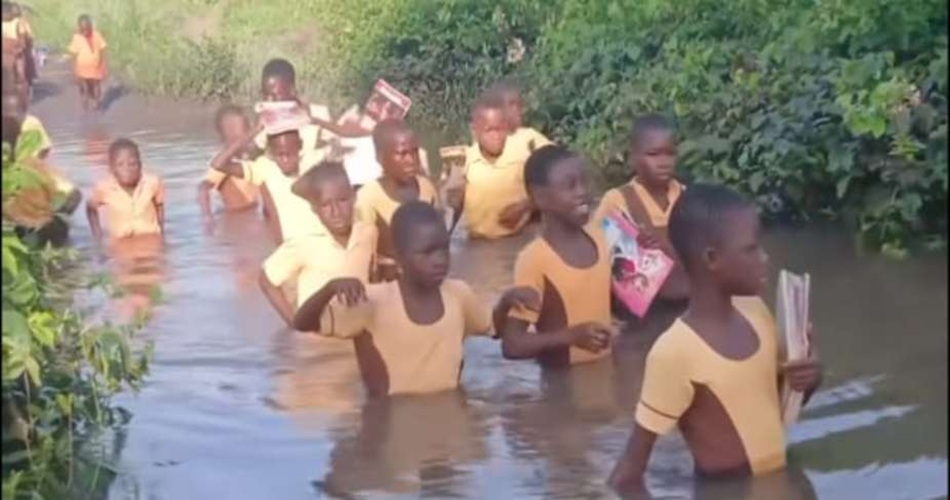
Why Are Schoolchildren in Avetakpo Risking Their Lives to Go to School?
Children in Avetakpo are literally swimming through danger just to learn.
Every school day, they cross a river without a bridge.
During the rainy season, this journey becomes life-threatening.
In the Ho West Constituency of the Volta Region, a troubling reality is unfolding. Pupils in Avetakpo must cross a river daily to attend school, often by swimming or wading through rising waters. This is not an isolated inconvenience, it is a systemic failure in infrastructure and access to education.
The situation becomes more dangerous during Ghana’s rainy seasons (typically April–June and September–November), when rivers swell rapidly. For children, especially those under 12, this dramatically increases the risk of drowning, injuries, or waterborne diseases.
According to global education data from organizations like UNESCO, physical access remains one of the biggest barriers to education in rural communities. In sub-Saharan Africa, millions of children still face unsafe journeys to school, often involving rivers, forests, or long walking distances.
What Has the Volta Resistance Movement (VRM) Said About the Situation?
The VRM has called the situation unacceptable and dangerous.
They say no child should risk their life for education.
They are demanding urgent government intervention.
The Volta Resistance Movement (VRM) has issued a strong statement condemning the conditions faced by pupils in Avetakpo. According to spokesperson Delanyo Agbe, the situation is both an educational crisis and a humanitarian emergency.
The group emphasized that:
- Children are exposed to daily life-threatening risks
- Attendance is dropping due to fear and exhaustion
- The issue reflects broader neglect of rural communities
Their statement underscores a critical point: access to education is not just about classrooms or policies—it is about safe, reliable infrastructure that enables children to get there.
How Is This Affecting School Attendance and Learning Outcomes?
Attendance is dropping because children are afraid.
Those who attend arrive tired and stressed.
Learning outcomes are being directly affected.
Research from World Bank shows that unsafe or long commutes to school significantly reduce attendance rates. In some rural African communities, attendance can drop by up to 30% when access barriers exist.
In Avetakpo:
- Some pupils skip school entirely during heavy rains
- Others arrive exhausted after physically demanding crossings
- Emotional stress impacts concentration and performance
Education experts agree that a child’s ability to learn is closely tied to their physical and emotional well-being. When a school journey involves fear and risk, academic success becomes secondary to survival.
Why Is Infrastructure Like Bridges Critical for Education Access?
Infrastructure is not optional, it is essential.
A simple bridge could eliminate the risk entirely.
Without it, education remains unequal.
Access to basic infrastructure such as bridges, roads, and transportation systems plays a direct role in education delivery. According to UNICEF, improving school accessibility can increase enrollment and retention rates significantly.
In Ghana, the government has made strides in education through initiatives like Free Senior High School (Free SHS). However, cases like Avetakpo reveal a gap between policy and practical accessibility.
A bridge over the river would:
- Remove daily safety risks
- Improve attendance consistency
- Enhance community confidence in public services
What Actions Are Being Demanded from the Government?
VRM is calling for immediate construction of a bridge.
They want coordinated action from key ministries.
They are pushing for accountability and urgency.
The VRM has specifically appealed to:
- The Ministry of Roads and Highways
- The Ministry of Education
Their demands are straightforward:
- Construct a safe bridge over the river
- Provide interim solutions such as boats or temporary crossings
- Prioritize rural infrastructure in national development plans
The call for urgency is justified. Infrastructure delays in rural areas often persist for years, leaving communities vulnerable and underserved.
How Does This Reflect Broader Inequality in Ghana?
Rural communities face disproportionate challenges.
Infrastructure gaps widen inequality.
This case highlights systemic development issues.
Despite Ghana’s reputation as one of West Africa’s more stable and developing economies, disparities between urban and rural areas remain significant.
Data from the Ghana Statistical Service shows that rural areas have lower access to infrastructure, healthcare, and education facilities compared to urban centers.
In practical terms, this means:
- Urban children commute safely to school
- Rural children may risk their lives daily
- Opportunities are unevenly distributed
This inequality undermines national development goals and contradicts the principle of equal access to education.
What Role Can Local Leaders and Organizations Play?
Local stakeholders are critical to solving the problem.
Community collaboration can accelerate action.
Support from NGOs and partners is essential.
The VRM has also called on:
- Traditional leaders
- Local government authorities
- Civil society organizations
- Development partners
Community-driven initiatives have proven effective in similar cases across Africa. For instance, NGO-supported bridge projects in rural Kenya and Uganda have reduced school absenteeism by over 20%, according to development reports.
Public-private partnerships can:
- Mobilize funding faster
- Ensure accountability
- Deliver sustainable solutions
Are There Real Examples of Similar Problems Being Solved?
Yes, and the results are encouraging.
Simple infrastructure changes have transformed communities.
The same can be done in Avetakpo.
In rural Rwanda, the government partnered with NGOs to build pedestrian bridges in flood-prone areas. The result:
- School attendance increased by 25%
- Travel time reduced significantly
- Safety risks nearly eliminated
Similarly, in parts of northern Ghana, community-built footbridges have improved access to schools and markets.
These examples prove one thing clearly:
The Avetakpo situation is solvable.
Why Is This a National Issue, Not Just a Local One?
It reflects the country’s commitment to education.
It impacts national development goals.
It raises questions about equity and governance.
Ghana is a signatory to the United Nations Sustainable Development Goals (SDGs), including:
- SDG 4: Quality Education
- SDG 9: Infrastructure and Innovation
Failing to provide safe access to education directly contradicts these commitments.
Moreover, education is a key driver of economic growth. According to the World Economic Forum, each additional year of schooling can increase a person’s income by up to 10%.
When children are unable to attend school safely, the long-term economic impact extends beyond the individual to the entire nation.
What Happens If Nothing Is Done?
The risks will continue and possibly worsen.
Educational inequality will deepen.
Public trust in institutions may decline.
The VRM has warned that inaction could have serious consequences:
- Increased dropout rates
- Higher risk of accidents or fatalities
- Growing frustration among affected communities
Infrastructure neglect can also erode confidence in government institutions, especially when basic needs remain unmet.
What Is the Way Forward?
Immediate intervention is required.
Long-term planning must follow.
Accountability must be enforced.
A practical roadmap includes:
Short-term solutions
- Provide temporary crossing options (boats, supervised crossings)
- Deploy safety personnel during peak school hours
Medium-term solutions
- Begin bridge construction with clear timelines
- Allocate emergency funding
Long-term solutions
- Integrate rural infrastructure into national planning
- Monitor and evaluate similar risk areas across the country
Education Should Never Be a Risk
No child should gamble with their life for education.
The Avetakpo situation is urgent but solvable.
What’s needed now is action not promises.
The story of these children is both alarming and revealing. It highlights the gap between policy and lived reality, between intention and execution.
The call from the Volta Resistance Movement is not just advocacy it is a demand for basic human dignity.
If Ghana is to truly uphold its commitment to accessible and equitable education, then cases like Avetakpo must be addressed immediately. A bridge is more than infrastructure it is a pathway to safety, opportunity, and a better future.
Also Read: Tatale SHS Storekeeper Accused of Trying to Steal School Food