
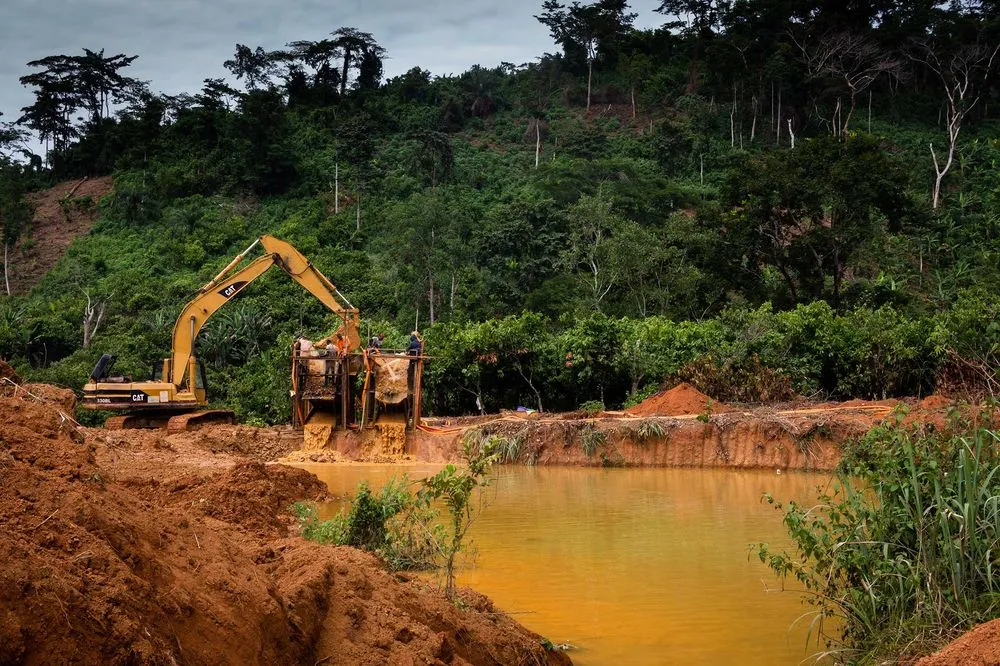
Galamsey is illegal small-scale gold mining in Ghana where miners operate without licenses and use harmful chemicals to extract gold, destroying forests, polluting rivers, and putting communities at risk. The term Galamsey was derived from the phrase “gather them and sell” and It has become one of the country’s biggest environmental and public health challenges.
The survival of Ghana as a viable nation-state is currently being weighed on the scales of illegal gold mining. To the casual observer, the term “Galamsey” might sound like a localized economic activity, but for the thirty-three million people living in Ghana, it has become synonymous with an ecological death sentence. This isn’t just about men digging in the dirt for gold; it is a complex, high-stakes crisis that sits at the intersection of global commodity demand, local poverty, and systemic political failure.
Decoding Galamsey: Beyond the “Gather and Sell” Myth
To understand the weight of this crisis, one must first peel back the linguistic layers of the word itself. Galamsey (AKA – Gala) is a localized phonetic evolution of the English phrase “Gather them and sell.” Historically, this described a relatively harmless, artisanal approach to mining where individuals used basic pans and shovels to find gold flakes in riverbeds.
By 2026, however, that definition has become obsolete. Modern Galamsey is a highly mechanized, multi-billion-dollar illegal industry. The transition from pans to excavators and “changfans” machines, improvised dredging machines now has moved the activity from the fringes of the forest into the very heart of Ghana’s most protected ecological zones. We are no longer talking about “gathering and selling”; we are talking about the industrial-scale destruction of the environment for short-term gain.

The Environmental Heart Attack: Why This News Matters
This crisis dominates national discourse because the biological foundations of Ghana are failing. The country is essentially experiencing a self-inflicted environmental heart attack.
1. The Death of the Rivers
The Transformation into Toxic Sludge Major lifelines like the Pra, Ankobra, and Birim rivers, which once provided clean water to millions of households, have undergone a radical and deadly change. Due to constant dredging, these rivers have transitioned from clear, life-sustaining streams into thick, ochre-colored sludge. This isn’t just a change in appearance; it is a fundamental shift in the water’s chemical and physical makeup, rendered toxic by the heavy metals and sediment churned up from the riverbeds.
The Failure of Industrial Filtration The Ghana Water Company Limited (GWCL) is currently facing an operational nightmare. The siltation levels the amount of suspended dirt and rocks in the water—have reached such extremes that standard treatment machinery is being pushed to its breaking point. These plants were designed to filter natural river water, not the heavy, mud-like consistency currently being pumped into them. This results in frequent plant shutdowns and a massive increase in the cost of aluminum sulphate and other chemicals needed to make the water even remotely safe.
The Turbidity Breaking Point In the world of water treatment, “turbidity” refers to how cloudy or thick a liquid is. When a river’s turbidity reaches the current levels seen in mining districts, standard treatment plants simply cannot cope. The filters clog instantly, and the chemical reactions required to settle the dirt fail to work. This creates a dangerous gap in supply, leaving entire cities and towns without running water for days or weeks at a time as engineers struggle to “unplug” the system.
The Looming Threat of Water Importation The most chilling aspect of this trajectory is the loss of national sovereignty over our most basic resource. Ghana is naturally blessed with an abundance of surface and groundwater, yet we are on a path where we may be forced to import drinking water by the end of the decade. For a nation that sits on some of the largest freshwater reserves in West Africa, the prospect of buying water from foreign neighbors is a stark reminder of the total environmental bankruptcy caused by Galamsey.
Also Read: Chaos at Galamsey Site as Miners Attempt to Disarm Police, One Shot Dead

2. The Mercury Legacy
Expert insights into the chemistry of Galamsey reveal a silent, invisible killer: mercury. To extract gold from ore, miners use liquid mercury to create an amalgam, which is then heated. This process releases toxic vapors and allows mercury to seep into the soil and water table.
Mercury does not disappear. It bioaccumulates in the food chain, specifically in fish and crops like cassava and plantain. Medical professionals in mining hubs are already sounding the alarm over a surge in kidney failures and inexplicable birth defects. The mercury being poured into the ground today will remain a threat to Ghanaian health for at least fifty years.
A Continental Epidemic with Local Names
While Ghana is the epicenter of this struggle in West Africa, the phenomenon of desperate, illegal mining is a continental issue. Each region has its own name for this struggle, yet the underlying cause the lack of formal economic opportunity remains identical.
- Zama Zama (South Africa): Meaning “to try your luck,” these miners often risk their lives in abandoned, deep-level industrial mines.
- Makorokoza (Zimbabwe): Highly mobile artisanal miners who often follow in the wake of large-scale commercial mining closures.
- Creuseurs (DRC): The “diggers” who provide the cobalt and coltan that power the world’s smartphones, often working in conditions that resemble modern-day slavery.
- Orpailleurs (Burkina Faso and Ivory Coast): The Francophone equivalent of Galamseyers, frequently crossing porous borders to follow the gold veins.
Beyond Ghana: Galamsey’s Siblings Across Africa
Ghana is not alone in this struggle. Across the African continent, illegal artisanal mining is a massive informal economy, though it goes by different names depending on the region and the mineral being sought.
| Country | Local Term | Primary Mineral | Nature of Operation |
| South Africa | Zama Zama | Gold / Diamonds | Often involves abandoned deep-level industrial mines. “Zama Zama” literally means “to try your luck” in Zulu. |
| Zimbabwe | Makorokoza | Gold | Highly mobile artisanal miners, often moving into areas after large-scale mines close. |
| DRC | Creuseurs | Cobalt / Coltan | Artisanal miners who work in incredibly dangerous conditions to fuel the global tech industry. |
| Ivory Coast / Burkina Faso | Orpailleurs | Gold | Francophone term for artisanal miners; many cross borders between Ghana and Burkina Faso. |
| Sierra Leone | Artisanal Miners | Diamonds | Famous for “alluvial” mining in riverbeds, similar to the early days of Galamsey. |
The Anatomy of Failure: Expert Analysis
Since 2017, multiple military operations, including “Operation Halt,” have attempted to crush Galamsey by burning equipment and making arrests. Yet, as we look at the landscape in 2026, the murky waters suggest these efforts have failed. Why?
The answer lies in the “Political Economy of Gold.” Galamsey is not a subterranean activity; it is an “open secret” protected by a network of “big men.” Expert analysis reveals that the youth in the pits are often just employees for powerful patrons, including local politicians and traditional leaders. When the military burns a machine, it is often seen as a business loss rather than a legal deterrent.
Furthermore, there is the “Poverty Trap.” In many rural districts, a young man can earn ten times more in a day of mining than he could in a month of cocoa farming. Until the economic incentive for farming outweighs the lure of illegal gold, the excavators will keep digging.

Future Implications: The Ticking Clock
The long-term consequences of failing to stop Galamsey are catastrophic.
- Economic Collapse: Ghana is the world’s second-largest cocoa producer. Galamsey is physically destroying cocoa plantations and poisoning the soil. If international buyers begin to detect heavy metals in Ghanaian cocoa beans, the country’s primary export could be blacklisted.
- National Security: Water scarcity is a primary driver of conflict. As clean water becomes a luxury, we could see localized “water wars” and mass migration from rural areas to already overcrowded cities.
- The 2026 Turning Point: There is a growing “Green Revolution” among the Ghanaian youth. The narrative is shifting from seeing Galamsey as a “job” to seeing it as “Environmental Terrorism.” The pressure is mounting for the government to move beyond symbolic gestures and implement a total, uncompromising ban on all mining in water bodies.
Final Analysis
Galamsey is the ultimate test of Ghana’s governance. It is a mirror reflecting global priorities: the world wants cheap gold for jewelry and electronics, and the cost is the destruction of a sovereign nation’s ecosystem. For the global reader, understanding Galamsey is an invitation to look at the gold in your hand and ask if it was worth the life of a river. For Ghana, the choice is simple: stop the machines, or prepare for a future where gold is plentiful but water is a memory.
Also Read: Video Shows NADMO Officials Clashing With Municipal Authorities Over Galamsey Enforcement