

 By Collins Sarkodieh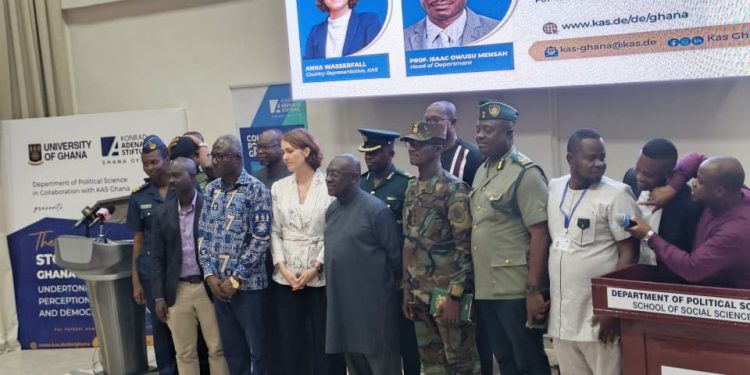
A recent report by the University of Ghana’s Political Science Department has sparked a national conversation about the state of our democracy.
The study, titled Undertones and Public Perceptions of Military Rule and Democracy in Ghana, reveals that approximately 43% of Ghanaians believe military takeovers are sometimes justified.
Researchers surveyed 6,719 respondents across all 16 regions to understand how citizens perceive the role of the military in governance. While the results are striking, they highlight a complex relationship between public expectations and the reality of democratic outcomes.
The study indicates that support for military intervention is not uniform across the country. Northern regions, including the Savannah, Upper West, Upper East, Northern, and North East, recorded the highest levels of agreement. Interestingly, the Eastern Region also showed high support, with 77% of its respondents suggesting military rule is occasionally necessary.
Economic frustration appears to be the primary driver behind these shifting sentiments. The report found that 34% of respondents would support a takeover if democracy fails to improve economic conditions, while 28% cited the failure to tackle corruption as a potential justification.
It is easy to look at these statistics and panic, but the reality is more nuanced. Citizens are not necessarily asking for a dictatorship; they are asking for a democracy that actually works.
When people feel that their voices are ignored or that corruption is stripping away their future, they start looking for alternatives. Logic dictates that the best way to keep the military in the barracks is to make civilian life significantly better for the average person.
Democracy remains the preferred system for the vast majority, but its success depends on its ability to deliver results. If the system fails to provide jobs, safety, and honest leadership, the temptation to look for a “quick fix” will unfortunately persist.
Moving forward, the government must prioritize the critical needs of citizens to bridge this trust gap. Strengthening accountability and fostering genuine participation are no longer optional—they are essential for protecting the democratic foundation of Ghana.
Also Read: Minister Sam George Urges Responsible Communication to Safeguard Ghana’s Democracy
Source: Ghana news updates