

 By Collins Sarkodieh
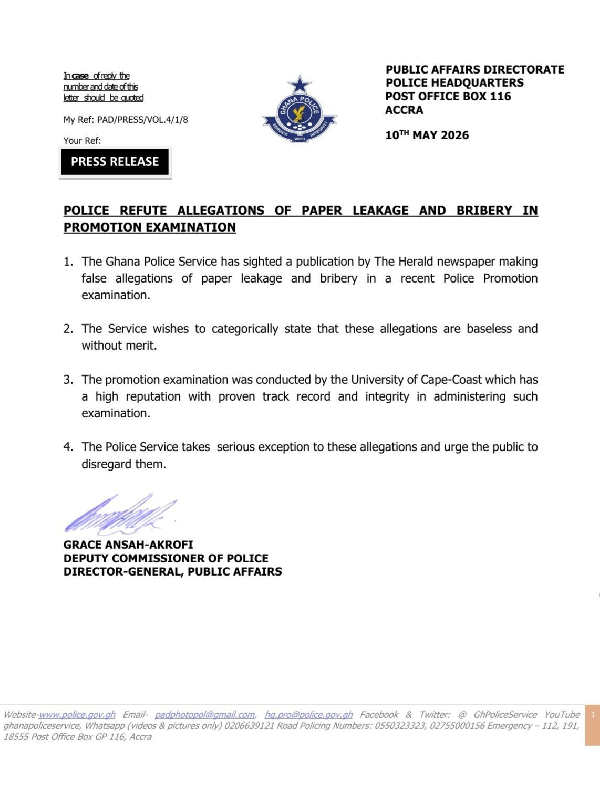
The Ghana Police Service has officially denied widespread rumors of examination paper leakage and bribery during the 2026 Police Competitive Promotional Examination (PCPE). In a formal statement released by the IGP’s Secretariat on May 10, 2026, the administration described the claims as “false and misleading,” asserting that the process remains one of the most transparent in the history of the Service.
According to the Police Administration, there is zero evidence to support the sensational claims that Chief Inspectors were required to pay between GH¢70,000 and GH¢100,000 for placement into the Police Academy. The exams are conducted in collaboration with the University of Cape Coast (UCC), an external academic body, to ensure that merit not money dictates who moves up the ranks.
For the public and the officers involved, this clarification is vital for maintaining trust in the country’s security architecture. The administration has urged any aggrieved candidates to follow internal grievance procedures rather than venting through the media, as the latter only serves to undermine the credibility of the entire institution.
Did the 2026 Police Promotional Examination papers leak?
The Ghana Police Service states categorically that no examination papers were leaked to any officer prior to the 2026 promotion exams. The administration maintains that stringent security measures were implemented before, during, and after the testing phase to prevent any form of malpractice or unauthorized access to the questions.
The involvement of the University of Cape Coast (UCC) adds a layer of academic oversight that makes a local “leak” highly improbable. UCC handles the printing and transportation of the papers under high-security protocols similar to those used for national academic exams. The Police Administration insists that the integrity of these papers was maintained at every stage of the logistics chain.
While the media reported concerns from some quarters, the IGP’s Secretariat has labeled these as “unfounded and unwarranted.” In any high-stakes exam, rumors of leakage often surface from those who may not have performed as well as they hoped, but in this case, the official word is that the vault remained sealed until the clock started.
Is there evidence of a bribery scandal for Chief Inspector promotions?
The Police Administration has dismissed claims that officers paid up to GH¢100,000 for promotions as “unsupported by evidence.” The statement issued on May 10 clarified that no officer paid money to secure a spot in the Police Academy, and the recruitment process remains strictly based on the competitive exam scores.
The allegation that promotion could be “bought” for the price of a luxury car or a small house has been characterized as an attempt to smear the reputation of the current leadership. The Service emphasizes that the PCPE is designed to be a “level playing field” where the only currency that matters is professional knowledge and a high test score.
If such large sums of money were changing hands, it would likely leave a trail. The Police Administration’s confidence in denying these claims stems from the fact that no formal complaints or physical evidence have been presented to back the media reports. They argue that the transparency of the partnership with an external university makes such high-level bribery nearly impossible to execute.
How does the University of Cape Coast ensure exam transparency?
The University of Cape Coast (UCC) acts as an external examiner to provide independent oversight, ensuring that the marking, invigilation, and grading of the PCPE are free from internal police influence. This collaboration is specifically intended to remove bias and ensure that the promotion of Chief Inspectors is handled with academic rigor and accountability.
By outsourcing the core components of the examination to a reputable university, the Ghana Police Service creates a “buffer zone” against internal corruption. UCC’s reputation is built on its strict examination standards, and the university has overseen these promotional exams for several years without major incident.
This external model is a common best practice in modern policing worldwide. It ensures that the administration cannot “hand-pick” favorites. Instead, the results are processed by an entity whose sole interest is the accuracy of the data. The Police Administration points to this long-standing partnership as the primary reason why the recent allegations of impropriety do not hold water.
Also Read: Citizen Captures Checkpoint Confrontation: Ghana Police Officers Decline GH¢100 Bribe
Factual Insights into Ghana Police Promotion and Examination Processes:
- PCPE Definition: The Police Competitive Promotional Examination (PCPE) is the mandatory gateway for Chief Inspectors seeking admission to the Police Academy for officer-level training.
- External Partnership: The University of Cape Coast (UCC) has a multi-year standing agreement to handle the academic integrity of these specific police exams.
- Administrative Response: The formal denial was issued on May 10, 2026, exactly one week after media outlets first published the bribery allegations.
- Alleged Amounts: Media reports cited figures ranging from GH¢70,000 to GH¢100,000, which the police have labeled as “imaginary” and “false.”
- Security Protocol: PCPE security includes supervised transport of papers and the use of external invigilators who are not members of the Police Service.
- Grievance Channels: According to the Police Service Act and standing orders, officers are required to use the “Internal Petition” system to address grievances rather than public media.
- Transparency Rank: The administration claims the 2026 exam cycle is among the most “professionally organized” in the history of the Ghana Police Service.
What should aggrieved officers do instead of going to the media?
The Police Administration has advised all officers with concerns or grievances to use the “laid-down procedures” for redress within the Service. This typically involves submitting a formal petition through the chain of command to the Police Secretariat or the IGP’s office, where the complaint can be investigated internally and confidentially.
Resorting to the media is seen as a breach of service discipline and can lead to “misleading” narratives that damage the public’s view of the entire force. The administration believes that the internal grievance mechanism is robust enough to handle genuine cases of unfairness or technical errors in the exam process.
The “silence” that was broken on May 10 was a clear signal that while the administration is open to correcting errors, it will not tolerate what it views as a “smear campaign” conducted through news headlines. For any Chief Inspector who feels their result was incorrect, the message is clear: pick up a pen and file a petition, don’t call a journalist.
Upholding the Integrity of the Uniform
The 2026 Police Competitive Promotional Examination is a high-stakes moment for hundreds of dedicated officers, and rumors of corruption can be incredibly demoralizing. However, the Ghana Police Service’s firm denial of any bribery or paper leakage backed by their partnership with the University of Cape Coast suggests that the system’s integrity remains intact.
Promotion should always be a reflection of hard work and merit. By sticking to the facts and dismissing “unwarranted” claims, the Police Administration is working to ensure that the next batch of leaders entering the Police Academy does so with their heads held high.
Also Read: President Mahama Donates New Armoured Vehicles to Ghana Police Services