
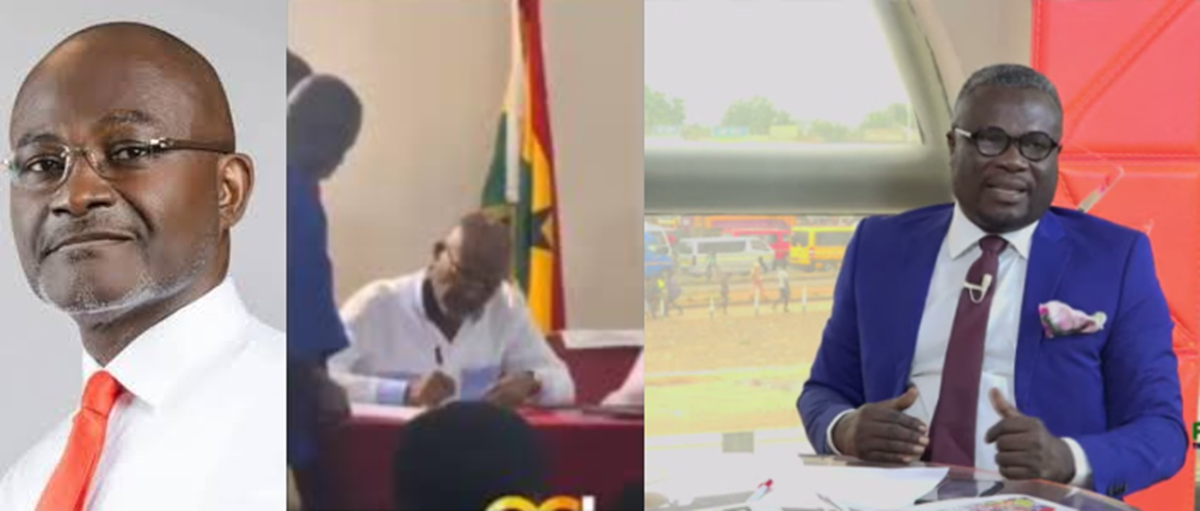
Politics is not church, and peace documents are not prayers. That reality is staring the NPP in the face as the 2026 presidential primaries approach.
According to Lawyer Amoh Dartey, spokesperson for the Kennedy Ohene Agyapong campaign, Kennedy was not ambushed on the day of the so-called peace document signing. He had been given the document in advance, reviewed it, and even submitted it with comments. That part matters.
The problem, they insist, came on the day of signing.
There were no missing pages. Instead, changes had been made to some parts of the agreement. Certain clauses that were earlier discussed had been omitted, while others had been twisted or reworded in ways that altered their original intent. And Kennedy, known for many things but not for signing altered agreements, refused to append his signature.
That decision alone has unsettled the race.
So What Were They Hoping to Achieve by Making Changes?
That is the uncomfortable question nobody wants to answer loudly.
In politics, agreements do not change by coincidence. Clauses are not removed or reshaped without intent. If parts of the document were altered, then someone believed the original wording no longer served a purpose.
Was it to limit certain candidates while protecting others?
Was it to restrict outspoken contenders under the cover of party unity?
Or was it to introduce flexibility that would later be applied selectively?
Kennedy’s camp believes the changes would have curbed his style of campaigning, especially his blunt and confrontational approach, while allowing others to continue with softer but equally damaging political messaging.
Peace, in this sense, begins to look less like unity and more like management.
A Party Uneasy With Its Own Contest?
Let’s be honest. The NPP primaries are not shaping up as a smooth internal exercise. Beneath the handshakes and smiles, there is visible tension.
Some candidates appear confident. Others are cautious. A few seem clearly uncomfortable with how unpredictable the race has become.
Kennedy Agyapong’s appeal to sections of the grassroots has unsettled parts of the party. He does not campaign traditionally. He does not speak in coded language. And he does not submit quietly.
That alone creates discomfort.
So yes, it is fair to ask: do some candidates or power blocs have a negative outlook on how the 2026 primaries might unfold? Are internal mechanisms being adjusted quietly to reduce surprises?
Peace Must Not Become a Tool
Kennedy’s position, according to his team, is not a rejection of peace but a rejection of quiet alterations.
You cannot invite a candidate to sign an agreement in good faith and then adjust its substance at the final stage. That undermines trust.
If the agreement had remained exactly as reviewed and discussed, this controversy would not exist. The backlash exists because the content changed.
And content is everything.
What This Signals for the 2026 NPP Presidential Primaries
This episode has revealed more than a disagreement over wording. It has exposed deeper trust deficits within the party—between candidates, organisers, and the process itself.
If peace is the goal, it must be transparent.
If unity is the message, it must be consistent.
And if the primaries are to command respect, agreements must not be reshaped behind closed doors.
Kennedy Agyapong’s refusal to sign may divide opinion, but from his camp’s perspective, endorsing an altered document would have meant surrendering leverage.
And in politics, once you accept a rewritten agreement, the consequences follow you long after the signatures dry.