

 By Emmanuel Bamfo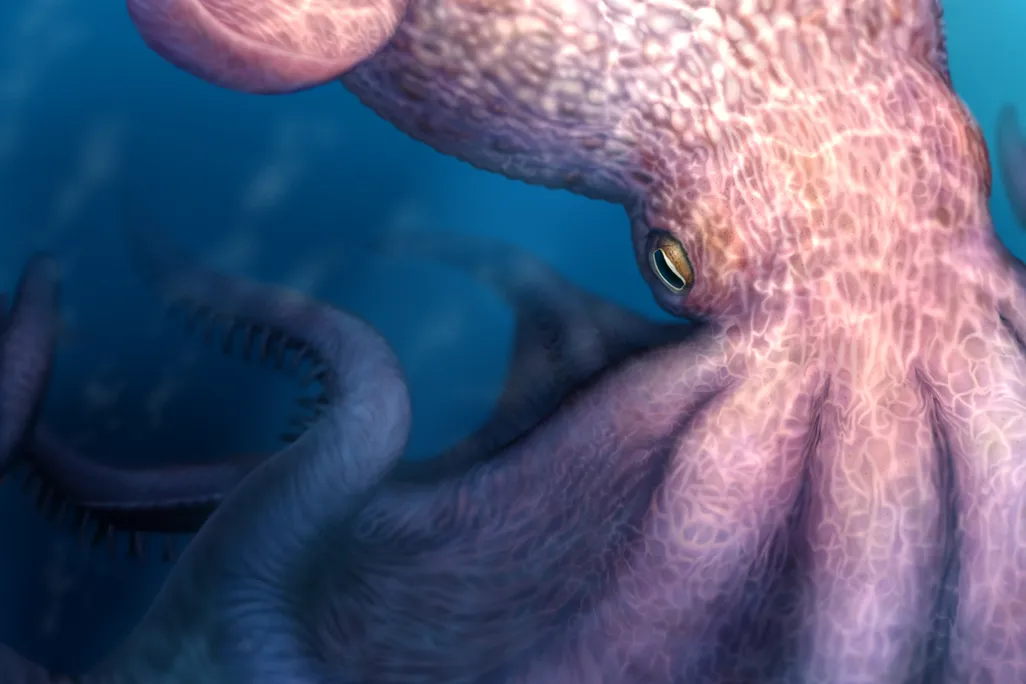
Charley, if you think modern oceans are scary with their sharks and killer whales, then you need to buckle up for some serious pre-historic drama. Paleontologists have recently dug up fossilized evidence of an absolute real-life Kraken that cruised our oceans during the age of the dinosaurs. This is not your regular folklore story told by fishermen over cold bottles of Club beer; this is verified, mind-blowing science that is completely rewriting the history of marine life.
For generations, everyone assumed that only backboned animals like massive marine reptiles ruled the ancient deep blue. But this spectacular scientific discovery proves that a soft-bodied, spineless creature rose up to become one of the most terrifying apex predators to ever swim the Earth.
The revelation has sent massive shockwaves through the global scientific community while leaving marine biologists completely speechless. Let us dive straight into the deep, dark details of this ancient monster and find out why the world cannot stop talking about it.
What Is the Giant Ancient Octopus Fossil That Left Scientists Amazed?
Scientists have discovered exceptionally well-preserved fossilized jaws belonging to a colossal prehistoric octopus named Nanaimoteuthis haggarti. These ancient mouthparts prove that a monstrous, tentacled predator measuring up to sixty-two feet in length actively hunted in the oceans during the Late Cretaceous period. This gargantuan creature lived approximately eighty-six to seventy-two million years ago, competing directly with fearsome marine reptiles for food.
The groundbreaking study was published in the prestigious journal Science by a team of dedicated researchers from Hokkaido University in Japan. Since the soft flesh of an octopus almost never fossilizes, finding these incredibly tough, beak-like jaws in calm seafloor sediments was a massive stroke of luck for the team.
These rare specimens were recovered from Vancouver Island in Canada and the rocky shores of Hokkaido, Japan. By using advanced digital fossil-mining and zero-shot learning artificial intelligence models, the team reconstructed the exact size of the beast. They realized they were looking at an invertebrate that was easily twice the size of a modern giant Pacific octopus.
How Did This Real-Life Kraken Rule the Dinosaur-Era Oceans?
This ancient giant was a fierce apex predator that sat comfortably at the very top of the marine food chain alongside massive mosasaurs. Unlike modern deep-sea octopuses that prefer to hide quietly in rocky crevices, Nanaimoteuthis haggarti was an aggressive, active hunter. It used its eight powerful arms to snatch up prey before crushing them with its hard, chitinous beak.
The key to understanding its aggressive lifestyle lies in the extensive wear and tear preserved on the fossilized jaws. Microscopic analysis revealed deep scratches, chips, and polished edges across the biting surfaces of the beaks. This tells us the creature was constantly and forcefully crushing highly durable food like thick shells and heavy bones.
Scientists estimate that up to ten percent of the jaw tip on mature specimens had been worn down from repeated, violent biting. This level of dental wear is far more extreme than anything we see in modern cephalopods today. It paints a vivid picture of a terrifying sixty-foot monster tearing through ancient crabs, heavily armored fish, and baby marine reptiles with absolute ease.
Why Are Researchers Arguing About Its Mind-Blowing Size?
While the discovery is historic, some paleontologists are highly skeptical about the upper-end size estimate of sixty-two feet. Skeptics argue that estimating the total length of an extinct, soft-bodied animal using only its beak is a highly speculative method. They point out that different octopus species have wildly different body-to-beak ratios, which can easily distort the math.
Cephalopod expert Christian Klug from the University of Zurich publicly stated that the sixty-two-foot estimate is quite extreme. He cautioned that without finding a preserved body or arm fossil, we must treat these giant dimensions with a healthy dose of scientific caution.
However, even if we look at the most conservative and modest estimates, Nanaimoteuthis haggarti would still measure at least twenty-two feet long. That still makes it a terrifying, bus-sized predator that would easily dwarf any diver today. The fact remains that its lower jaw alone is about one point five times larger than that of the largest modern giant squid.
What Does This Discovery Tell Us About Ancient Octopus Intelligence?
The wear patterns on the fossilized jaws suggest that these prehistoric giants possessed advanced brains and highly complex behaviors. Researchers noticed a fascinating asymmetry in the wear, meaning one side of the jaw was consistently more worn down than the other. This suggests the animal preferred using one specific side of its mouth to crack open tough prey.
In the animal kingdom, this habit of favoring one side of the body is called lateralization. It is a trait highly associated with advanced neural processing, similar to how humans are naturally left-handed or right-handed. Finding evidence of this behavior in a hundred-million-year-old fossil indicates that these giant invertebrates were remarkably smart.
This high level of intelligence would have made them incredibly efficient and adaptive hunters. They did not just rely on brute, brainless strength to overpower their prey in the dark water. Instead, they used calculated, tactical bites to dismantle hard-shelled organisms, proving that octopus smarts evolved much earlier than we originally thought.
Why Was the World’s Oldest Octopus Fossil Just Exposed as a Lie?
To make things even more dramatic, scientists recently proved that a famous three-hundred-million-year-old fossil, long crowned as the world’s oldest octopus, is an absolute fake. The fossil specimen, known as Pohlsepia mazonensis, had even secured a proud spot in the Guinness Book of Records. But modern technology has exposed this legendary find as a classic case of mistaken identity.
Lead researcher Dr. Thomas Clements from the University of Reading used super-bright synchrotron X-ray imaging to look inside the rock. The high-tech scans revealed rows of tiny hidden teeth inside the fossil that are completely foreign to octopuses. The tooth count proved the animal was actually a decaying relative of the shelled Nautilus, not an eight-armed octopus.
It turns out the creature had rotted and decomposed for several weeks before getting buried in ancient mud. This decomposition process flattened its body and made it look convincingly like a soft octopus to researchers twenty-five years ago. This major correction has completely rewritten the timeline, pushing the true origin of octopuses much later into the Jurassic period.
How Did Convergent Evolution Create Two Different Types of Monsters?
The rise of the giant ancient octopus is a spectacular example of convergent evolution in our planet’s history. Convergent evolution happens when completely unrelated species independently develop similar physical traits to survive in similar environments. In this case, a spineless invertebrate and backboned marine reptiles both evolved into massive, intelligent apex predators.
To achieve this elite predator status, both groups had to undergo two massive evolutionary changes. First, they both completely lost their heavy, protective outer shells or superficial skeletons to gain incredible speed and agility in the water. Second, they both developed incredibly powerful, sharp jaws to crush and process highly diverse prey.
This shows that nature has a very specific blueprint for creating a successful, world-class ocean hunter. Whether you start as a bony reptile or a soft-bodied mollusk, the recipe for ruling the ocean remains the same. The discovery of Nanaimoteuthis haggarti proves that invertebrates were not just passive victims of history, but active rulers of the prehistoric seas.
What Does This New Deep-Sea Discovery Mean for the Future of Science?
This incredible fossil discovery reminds us that our understanding of earth’s ancient history is constantly evolving. There are still countless secrets buried deep within the rock layers and ocean floors waiting for us to find them. As technology improves, we will continue to correct old mistakes and uncover even more mind-boggling creatures from the past.
The fact that a creature as soft and fragile as an octopus could leave behind clues of its giant reign is truly a miracle. It challenges paleontologists to look closer at fossilized jaws and teeth rather than just searching for giant bones.
Next time you look out at the beautiful, calm ocean, just remember that seventy million years ago, a sixty-foot intelligent monster with three hearts and zero bones was ruling those exact same waters. The ancient world was a wild, terrifying place, and science is finally bringing its coolest monsters back to life.
Also Read: world malaria day 2026 why scientists are sounding the alarm in ghana