

 By Collins Sarkodieh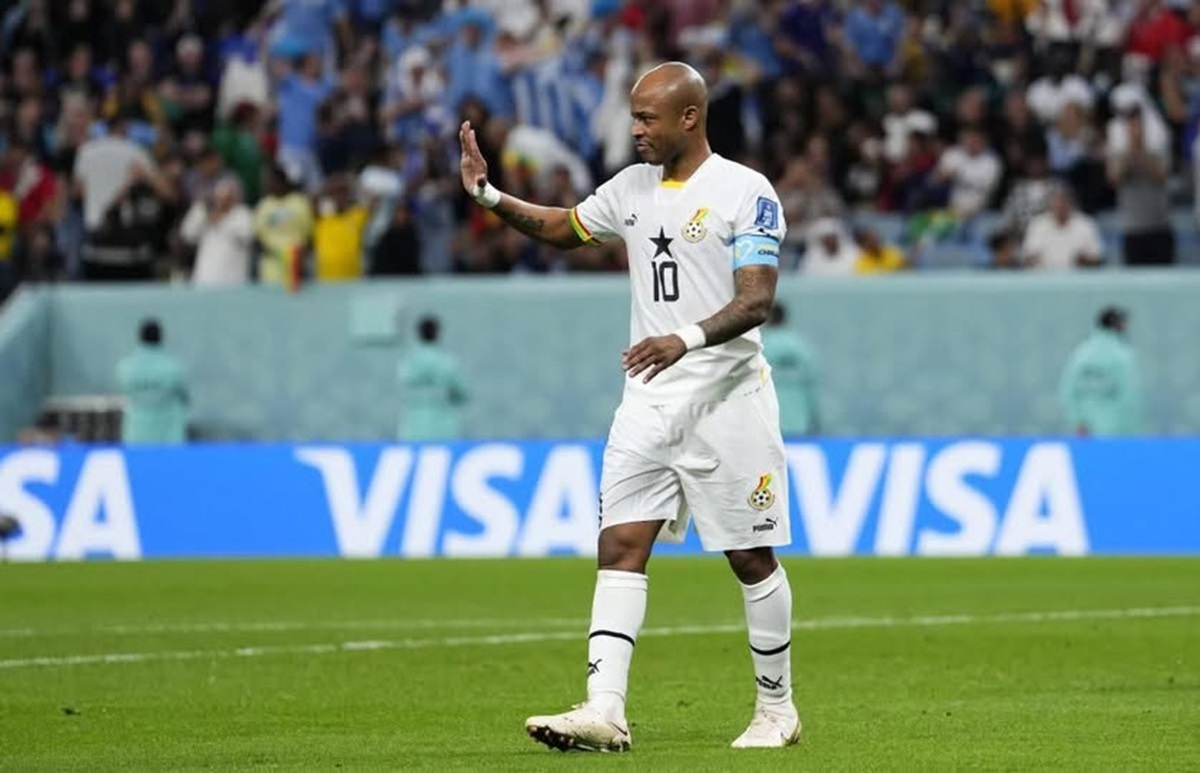
Carlos Queiroz is reportedly preparing to finalize the 2026 World Cup roster with a “ruthless” approach that puts five veteran players at risk, including longtime captain Andre Ayew.
The central debate for the technical team involves weighing Ayew’s immense global name recognition and leadership against the urgent need to integrate a faster, more athletic new generation of talent.
As the tournament in North America approaches, the Andre Ayew Black Stars World Cup 2026 squad Queiroz decision has become the single most discussed topic in Ghanaian sports media. While Ayew has been the heartbeat of the team for over a decade, Queiroz is known for prioritizing tactical discipline and high-pressing systems that require peak physical intensity. With five potential “axe” candidates on the table, the veteran’s future hangs in a delicate balance between his status as a national icon and the cold, hard requirements of modern tournament football.
Is Andre Ayew at risk of missing the 2026 World Cup?
Yes, Andre Ayew is currently among five high-profile players whose inclusion in the final squad is being debated by Carlos Queiroz due to shifting tactical needs. While his experience is unmatched, the coaching staff is under pressure to ensure every roster spot is occupied by a player capable of meeting the high physical demands of a 48-team World Cup format.
The logic behind Queiroz’s hesitation isn’t personal; it is purely mathematical and tactical. At this stage of his career, Ayew’s role has shifted from a box-to-box threat to a more positional leader. However, in a tournament where Ghana will face high-intensity opponents, Queiroz must decide if he can afford to carry a “locker room leader” who might not contribute significant minutes on the pitch. This “ruthless” vetting process is a standard part of the Queiroz playbook, where reputation often takes a backseat to current physical data.
What factors is Carlos Queiroz considering for the “Axe” list?
Queiroz is evaluating players based on three main criteria: current match fitness in competitive leagues, adaptability to a high-press defensive system, and the “substitution impact” for a tournament setting. The veteran players at risk are those whose physical metrics have dipped below the squad average, regardless of their historical contributions to the Black Stars.
The manager has been vocal about creating a “team of the future” rather than a “team of the past.” By analyzing the “5 World Cup axe candidates,” Queiroz is essentially looking to see who can sustain 90 minutes of high-intensity football in the heat of North American summers. If Ayew or other veterans cannot guarantee that level of output, the coaching staff may prefer to use those spots on younger prospects from the U-23 ranks who are currently excelling in European leagues.
Why is Andre Ayew’s global name recognition a factor in the decision?
Andre Ayew remains one of the most recognizable faces in African football, providing a level of “Global Authority” that can influence referees, intimidate opponents, and settle a young dressing room. His presence at a World Cup brings significant media attention and a psychological boost to his teammates, many of whom grew up watching him lead the nation.
However, name recognition does not win matches on its own. The Andre Ayew Black Stars World Cup 2026 squad Queiroz decision involves a trade-off: do you keep the veteran for his “intangibles,” or do you sacrifice that legacy for a player with more “tangible” physical output? Queiroz has faced similar dilemmas in the past with the Iranian and Portuguese national teams, and he has historically leaned toward tactical efficiency over sentimental inclusions.
Also Read: The Queiroz Era Begins: Carlos Queiroz Unveiled as Black Stars Head Coach in Accra
How does the new generation of talent challenge the veteran’s spot?
The emergence of young, explosive attackers playing in top-tier European leagues has significantly narrowed the window for veteran players to retain their starting roles. These younger players offer the “verticality” and speed that Carlos Queiroz’s counter-attacking system relies on to be effective against world-class defenses.
In the current squad, there are at least three or four youngsters who can play in Ayew’s preferred positions. These athletes are products of modern academies where high-speed transitions are the norm. When Queiroz looks at the tape, he sees players who can track back 60 yards in seconds a task that becomes increasingly difficult for players in the twilight of their careers. The “axe” is effectively a byproduct of a talent boom that is forcing the Black Stars to evolve faster than some fans might like.
What are the “5 World Cup axe candidates” names being discussed?
While the official list is under wraps, insiders suggest the names being scrutinized alongside Andre Ayew include older defenders and midfielders who have been staples of the squad since 2019. The focus is on any player who has seen a significant drop in playing time at the club level over the last six months.
Being on the “axe list” doesn’t mean a player is definitely out; it means they are on “probation.” Queiroz is likely using the upcoming international friendlies as a final trial. For Andre Ayew, these matches represent a “do or die” moment to prove he can still influence the game at the highest level. The logic is simple: in a World Cup, there is no room for passengers, only contributors.
How could Ayew’s exclusion affect the team’s chemistry?
Excluding a captain as influential as Andre Ayew could be a “double-edged sword” that either liberates the younger players or causes a leadership vacuum that is hard to fill. Ayew has often acted as the “buffer” between the media and the squad, taking the pressure off the younger stars like Mohammed Kudus.
If Queiroz decides to move forward without him, he must ensure that a new “Alpha” emerges in the dressing room to maintain discipline. On the other hand, some analysts argue that the team needs to “step out of the shadow” of the older generation to truly forge a new identity. This “psychological restructuring” is perhaps the most difficult part of the Andre Ayew Black Stars World Cup 2026 squad Queiroz decision, as it involves changing the social fabric of the Black Stars.
What role does current club form play in Queiroz’s selection?
Carlos Queiroz is a firm believer that “you play how you train,” meaning players who are not starting regularly for their clubs are unlikely to find a place in his World Cup starting XI. He has consistently warned that no name is “too big to be benched” if the player is not match-sharp.
This philosophy puts veterans in a tough spot if they are currently in leagues with lower intensity or are struggling for minutes. The GFA technical directorate has been monitoring “Player Heatmaps” and “Sprint Distances” for all 5 axe candidates. If the data shows a decline that cannot be rectified by a pre-tournament camp, Queiroz is likely to pull the trigger and opt for the “ruthless” omission to protect the team’s overall performance.
Also Read: Video: Carlos Queiroz officially welcomed by Sports Minister ahead of Black Stars unveiling
Factual Insights for the 2026 World Cup Debate:
- Record Holder: Andre Ayew is currently one of Ghana’s most-capped players, having represented the nation in multiple AFCONs and World Cups.
- Queiroz Philosophy: Carlos Queiroz has a history of dropping veteran stars if they don’t fit his specific “Transition Defense” requirements.
- Roster Expansion: The 2026 World Cup allows for a 26-man roster, which might actually help Ayew if Queiroz decides to keep one “Senior Advisor” spot.
- Age Factor: By the time the 2026 World Cup begins, Ayew will be in his mid-30s, an age where recovery times between tournament matches significantly increase.
- Youth Influx: Over 60% of the current Black Stars pool is under the age of 25, marking the youngest average squad age in a decade.
- Tactical Shift: Ghana has moved toward a 4-3-3 or 4-2-3-1 system under Queiroz, both of which require high-mobility wingers and midfielders.
What is the fans’ perspective on the Andre Ayew decision?
Public opinion in Ghana is split down the middle: “Ayew Loyalists” believe his presence is a non-negotiable requirement for a stable campaign, while “Generation Nexters” are calling for a fresh start. The debate often becomes emotional, reflecting Ayew’s status as a symbol of the team’s resilience over the years.
Logic suggests that the “sweet spot” might be a reduced role for Ayew perhaps as a “Super Sub” or an off-field mentor. However, for a player of Ayew’s stature, accepting a diminished role is often difficult. If Queiroz cannot guarantee him a place in the tactical setup, he may decide that a clean break is better for both the player’s dignity and the team’s focus. The fans’ noise is loud, but Queiroz’s ears are likely tuned only to the data and the scouting reports.
Can Ayew convince Queiroz in the final pre-tournament friendlies?
The final window of international friendlies before the World Cup will be the ultimate proving ground for the “5 axe candidates.” If Ayew can demonstrate that he still possesses the “engine” to compete and the tactical intelligence to guide the youth, he could force Queiroz to reconsider.
Queiroz is not a “villain” looking to end careers; he is a professional looking to win. If Ayew shows up to camp in the best shape of his life and outshines the younger prospects in training drills, the “ruthless” decision might actually be to keep him. The ball, quite literally, is in the veteran’s court. He must prove that his global name recognition is backed by the physical capacity to compete in the most grueling tournament on earth.
Why is the 2026 World Cup squad selection different from previous years?
The 2026 tournament is unique because of the 48-team expansion and the vast travel distances between host cities in the USA, Canada, and Mexico. This logistical reality places a premium on physical “durability” and squad depth, making the inclusion of “part-time” players a significant risk.
In previous years, a team could survive on a core of 14 or 15 players. In 2026, the demand for rotation will be much higher. This makes the Andre Ayew Black Stars World Cup 2026 squad Queiroz decision even more critical. If a veteran takes a spot and cannot recover quickly between games, it effectively leaves the team short-handed during a marathon tournament. Queiroz’s “ruthlessness” is essentially a defensive measure against the physical toll of the new World Cup format.
The saga of the Black Stars’ roster selection is a reminder that in elite sports, the past and the future are always in conflict. Andre Ayew’s legacy is secure, but his immediate role in the “Queiroz Era” remains one of the most fascinating storylines of the 2026 World Cup cycle.
As we wait for the final squad announcement, one thing is certain: whether Andre Ayew is on the plane or not, the decision will be made with one goal in mind—propelling Ghana to its most successful World Cup finish in history.
Do you think it’s better to have a veteran like Andre Ayew for his leadership in the locker room, or should those spots strictly go to the most physically fit young players?
Also Read: Should Ghana Sack Queiroz and Appoint Renard? Here Is Why It Won’t Happen