

 By Ghana News
 The Bank of Ghana (BoG) has released its official daily exchange rates for Monday, May 18, 2026, offering crucial benchmarks for the performance of the Ghanaian cedi against dominant international currencies. These published figures, which reflect the average interbank transaction values at the close of the previous business week, serve as an essential guide for local commercial banks, corporate importers, and international investors.
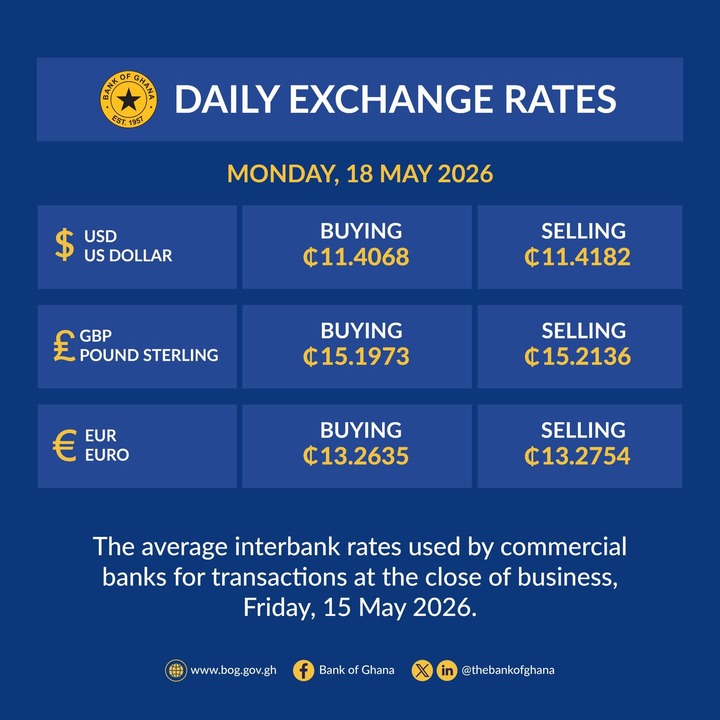
According to the central bank’s trading desk, the US dollar is being bought at GHS 11.4068 and sold at GHS 11.4182. The British pound sterling retains its premium position on the local market, trading at a buying rate of GHS 15.1973 and a selling rate of GHS 15.2136. Meanwhile, the euro maintains a stable middle ground, with the interbank market establishing a buying rate of GHS 13.2635 and a selling rate of GHS 13.2754.
Financial analysts note that these specific rates are grounded in data aggregated at the close of business on Friday, May 15, 2026. By providing consistent, timely updates, the regulatory institution aims to minimize speculative trading and maintain order within the domestic forex market. The predictable margins between the buying and selling indicators signal an environment that supports strategic planning for businesses exposed to foreign exchange risks.
The narrow spreads between the buying and selling rates are significant because they indicate lower transaction costs and relative short-term stability within the foreign exchange market. For corporate entities operating in an import-dependent economy like Ghana, wild fluctuations in forex spreads can completely erase profit margins overnight.
When the central bank maintains tight interbank corridors, local manufacturing and retail businesses can project their import duties and raw material costs with higher logical precision. This predictable environment prevents businesses from artificially inflating shelf prices to protect themselves against feared cedi depreciation.
Daily central bank rates impact remittance inflows by determining the exact purchasing power of funds sent home by Ghanaians working within the diaspora. When the cedi stabilizes, diaspora relatives can maximize their financial support toward local construction projects, school fees, and medical bills without losing substantial value to sudden currency drops.
Factual Insights into Ghana’s Monetary and Currency Dynamics:
- Official Exchange Value: The Bank of Ghana established the official interbank buying rate for the US dollar at GHS 11.4068 for the start of the week.
- Statutory Framework: The central bank issues daily forex data under its explicit mandate to regulate the country’s monetary and financial systems to support national economic growth.
- Data Origin: The publication relies directly on transaction data finalized by commercial banking desks at the close of business on Friday, May 15, 2026.
The latest daily exchange rate publication by the Bank of Ghana highlights the institution’s ongoing commitment to market transparency and active monetary management. Providing accurate, highly visible data ensures that all participants in the financial sector can operate on an even playing field with minimal information asymmetry.
Also Read: Ghana Cedi Exchange Rates Today: Why Market Rates Vary on May 11