

 By Collins Sarkodieh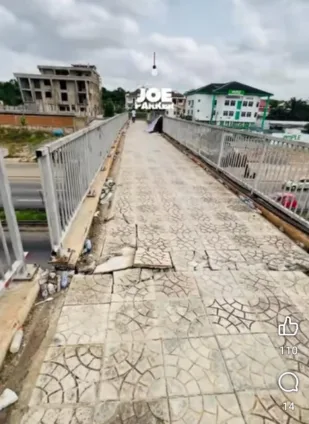
The decision by the Ghana Highway Authority to intervene on the Dzorwulu footbridge is more than a routine maintenance update. It exposes a deeper issue about how urban infrastructure in Accra is being used, misused, and often left vulnerable to preventable damage.
At first glance, the incident seems minor. A lowbed truck collides with a pedestrian bridge, the structure shifts slightly, engineers assess it, and repairs are scheduled. But that sequence hides a more systemic problem. Urban transport corridors in Accra are increasingly under pressure from mixed traffic systems where heavy-duty vehicles, informal transport, and pedestrian infrastructure coexist without adequate enforcement or spatial planning.
What makes the Dzorwulu case significant is not the extent of the damage but the implications of the “slight shift” in the bridge’s superstructure. In structural engineering terms, even minor displacement in load-bearing components can alter stress distribution across the entire structure. Over time, that can accelerate fatigue, especially in high-traffic zones where vibration and repeated loading are constant. In other words, what appears stable today could become a hazard tomorrow if left unchecked.
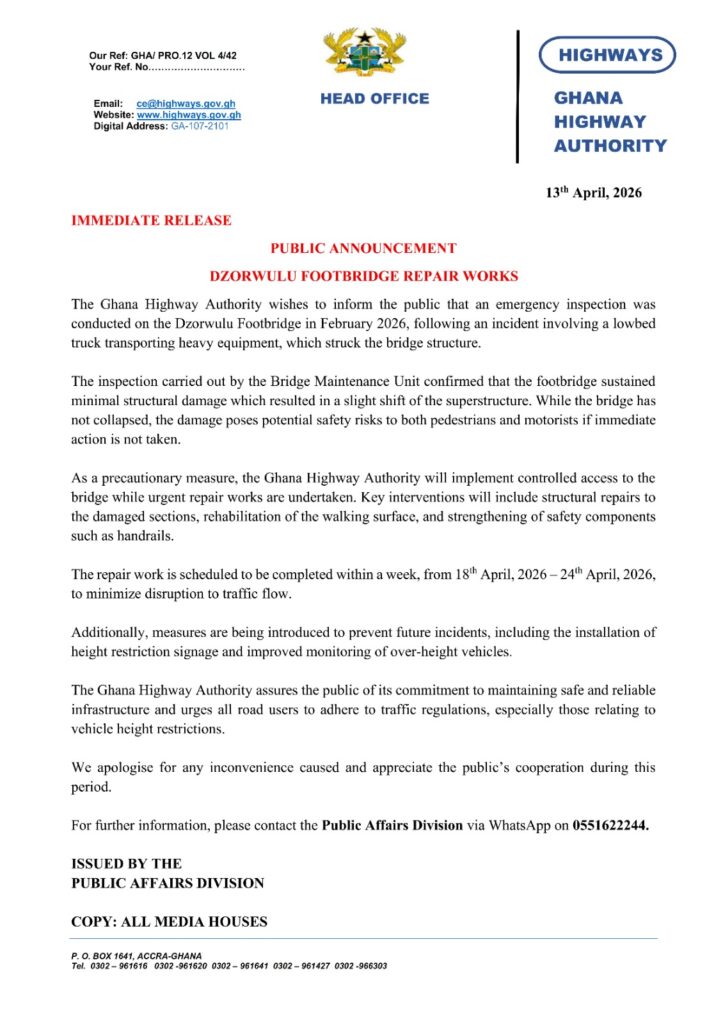
The fact that the bridge remains open under controlled access during repairs reflects a balancing act between safety and urban mobility. Dzorwulu is not just another neighborhood corridor. It is a critical pedestrian crossing point along a busy arterial road where foot traffic intersects with high-speed vehicular movement. Closing it entirely would likely push pedestrians into unsafe road crossings, increasing accident risk. Keeping it partially open introduces managed risk, which suggests authorities are prioritizing continuity while mitigating immediate danger.
This incident also highlights a recurring weakness in infrastructure protection across Ghana’s urban centers. Over-height vehicles striking bridges is not a rare occurrence. It points to gaps in enforcement, inadequate signage, and in some cases, a lack of real-time monitoring systems. In more advanced transport systems, height detection sensors and automated warning systems are deployed well before such impact points. Their absence in Accra indicates that infrastructure is still largely reactive rather than preventive.
From an urban planning perspective, the growing frequency of these incidents suggests that road usage patterns are evolving faster than regulatory frameworks. The increase in logistics activity, construction transport, and heavy haulage within city limits means that infrastructure originally designed for lighter, more predictable traffic is now exposed to new stressors.
There is also an economic dimension to consider. Emergency repairs, even when classified as minor, divert public funds that could have been allocated to expansion or modernization projects. Repeated incidents of this nature compound maintenance costs and reduce the lifecycle efficiency of infrastructure investments.
Looking ahead, the measures proposed by the Authority such as improved height restriction signage and stricter monitoring are a step in the right direction, but they may not be sufficient on their own. Effective prevention will likely require a combination of enforcement technology, stricter penalties for non-compliance, and better coordination between transport regulators and freight operators.
There is also an opportunity here to rethink pedestrian infrastructure design. Future footbridges in high-risk corridors could incorporate higher clearance thresholds or protective structural buffers that absorb impact without transferring stress to critical components.
For residents and daily commuters in Dzorwulu, the immediate concern is safety and convenience during the repair window. For policymakers and urban planners, however, this incident should serve as a case study. It underscores the need to transition from reactive maintenance culture to predictive infrastructure management.
Ultimately, the Dzorwulu footbridge situation is not just about fixing a damaged structure. It is about addressing the conditions that allowed the damage to happen in the first place, and ensuring that as Accra continues to grow, its infrastructure evolves with it rather than constantly playing catch-up.
Also Read: Kaneshie Footbridge Closed for Urgent Structural Repairs