

 By Ishmeal
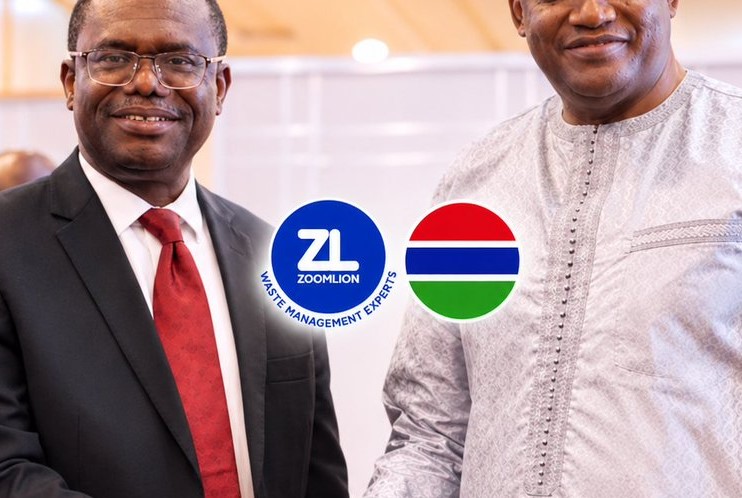
The Government of The Gambia has signed an integrated waste management agreement with Zoomlion Ghana Limited to improve sanitation, waste collection and disposal in the West African country.
The agreement was signed on Wednesday, October 28, 2026, at State House in Banjul, in the presence of Gambian President Adama Barrow. The signing was followed by a sod-cutting ceremony at Tambana, Brikama, in the West Coast Region to mark the commencement of the project.
The initiative, involving Zoomlion Ghana Limited and its parent company, the Jospong Group of Companies, is expected to strengthen waste management services, create employment opportunities and promote environmental sustainability in The Gambia.
What the Waste Management Agreement Covers
Under the first phase of the agreement, Zoomlion will finance, design and construct a Mechanical Biological Treatment (MBT) plant and waste transfer stations.
The company will also provide municipal solid waste collection and transportation services as part of efforts to improve sanitation and the management of household and commercial waste.
The project includes plans to decommission the Bakoteh and Mile 2 dumpsites and recover reusable materials, including plastics and metals. This approach is intended to reduce the amount of waste sent to disposal sites and encourage recycling.
The initial phase will focus on the Greater Banjul Area and the West Coast Region, covering communities around Banjul, Kanifing and Brikama.
Second Phase to Extend Waste Management Services
The agreement also outlines a second phase, expected to begin after the project’s second anniversary.
This phase will focus on liquid waste management and the expansion of services to other regions of The Gambia.
The broader goal is to establish an integrated waste management system that improves the collection, transportation, treatment and disposal of waste while recovering materials that can be reused for agricultural and industrial purposes.
The project is also expected to create jobs for young people and women and provide opportunities for local businesses to participate in the waste management industry.
Gambian Authorities Welcome the Initiative
The Minister of Environment, Climate Change and Natural Resources, Rohey John Manjang, welcomed the agreement as an important step towards addressing waste management challenges in The Gambia.
She emphasised the need for practical solutions, stronger partnerships and improved national capacity to deliver sustainable environmental services.
The Executive Director of the National Environment Agency, Dr Dawda Badgie, also described the agreement as a significant milestone.
He highlighted the importance of financial investment, technical expertise and cooperation among government institutions and other stakeholders in tackling the country’s waste management challenges.
The involvement of the relevant environmental authorities is expected to support efforts to establish a more coordinated and sustainable waste management system.
Jospong Group Highlights Opportunities for Local Businesses
The Executive Chairman of the Jospong Group of Companies, Dr Joseph Siaw Agyepong, said the partnership reflected the importance of African countries working together to address common development challenges.
He explained that discussions leading to the agreement included a visit by a Gambian government delegation to waste management facilities operated by the Jospong Group in Ghana.
Dr Agyepong also indicated that existing waste collectors, transporters, recyclers and other local businesses would have opportunities to participate in the project.
According to him, local companies could contribute in areas such as construction, procurement and maintenance. The initiative is also expected to provide employment and skills development opportunities, particularly for young people and women.
Strengthening Cooperation Between Ghana and The Gambia
The agreement represents another step in cooperation between Ghanaian waste management operators and the Gambian government.
Through the partnership, The Gambia aims to strengthen its waste management infrastructure and improve sanitation services, drawing on experience gained from waste management operations in Ghana.
If successfully implemented, the project could help reduce pressure on existing disposal sites, improve recycling and create new employment opportunities.
However, its long-term impact will depend on effective implementation, adequate maintenance of facilities and sustained cooperation between the government, local authorities, businesses and communities.
The agreement is expected to support The Gambia’s broader efforts to improve environmental sanitation and establish a more sustainable approach to waste management.
Also Read:Kwesi Kwarteng Declines Npp Deputy Communications Director Role