

 By Collins Sarkodieh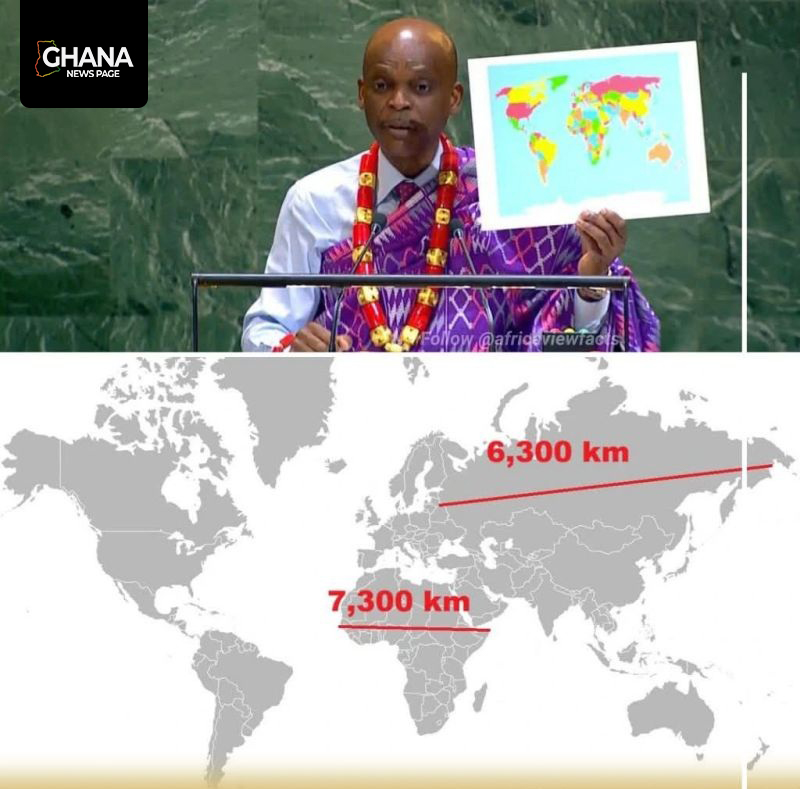
For generations, the way the world sees Africa has been shaped by a quiet distortion hiding in plain sight. It sits in classrooms, atlases, news graphics and digital maps. Most people never question it. Yet it has influenced how Africa is perceived politically, economically and psychologically.
Now, Togo is stepping into an unexpected leadership role, pushing for a global correction that goes beyond cartography. Backed by the African Union, the country plans to take its case to the United Nations, calling for a shift away from the long-dominant Mercator projection toward the more proportionally accurate Equal Earth projection.
At first glance, this might seem like an academic debate. It is not. It is about power, perception and how knowledge is constructed.
The Mercator projection, created in the 16th century for navigation, stretches landmasses near the poles and compresses those near the equator. The result is a world map where Europe and North America appear larger and more dominant, while Africa, positioned along the equator, looks significantly smaller than it actually is.
The reality is strikingly different. Africa spans roughly 30 million square kilometres. It is large enough to contain the United States, China, India and much of Europe combined. Yet the commonly used map does not communicate that scale. Over time, this visual misrepresentation has subtly reinforced narratives about Africa’s place in the world.
Why this matters goes beyond geography. Perception influences policy, investment, education and even identity. When a continent is consistently presented as smaller or less prominent, it shapes how it is valued in global conversations. This is not always deliberate, but the impact is real.
From an expert standpoint, maps are not neutral tools. They are interpretations shaped by historical context and purpose. The Mercator projection was designed for maritime navigation during an era of European expansion. Its continued dominance in modern education reflects inertia rather than accuracy.
The push for the Equal Earth projection represents a shift toward fairness in representation. Unlike Mercator, it preserves relative land area, offering a more truthful visual of the world. For Africa, this means reclaiming its actual scale on the global stage.
There are also practical implications. Educational systems across the world rely heavily on standardized maps. Updating these materials would influence how future generations understand global geography. Media organizations, publishers and digital platforms would need to adjust visual frameworks that have been in place for decades.
Resistance is likely. The Mercator projection is deeply embedded in global systems, from textbooks to mapping software. Changing it requires coordination, policy alignment and widespread adoption. It is not just a technical update. It is a cultural shift.
For Africa, this campaign aligns with a broader movement to reshape global narratives. Across sectors, there is growing emphasis on telling African stories with accuracy and depth, whether in economics, technology or culture. Correcting the map becomes part of that larger effort.
The timing is also significant. As African economies grow and digital transformation accelerates, the continent’s global relevance is expanding. Ensuring that its physical representation matches its real scale reinforces that shift.
Looking ahead, the success of this initiative will depend on how effectively it is communicated and adopted. If the United Nations endorses the proposal, it could trigger a gradual but meaningful change in global standards. Over time, the maps people grow up with would begin to reflect a more accurate world.
This is ultimately about more than geography. It is about how knowledge shapes perception and how perception influences reality. Africa has always been vast. The difference now is that there is a coordinated effort to make the world see it that way.
Also Read:WTO Talks in Cameroon Collapse After Brazil Blocks US Push to Extend E-Commerce Tax Ban