

 By Zobia Zulfqar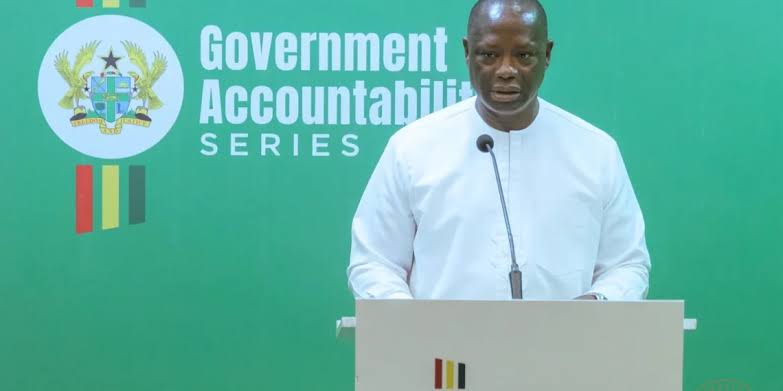
Ghana’s Cabinet has approved sweeping reforms to the country’s mining laws, paving the way for major changes to how mineral resources are regulated and managed.
The proposed amendments to the Minerals and Mining Act, 2006 (Act 703) have been forwarded to Parliament for consideration as the government seeks to modernise the legal framework governing the mining sector.
The announcement was made by the Minister for Lands and Natural Resources, Emmanuel Armah-Kofi Buah, during the Government Accountability Series held at the Presidency in Accra, where he presented the ministry’s achievements during the first half of 2026.
According to the Minister, the review of Act 703 followed extensive consultations with industry stakeholders before receiving Cabinet approval.
He explained that the revised legislation is designed to strengthen regulation, improve transparency and ensure that mining activities contribute more effectively to Ghana’s economic and social development.
One of the key changes in the proposed law is the establishment of district mining committees, which will serve as the first point of contact for mining licence applications.
The government believes this approach will improve local participation in the licensing process while strengthening oversight at the district level.
The revised bill also introduces a new medium-scale mining category, creating an additional classification between small-scale and large-scale mining operations.
Officials say the new category is intended to better reflect the different sizes and operational capacities of mining businesses.
Another major reform is the abolition of the reconnaissance licence. Under the proposed law, it will be replaced by a single prospecting licence with a maximum duration of five years.
The government says this change is intended to simplify the licensing process while encouraging more efficient mineral exploration.
The proposed legislation also reduces the maximum duration of mining leases to 20 years.
In addition, every mining lease will now be required to include a mandatory community development agreement.
The Minister said these agreements are intended to ensure that communities affected by mining activities receive direct development benefits through projects and investments agreed upon between mining companies and local residents.
“The revised Bill provides an updated, coherent and forward-looking legal regime to ensure that mining contributes immensely to national development,” Mr Buah said.
Alongside the legislative reforms, Cabinet has also approved a revised Minerals and Mining Policy, originally introduced in 2014.
According to the Minister, the updated policy places greater emphasis on local content, value addition and increasing the participation of Ghanaian businesses in the mining industry.
The government also approved the Minerals and Mining (Royalties) Regulations, 2025 (L.I. 2517).
The new regulations introduce a sliding-scale royalty system, where royalty rates will vary depending on changes in global commodity prices.
Officials say this approach is designed to ensure that the country receives a fair share of mining revenues during periods of high mineral prices while maintaining investment attractiveness during weaker market conditions.
Mining remains one of Ghana’s most important economic sectors, contributing significantly to export earnings, government revenue and employment.
The government believes the proposed reforms will strengthen regulation, improve environmental and social accountability, and create a more sustainable mining industry.
If Parliament approves the amendments, the revised law will replace key provisions that have governed Ghana’s mining sector for nearly two decades.
Government officials say the reforms form part of a broader strategy to maximise the long-term benefits of the country’s mineral resources while promoting responsible mining practices and sustainable national development.
Also Read: Ghana Launches Diplomatic Protest Over Canada Visa Denial of Thomas Partey