

 By Collins Sarkodieh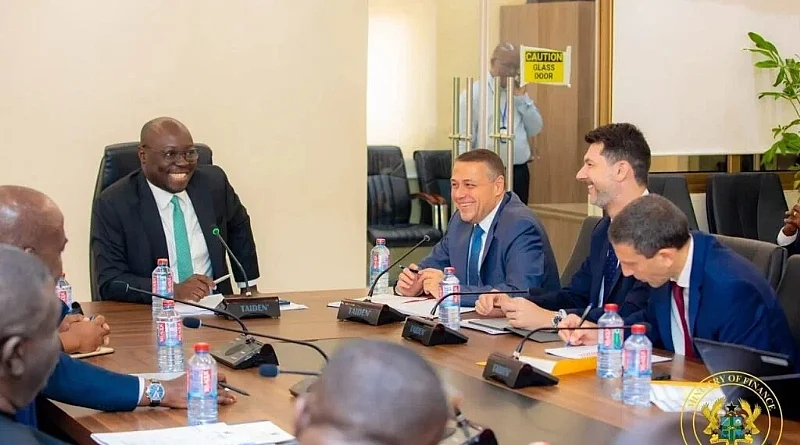
The International Monetary Fund (IMF) staff mission is officially arriving in Accra today, Tuesday, April 29, 2026, to commence the sixth and final review of Ghana’s $\$3$ billion Extended Credit Facility (ECF). Successful completion of this mission is expected to unlock the final disbursement of approximately $\$360$ million, marking a historic conclusion to the country’s three-year economic recovery programme.
While the team arrives today, official high-level engagements with the Ministry of Finance and the Bank of Ghana will begin on Thursday, April 30. This two-week visit is the ultimate “health check” for the Ghanaian economy, evaluating progress made since the last review in December 2025. With the programme now extended to August 16, 2026, this final review focuses on ensuring that fiscal reforms in the energy sector and the banking system are permanent rather than temporary fixes. For the average Ghanaian, this means the “IMF era” of strict austerity is nearing its end, potentially ushering in a period of more predictable exchange rates and lower inflation.
What is the primary goal of the IMF Ghana final review April 29 2026 mission?
The primary goal of the mission is to verify that Ghana has met all structural benchmarks and quantitative performance criteria required for the final $\$360$ million payout. The IMF team will specifically scrutinize the government’s spending in early 2026 to ensure there are no fiscal “slippages” that could undermine the debt sustainability achieved so far.
Think of this as the final exam after three years of intensive economic tutoring. The IMF isn’t just checking the balance sheets; they are looking at the “quality” of the growth. They want to see that the energy sector isn’t leaking money through unpaid debts and that the banking sector is robust enough to lend to local businesses without needing state bailouts. Logic dictates that if the “IMF Ghana final review April 29 2026 $\$360$ million” mission goes well, it signals to the world that Ghana is officially “back in business” and capable of managing its own finances without outside supervision.
How much money will Ghana receive after this final review?
Upon a successful “Staff-Level Agreement” at the end of this two-week mission, Ghana is set to receive a final tranche of approximately $\$360$ million. This brings the total support under the current ECF arrangement to the full $\$3$ billion originally promised in 2023.
This final $\$360$ million serves as a critical buffer for Ghana’s foreign exchange reserves. It helps the Bank of Ghana maintain a stable Cedi against the US Dollar as the country transitions out of the programme. While the cash is important, the “signal” it sends to international markets is worth much more. It validates the “Ghanaian Economic Miracle” narrative, making it cheaper for the government to attract foreign direct investment and lower the interest rates on future loans. Essentially, this money is the “graduation gift” for sticking to the hard rules of fiscal discipline.
What are the key economic projections for Ghana in 2026?
Ghana’s economy is projected to grow by a healthy 4.8 percent in 2026, a figure that slightly outperforms the broader Sub-Saharan Africa average. More importantly, inflation is on a steep downward trajectory, projected to settle at approximately 7.9 percent by the end of the year.
These numbers are not just random data points; they represent a significant victory over the “cost of living crisis” that gripped the nation in 2022 and 2023. A growth rate of 4.8 percent suggests that sectors like agriculture, gold mining, and services are firing on all cylinders. Lower inflation means your money stays in your pocket longer. When inflation drops to 7.9 percent, the aggressive price hikes at the grocery store should finally become a memory. It’s a logical progression: discipline leads to stability, and stability leads to growth that people can actually feel.
Why was the IMF programme extended to August 16, 2026?
The programme was extended by three months to August 16, 2026, to provide the government enough “buffer time” to complete complex structural reforms, particularly in the energy and cocoa sectors. This extension ensures that the “exit” from the IMF is clean and that all agreed-upon prior actions are fully implemented before the official oversight ends.
Extensions are common in IMF programmes when the finish line is in sight but a few “technical hurdles” remain. For Ghana, the priority was ensuring that the energy sector debt a long-standing headache for the national budget—was managed through a sustainable repayment plan. Logic suggests that it’s better to stay under the IMF umbrella for an extra 90 days and get the $\$360$ million with a perfect score than to rush the exit and leave investors wondering if the reforms will stick. This extra time allows the “IMF Ghana final review April 29 2026 $\$360$ million” process to be as thorough as possible.
Factual Insights on Ghana’s IMF Exit 2026:
- Growth Leadership: Ghana’s 4.8 percent growth projection is significantly higher than the 3.8 percent average projected for Sub-Saharan Africa in 2026.
- Inflation Control: From a peak of over 50 percent in 2022, the 7.9 percent projection for late 2026 represents one of the most successful disinflation campaigns in African history.
- Banking Stability: The final review will check the progress of the “Ghana Financial Stability Fund,” which was created to support banks affected by the domestic debt exchange.
- Energy Sector Reform: A key focus is the “Zero-Intervention” policy, ensuring that state-owned energy companies operate on a cost-recovery basis without needing daily subsidies.
- Reserve Building: The final $\$360$ million will help push Ghana’s gross international reserves toward a target of four months of import cover.
- Timeline: The mission lasts 14 days, with the official report expected to be presented to the IMF Executive Board in Washington by June 2026.
- Post-Programme Monitoring: Even after August 16, the IMF will continue “Article IV” consultations annually to ensure Ghana doesn’t slide back into excessive debt.
How will the banking system be evaluated in this final review?
The IMF team will conduct a “deep dive” into the balance sheets of Ghana’s commercial banks to ensure they have recovered from the 2023 debt restructuring. They are looking for evidence that banks are increasing their “Capital Adequacy Ratios” and are ready to support private sector growth through affordable credit.
A healthy banking system is the “engine room” of the economy. During the “IMF Ghana final review April 29 2026 $\$360$ million” mission, the focus is on whether the banks can survive without government “hand-holding.” If the banks are strong, they can give loans to the young entrepreneur in Kumasi or the factory owner in Tema. Logic dictates that a “pass grade” for the banking sector in this review will lead to lower interest rates for consumers by the end of 2026. It’s the final piece of the puzzle for a sustainable 24-hour economy.
What are the “Prior Actions” needed to unlock the final disbursement?
“Prior Actions” are specific legal or administrative steps the Ghanaian government must take before the $\$360$ million is released. These often include the passage of specific bills in Parliament or the implementation of new digital tax tracking systems to increase domestic revenue mobilization.
For the 2026 review, these actions likely involve finalizing the “Energy Sector Recovery Programme” (ESRP) and proving that the “Integrated Tax Administration System” (ITAS) is fully operational. These aren’t just “red tape”; they are the “mechanical guards” that prevent the economy from breaking down again. The IMF mission arriving today will verify if these guards are in place. Once the “Prior Actions” are ticked off, the $\$360$ million moves from Washington’s account to Accra’s account. It’s a performance-based system that ensures taxpayers’ money both locally and internationally is being handled with logic and care.
Also Read: IMF Ghana Final Programme Review April 2026 Accra: The Road to Economic Independence
Does the IMF exit mean the end of high taxes?
The exit from the IMF programme doesn’t mean taxes will vanish overnight, but it does mean the government will have more “fiscal space” to reconsider certain levies once the $\$360$ million is secured and the debt is stable. The focus will likely shift from “emergency taxation” to “efficient collection.”
Logic suggests that the government won’t immediately slash taxes because they need to maintain the “Primary Surplus” required by the IMF. However, with inflation at 7.9 percent and growth at 4.8 percent, the burden of those taxes feels lighter because the economy is expanding. The “IMF Ghana final review April 29 2026 $\$360$ million” mission is about creating a system where the government can fund its own projects without borrowing at 30 percent interest. High taxes are the “bitter medicine” that prevented a total collapse; the “exit” is the sign that the patient is healthy enough to start a normal diet again.
What should investors and the diaspora look for in the next two weeks?
Investors and Ghanaians in the diaspora should watch for the “Closing Press Statement” from the IMF mission head, typically released at the end of the two-week visit. Positive language regarding “fiscal consolidation” and “structural resilience” will be the “buy signal” for Ghanaian bonds and the Cedi.
If you are sending money home to build a house or start a business, this is your “green light” period. The “IMF Ghana final review April 29 2026 $\$360$ million” ensures that the Cedi you send today won’t be worth 20 percent less tomorrow. The diaspora’s confidence is a major part of the 4.8 percent growth projection. When the IMF gives its final nod, it tells everyone from Wall Street to London that Ghana’s economy is a “safe harbor” once again. The mission arriving in Accra today is the final act of a long drama, and the ending looks like a blockbuster for the national economy.
What happens after the programme officially ends on August 16?
After August 16, 2026, Ghana enters a “Post-Programme Monitoring” phase, where the IMF remains a “trusted advisor” rather than a “strict supervisor.” The government will regain full sovereignty over its economic policies but will be held accountable by the “Market Discipline” of international investors.
The “logic of the exit” is that Ghana has built enough “internal muscle” to stay fit on its own. The $\$360$ million is the final “protein shake” to get the country through the transition. We will see more focus on the “24-Hour Economy” and industrialization as the government uses its newfound stability to drive long-term prosperity. It’s an exciting time; for the first time in years, the “Ghanaian Cedi” and “Stability” might finally be mentioned in the same sentence without a hint of irony.
Also Read: IMF Ghana Final Programme Review April 2026 Accra: The Road to Economic Independence