

 By Collins Sarkodieh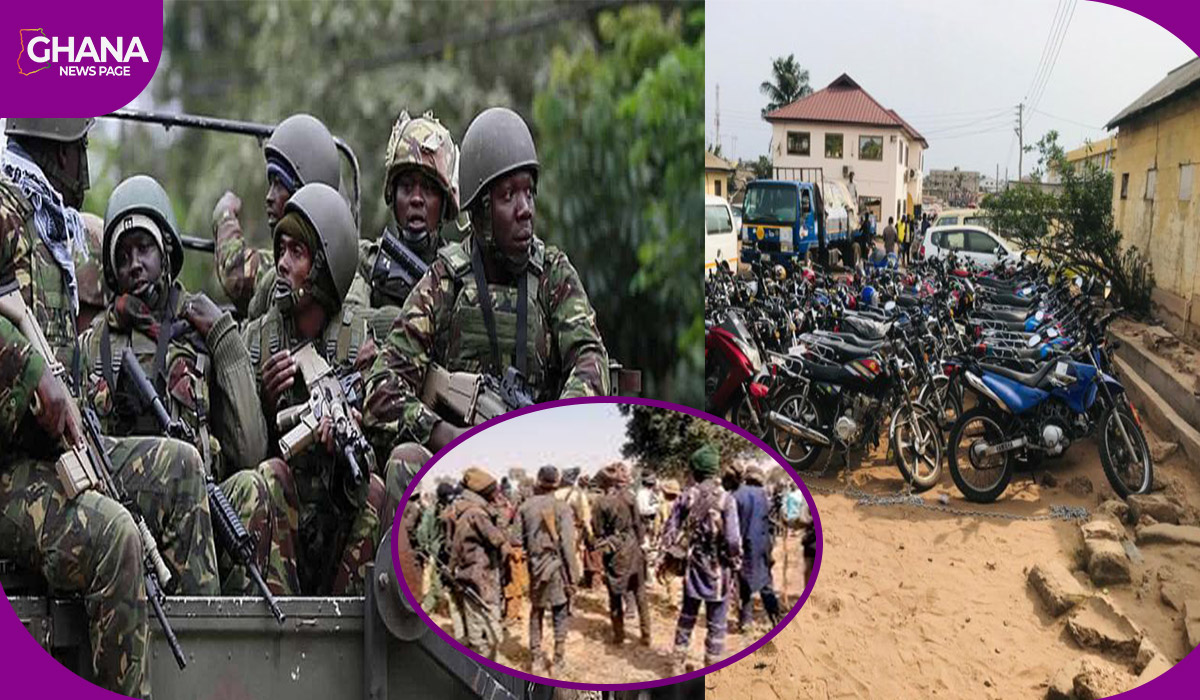
The Ministry of Interior has officially imposed an immediate ban on the use of motorbikes in the Binduri Township and its surrounding areas following a deadly ambush on a military-protected civilian convoy. This directive, signed by Interior Minister Muntaka Mohammed-Mubarak, aims to curb the mobility of armed groups who have used two-wheeled vehicles to launch hit-and-run attacks in the Upper East Region.
The security situation escalated significantly after the “Binduri attack Ghana military convoy 2026” incident on Monday, April 27, where unknown gunmen opened fire on 140 civilians under military escort. While the Ghana Armed Forces (GAF) successfully repelled the assault, killing seven assailants, the tragic loss of three civilian lives has forced the government to implement stringent movement restrictions. With the total number of arrests now rising to 21, the regional security council is utilizing every available tactical measure to dismantle the network responsible for this bold provocation against the state.
Why did the Ministry of Interior ban motorbikes in Binduri?
The Ministry of Interior banned motorbikes in Binduri because they have become the primary mode of transport for insurgents and “unknown elements” to carry out rapid ambushes and escape into difficult terrain. By removing motorbikes from the streets, security forces can more easily identify suspicious movements and limit the tactical agility of armed groups.
In many parts of Northern Ghana, motorbikes are the lifeblood of rural transport, but in conflict zones, their utility is often co-opted for violence. Logic suggests that an assailant on a bike can navigate bush paths where a heavy military armored car cannot follow. Minister Muntaka Mohammed-Mubarak’s decision is a mechanical necessity to “freeze” the battlefield. While this disrupts the daily lives of law-abiding citizens, the “Binduri attack Ghana military convoy 2026 motorbike ban” is viewed as a vital sacrifice to prevent further loss of life during this high-stakes security operation.
How did the Binduri attack on the military convoy unfold?
The attack occurred on Monday morning when a GAF escort convoy, protecting roughly 140 civilians traveling from Bawku to Bolgatanga, was ambushed by gunmen. The attackers utilized heavy fire, resulting in the immediate death of three civilians and injuries to another, before the military initiated a lethal repulse.
Military reports indicate that the “unknown elements” were positioned in a way that maximized civilian exposure. The GAF responded with overwhelming force, neutralizing seven of the attackers on the spot. This wasn’t just a random act of banditry; the use of high-caliber weapons like the G3 automatic rifle suggests a level of coordination and intent that goes beyond petty crime. The recovery of 176 rounds of ammunition from a suspect who attempted to hide in a mosque proves that the group was prepared for a sustained firefight with the army.
Who are the 21 suspects currently in military custody?
The number of arrests has risen to 21 following an intensive manhunt across Binduri and the surrounding border communities. These individuals are currently being interrogated to determine their links to local ethnic militias or potential external insurgent groups operating across the Sahelian border.
The jump from 11 initial arrests to 21 within 24 hours shows that military intelligence is moving at a rapid pace. These suspects were apprehended during “cordon and search” operations in areas where the escapees were believed to be hiding. Logic dictates that the interrogation of the individual caught with the G3 rifle and 176 rounds of ammunition will be the key to unlocking the group’s command structure. The goal is to move beyond the foot soldiers and find the financiers or “intellectual authors” who provided the weaponry for such a daring assault on a protected convoy.
What is the root cause of the violence in the Bawku-Binduri area?
The violence is deeply rooted in a protracted chieftaincy and land dispute between the Mamprusi and Kusasi ethnic groups over who holds the authority to appoint a paramount chief for Bawku. This decades-old conflict has claimed over 300 lives since 2021 alone, creating a volatile environment where even minor provocations can trigger deadly cycles of retaliation.
While the “Binduri attack Ghana military convoy 2026 motorbike ban” is a specific response to Monday’s events, it cannot be separated from the broader Bawku crisis. The conflict has essentially “militarized” local youth, making it easier for unknown elements to recruit fighters for ambushes. The logic of the Interior Ministry is that by calming Binduri, they prevent the violence from bleeding further into the Bolgatanga corridor. It is a complex social puzzle that requires more than just guns to solve, yet currently, the priority is the “Order” side of the “Law and Order” equation.
What weapons were recovered during the Binduri manhunt?
The primary recovery was a G3 automatic rifle, two fully loaded magazines with 20 rounds each, and an additional 176 rounds of loose ammunition. This specific haul was retrieved from an escapee who fled into a mosque in Binduri township shortly after the military repelled the initial ambush.
The G3 is a battle rifle that fires a 7.62mm round, capable of penetrating standard vehicle plating and causing massive trauma at long range. Having nearly 200 rounds of ammunition suggests the attackers were not just trying to scare the convoy but were equipped to engage in a protracted battle. Logic suggests that the “search and retrieve” missions will continue until the GAF is confident that no other high-powered caches are hidden in residential or religious spaces. For a civilian convoy of 140 people, the presence of even one such rifle in the hands of an attacker is a catastrophic risk.
Factual Insights on the Binduri and Bawku Conflict:
- Casualty Count: Over 300 people have been confirmed dead in the Bawku-related violence since the conflict flared up again in late 2021.
- Convoy Demographics: The Monday convoy consisted of 140 civilians, primarily traders and families moving between the two regional hubs for safety.
- Weaponry Specs: The G3 automatic rifle recovered is a military-grade weapon with an effective firing range of up to 500 meters.
- Arrest Surge: Security forces increased the arrest count from 11 to 21 within a single day of the Interior Ministry’s directive.
- Geographic Sensitivity: Binduri is a key transit point; a total blockade here effectively cuts off the northernmost parts of Ghana from the regional capital.
- Ethnic Groups: The conflict primarily involves the Mamprusi and Kusasi groups, but the influx of “unknown elements” suggests wider regional instability.
- Escort Protocol: The Ghana Armed Forces have been providing daily escorts for months due to the high risk of snipers on the Bawku-Bolgatanga road.
How does the motorbike ban affect the 24-hour economy in the North?
The motorbike ban significantly hinders the “24-Hour Economy” goals in the Upper East Region by restricting the movement of labor and goods during the night and early morning hours. Since motorbikes are the primary “taxis” for the rural population, this ban creates a logistical bottleneck for farmers, traders, and health workers.
However, the Ministry of Interior argues that you cannot have a 24-hour economy without 24-hour security. The logic is that the temporary economic pain of the “Binduri attack Ghana military convoy 2026 motorbike ban” is a necessary investment for long-term stability. If the army can clear the “unknown elements” and ensure that the Bawku-Bolga road is safe, the economy will recover much faster than if it remains a “kill zone” where traders are afraid to travel. For now, the people of Binduri must adapt to a “walking economy” while the military completes its sweep.
What are the “Downside Risks” of the military manhunt?
The primary risks include the potential for “intelligence errors” leading to the arrest of innocent civilians and the possibility of retaliatory strikes against military outposts. There is also the danger that the “unknown elements” may flee across the porous borders into neighboring countries, only to return once the military presence is scaled back.
Logic suggests that the GAF must maintain a “high-trust” relationship with the local population to get the best leads on the remaining suspects. If the search becomes too aggressive or insensitive to local customs, the “21 arrested” could become a source of resentment rather than a sign of progress. The military’s challenge is to be “surgical” removing the gunmen while protecting the 140 civilians (and the thousands of others) who just want to live in peace. The manhunt is a delicate balance of iron-fisted strength and velvet-gloved community relations.
What should the public expect in the coming days?
The public should expect an increased number of checkpoints, more frequent aerial surveillance via drones or helicopters, and potentially a formal curfew if the arrests do not lead to the immediate neutralization of the remaining cell. The motorbike ban will likely remain in place until the “G3-bearing” network is fully mapped and dismantled.
Interior Minister Muntaka Mohammed-Mubarak has stated that the government will not hesitate to expand the ban to neighboring districts if the intelligence points toward a wider conspiracy. For those traveling through the Upper East Region, the “Winning Language” is patience and compliance. Logic dictates that the more the public cooperates with the 21 arrests and the search for weapons, the sooner the “Binduri attack Ghana military convoy 2026 motorbike ban” can be lifted. This is a time for national vigilance, as the safety of the northern corridor is a prerequisite for the safety of the entire nation.
How can the Binduri community help restore peace?
The community can help by providing “anonymous tips” regarding the whereabouts of the suspects who fled and by strictly adhering to the motorbike ban to ensure that security forces can focus their energy on actual threats. A “See Something, Say Something” approach is the most effective way to protect the 140 civilians who were nearly lost on Monday.
The 21 people in custody didn’t act in a vacuum; someone in the community knows where the rest of the ammunition is hidden. Logic suggests that the “unknown elements” are only unknown as long as the community remains silent. By working with the GAF, the people of Binduri can reclaim their town from the shadow of the Bawku conflict. The restoration of peace starts with the realization that a G3 rifle in a mosque is a threat to everyone, regardless of their ethnic group or political affiliation.
Also Read: Ghana Army Gun Battle in Binduri: 10 Confirmed Dead and 11 Arrested in Deadly Ambush