

 By Collins Sarkodieh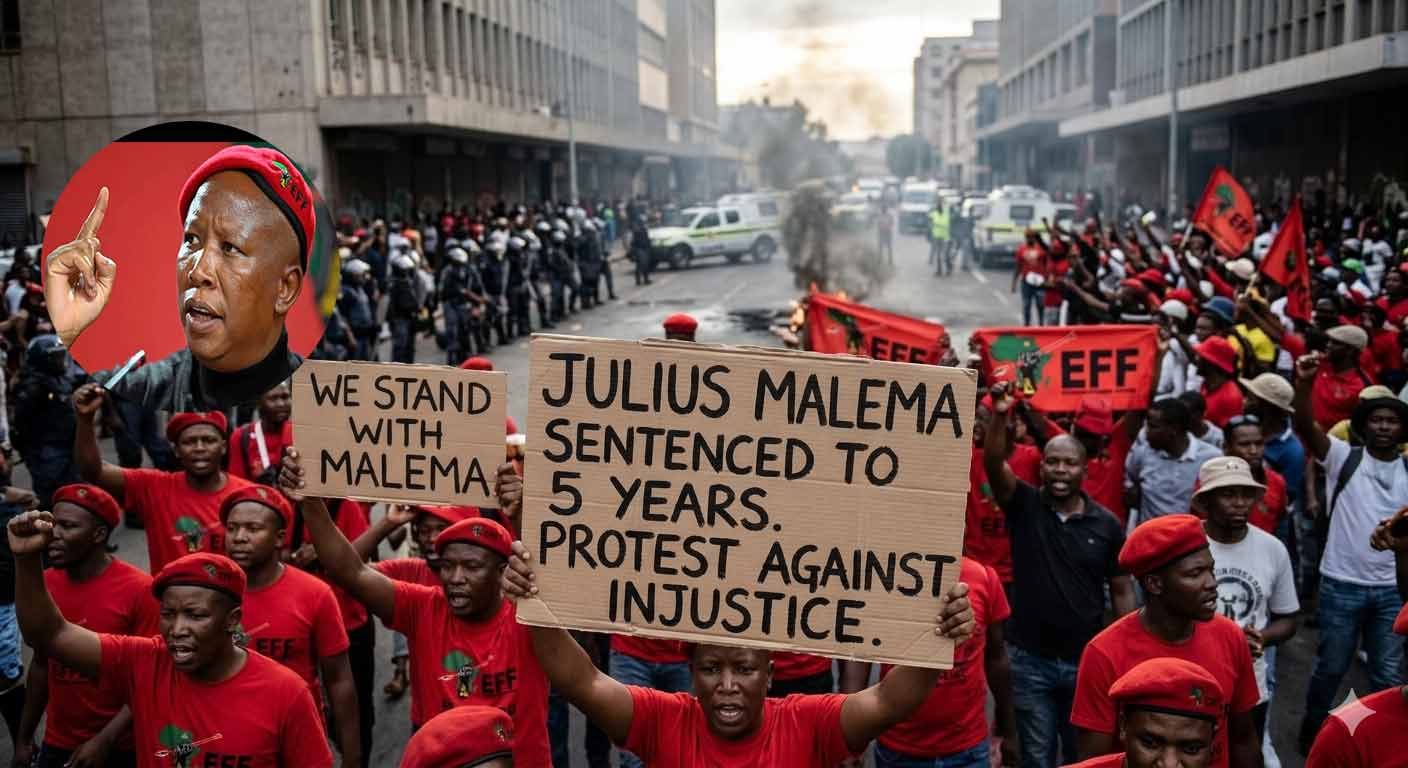
South African court sentences opposition leader Julius Malema to five years in jail for firing a gun at a public rally in 2018.
That single ruling has quickly moved beyond a legal headline into a full-blown political moment, raising questions about accountability, power, and the stability of South Africa’s already fragile political climate. What is unfolding is not just a criminal case, but a test of how the country balances the rule of law with the influence of one of its most polarising political figures.
Inside and outside the East London Magistrates’ Court, the response was immediate. Supporters of the Economic Freedom Fighters gathered in large numbers, chanting and showing solidarity with their leader. For a party built on strong grassroots mobilisation, this reaction was expected. What stands out, however, is the speed with which the EFF shifted from protest to strategy, announcing plans to appeal the ruling almost instantly.
From a legal standpoint, the case revolves around firearm-related offences, including discharging a weapon in a built-up area. These are serious charges in any jurisdiction, particularly in a country grappling with high levels of gun violence. The court’s decision signals a strict interpretation of the law, reinforcing the idea that public figures are not exempt from legal consequences.
Yet, in South Africa’s political landscape, legal decisions rarely exist in isolation. The EFF has framed the sentence as more than a judicial outcome, suggesting it carries political undertones. This framing is crucial because it shapes how supporters interpret the ruling. For many within the party, the issue is no longer just about what happened in 2018, but about whether state institutions are being used to weaken opposition voices.
The sentencing of Julius Malema has triggered a political flashpoint in South Africa, one that extends well beyond the courtroom and into the country’s already tense national discourse. What might appear at first glance as a criminal justice matter involving firearm-related offences is rapidly evolving into a broader contest over power, perception, and political influence.
At the center of the storm is the swift reaction from the Economic Freedom Fighters, a party that has built its identity on confrontation, populist messaging, and strong grassroots mobilization. Within hours of the ruling at the East London Magistrates’ Court, party officials made it clear that the legal battle was far from over. The commitment to appeal immediately is not just a legal strategy but a political one. It signals to supporters that the leadership is resisting not only a sentence, but what they frame as a targeted effort to weaken the movement.
The charges themselves stem from an incident involving the discharge of a firearm in a public setting, raising questions about accountability and the boundaries of political behavior. In many democracies, cases like this are treated strictly within the legal framework. In South Africa, however, the intersection of law and politics often carries deeper implications, particularly when it involves high-profile figures with significant public followings.
Supporters gathering outside the court, chanting and displaying party colors, is not unusual for the EFF. The party has long demonstrated an ability to mobilize quickly and visibly. What is notable in this instance is the intensity of the rhetoric emerging alongside the protests. Statements suggesting that the country could become “ungovernable” if Malema is imprisoned introduce a layer of risk that authorities cannot ignore.
From a political risk perspective, this moment is significant. South Africa has a history of protest-driven pressure influencing national conversations. When legal proceedings intersect with mass mobilization, the potential for escalation increases. This is why the response from the South African Police Service has been measured but firm, emphasizing preparedness while attempting to avoid inflaming tensions further.
There is also a legal dimension that deserves closer scrutiny. Appeals in cases involving public figures often hinge on procedural integrity, interpretation of intent, and proportionality of sentencing. Malema’s legal team is likely to challenge not just the verdict but the severity of the punishment, framing it as excessive or inconsistent with precedent. The outcome of that appeal could have implications for how similar cases are handled in the future.
Why this story matters goes beyond Malema as an individual. It touches on the credibility of institutions. If the judiciary is perceived as impartial and consistent, the ruling may strengthen confidence in the rule of law. If, however, a significant portion of the public views the decision as politically motivated, it risks deepening existing divisions.
Economically and socially, prolonged instability is a concern. Investor confidence, already sensitive to political uncertainty, can be affected by sustained unrest or threats of disruption. The language of making a country ungovernable is not just political theater. It has real-world implications if it translates into coordinated protests, shutdowns, or clashes with security forces.
Looking ahead, the situation could unfold in several ways. A successful appeal may defuse immediate tensions while reinforcing the EFF’s narrative of resilience. A failed appeal, on the other hand, could intensify mobilization efforts and test the state’s capacity to maintain order without appearing heavy-handed.
This episode ultimately underscores a recurring theme in South African politics. Legal outcomes do not exist in isolation. They are interpreted, contested, and amplified within a broader struggle over legitimacy and influence. In that sense, the courtroom is only one arena. The real contest is playing out in the streets, in public opinion, and in the country’s political future.
He reassured the supporters that there was nothing that would disrupt the revolution.
Also Read: South Africa Welcomes New US Ambassador Despite Tensions
“No one has reason to panic. I am too old to be shaken by young Afrikaner boys, he stated.