

 By Collins Sarkodieh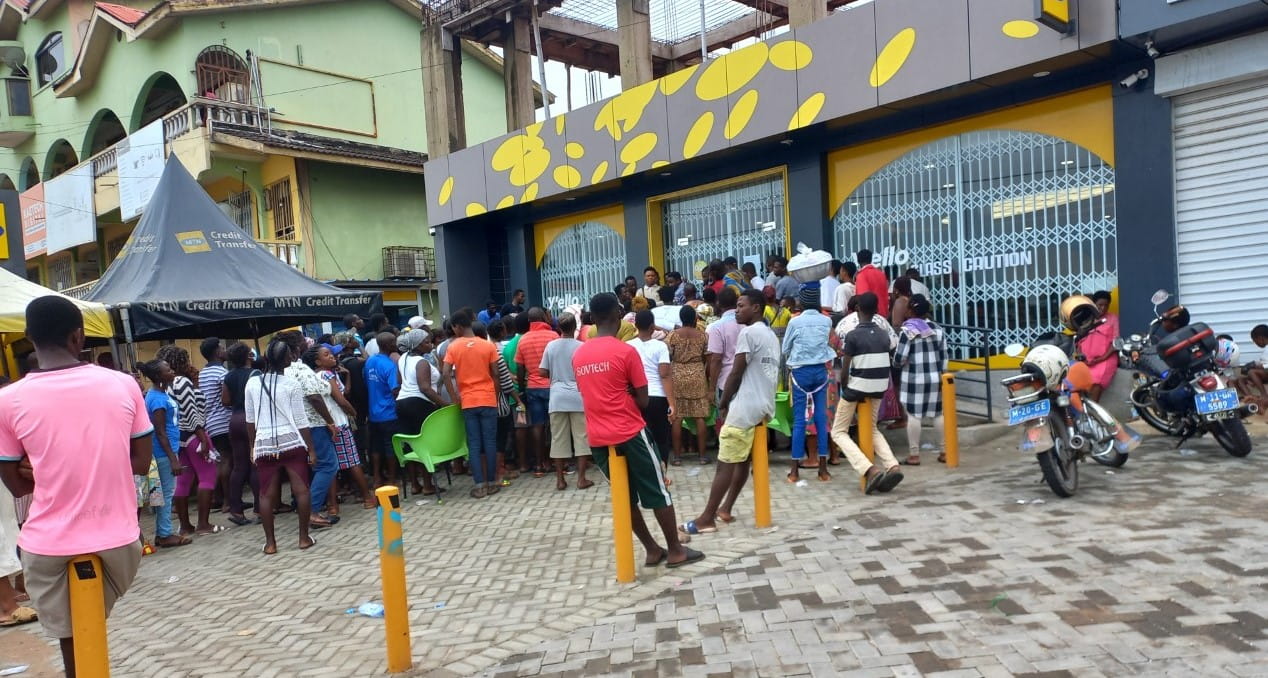
Tension is mounting around MTN Group operations in Ghana as a viral video shows a large crowd of mobile money(MoMo) agents gathered outside an MTN office, demanding answers over the sudden blocking of their agent SIM cards.
The affected agents claim their lines were deactivated without prior notice, locking them out of mobile money wallets that reportedly contain significant sums of money. For many, these accounts are not just business tools but their primary source of daily income. The abrupt disruption has left them stranded, unable to access funds, serve customers, or sustain their livelihoods.
At the center of the outrage is the lack of clear communication. Agents insist they were given no detailed explanation for the action, creating confusion and suspicion. In a sector built on trust and instant transactions, any restriction on access to funds quickly escalates into a serious economic and reputational issue.
The situation highlights the critical role mobile money(MoMo) plays in Ghana’s financial ecosystem. Thousands of agents act as the backbone of the system, bridging the gap between formal banking and everyday users. When their operations are halted, the ripple effects extend beyond individual losses to affect entire communities that depend on cash-in and cash-out services.
From a regulatory and compliance perspective, SIM blocking is not unusual in the telecom and fintech space. Companies often take such steps to address suspected fraud, identity verification gaps, or breaches of operational guidelines. However, the challenge lies in execution. Sudden enforcement without structured communication or phased resolution mechanisms can trigger panic, especially when large sums of money are involved.
The protest captured in the circulating video reflects deeper tensions within the mobile money(MoMo) ecosystem. Agents are demanding transparency on why the blocks occurred, how long they will last, and what steps are required to regain access. More importantly, they are calling for assurances that their funds remain secure.
For MTN Ghana, the incident presents both a crisis and an opportunity. How the company responds will likely shape public perception in the coming weeks. A slow or unclear response could erode confidence not only among agents but also among millions of customers who rely on the platform daily. On the other hand, a swift resolution backed by clear communication could reinforce trust and demonstrate operational accountability.
Looking ahead, this development may push for stricter regulatory oversight within Ghana’s digital finance sector. Authorities could be compelled to introduce clearer guidelines on how telecom operators handle agent accounts, especially in situations involving suspected irregularities. There may also be renewed emphasis on dispute resolution frameworks to protect agents from abrupt disruptions.
The broader implication is clear. As mobile money(MoMo) continues to dominate financial transactions in Ghana, the systems supporting it must evolve to match its scale. Reliability, transparency, and communication are no longer optional. They are essential.
For now, the focus remains on the agents gathered outside MTN offices, waiting not just for answers, but for access to the funds that keep their businesses and households running.
Also Read: The 2026 Guide to Securing Your Mobile Money: How to Outsmart the Latest “Double Your Cash” Scams