

 By Collins Sarkodieh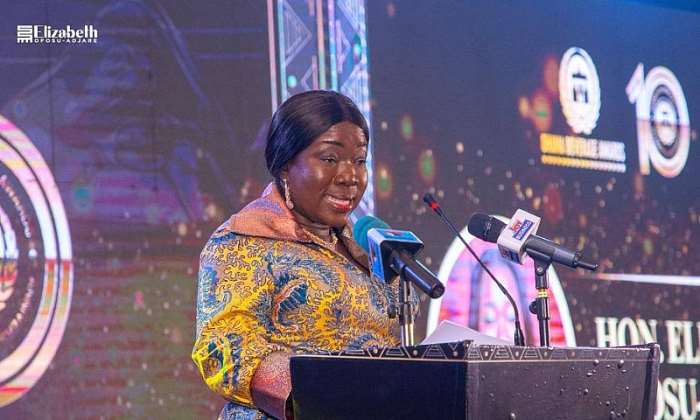
The Minister for Trade, Agribusiness, and Industry, Mrs. Elizabeth Ofosu-Adjare, has officially announced the revival of the “Made-in-Ghana Fair” to serve as a high-visibility platform for local beverage producers. Speaking at the 10th Edition of the Ghana Beverage Awards (GBA) on Saturday, April 18, 2026, the Minister emphasized that the fair is a strategic tool designed to build consumer confidence and elevate homegrown brands to international standards.
The government’s plan involves more than just a trade show; it is a holistic approach to industrialization that bridges the gap between rural farming and urban manufacturing. By providing a dedicated space for “Made-in-Ghana” products, the Ministry aims to showcase the innovation of local brewers and distillers while encouraging Ghanaians to choose local over imported alternatives. This revival comes at a critical time as the nation looks to strengthen its non-traditional exports and capitalize on the African Continental Free Trade Area (AfCFTA).
Why is the revival of the Made-in-Ghana Fair significant for local brands?
The revival of the Made-in-Ghana Fair provides local producers with a state-backed stage to prove their quality and reliability to both domestic and international buyers. Mrs. Elizabeth Ofosu-Adjare noted that the platform is essential for enhancing the image of Ghanaian brands, ensuring they are no longer viewed as “alternatives” but as first-choice products.
For many small and medium-scale beverage producers, marketing budgets are often the first casualty of economic pressure. The fair acts as a subsidized marketing engine, allowing brands from the various regions of Ghana to interact directly with consumers. This direct engagement is vital for building the “trust equity” that homegrown brands need to compete with global giants. By bringing these producers under one roof, the government is facilitating B2B networking that could lead to new distribution deals and export partnerships.
What is the “Feed the Industry” initiative and how does it support farmers?
The “Feed the Industry” initiative is a strategic program designed to create a seamless supply chain between Ghanaian farmers and beverage manufacturers. It ensures that raw materials—such as cocoa, fruits, and grains—are sourced locally, thereby reducing the industry’s reliance on expensive imported concentrates and additives.
This initiative creates a “win-win” scenario: manufacturers get a stable, traceable supply of fresh inputs, while local farmers get a guaranteed market for their produce. During her remarks at the Ghana Beverage Awards, the Minister highlighted that this linkage is a pillar of national economic development. By “feeding” the manufacturing sector with local agricultural output, the government is effectively retaining more wealth within the country and insulating the beverage industry from global supply chain shocks and exchange rate volatility.
How will the new Agribusiness Policy accelerate industry growth?
The upcoming Agribusiness Policy will provide a formal strategic framework that incentivizes value addition and helps local businesses expand their market reach. Rather than just exporting raw agricultural goods, the policy encourages companies to process those goods into finished beverages, which command much higher prices on the global market.
The policy is expected to include tax incentives for agro-processors, streamlined export procedures, and support for meeting international quality certifications. This isn’t just about making “more” products; it’s about making “better” products that meet the stringent standards of European and American markets. By providing a clear roadmap for expansion, the government is giving local entrepreneurs the confidence to invest in new machinery and larger production facilities, ultimately leading to more sustainable jobs.
Why is Artificial Intelligence (AI) becoming a priority for Ghana’s beverage sector?
Mr. Ernest Boateng, CEO of Global Media Alliance, urged beverage producers to adopt AI-driven tools to predict market trends and better understand rapidly changing consumer preferences. In an era where consumer tastes shift overnight, AI can help local companies analyze data to see which flavors or packaging styles are trending before they invest in a full production run.
Beyond marketing, AI has the potential to revolutionize operational efficiency and quality control. For instance, AI-powered sensors can monitor fermentation processes in real-time, ensuring consistency across every bottle produced. This technological leap is what will allow a small-scale producer in Accra to maintain the same quality standards as a multinational corporation. As Mr. Boateng pointed out, those who embrace these emerging technologies will be the ones who survive and thrive in an increasingly competitive global landscape.
What was the theme of the 10th Edition of the Ghana Beverage Awards?
The 10th-anniversary edition of the Ghana Beverage Awards was celebrated under the theme “A Toast to Ten,” marking a decade of recognizing excellence and innovation in the sector. Over the past ten years, the GBA has evolved from a simple ceremony into a credible industry benchmark that encourages brands to constantly improve their standards.
The event held on Saturday at the Kempinski Hotel was not just a celebration but a reflection on how far the industry has come. In 2016, many local brands struggled with packaging and consistency; by 2026, Ghanaian beverages are winning international awards and appearing on shelves across the diaspora. The Minister praised the resilience of the industry leaders who have “held the fort” through various economic cycles, proving that the beverage sector is one of the most robust pillars of the Ghanaian economy.
Also Read: Wall Street ended the day mixed but with a bit of optimism in the air
How does the beverage industry contribute to Ghana’s national economy?
The beverage industry spans the entire economic spectrum from agriculture and manufacturing to retail and hospitality making it a massive engine for employment and tax revenue. Mrs. Ofosu-Adjare noted that the sector touches every aspect of daily life, providing livelihoods for hundreds of thousands of Ghanaians.
From the farmer growing the hibiscus for “sobolo” to the truck driver delivering crates of water and the bartender serving at a local resort, the “multiplier effect” of the beverage sector is enormous. Every cedi spent on a locally produced drink supports a chain of workers who are predominantly indigenous. This is why the government views the sector as a “non-traditional export” powerhouse that can help diversify the economy away from a heavy reliance on gold, cocoa, and oil.
What are the “Sustainability and Plastic” goals discussed at the 10th GBA?
With the 10th anniversary, organizers and government officials have placed a renewed focus on sustainability, particularly regarding the plastic waste generated by the beverage industry. The 2026 mandate includes encouraging brands to adopt more eco-friendly packaging and participate in nationwide recycling programs.
The Minister urged industry players to not only focus on growth but on “responsible growth.” As the sector expands, the environmental footprint must be managed to ensure that the beauty of Ghana’s natural landscape is preserved. Many brands are now being judged not just on their taste, but on their Corporate Social Responsibility (CSR) and their commitment to a “circular economy” where plastic bottles are recovered and repurposed rather than ending up in the ocean.
Can Ghanaian beverages compete on the global market via the AfCFTA?
With the strategic framework of the AfCFTA and the new Agribusiness Policy, Ghanaian beverages are better positioned than ever to dominate the continental market. The Made-in-Ghana Fair revival is specifically designed to prepare these brands for the “Export Economy” that President John Dramani Mahama has been championing.
The goal is for a “Made-in-Ghana” label to be a mark of premium quality across the 54 nations of the African Union. By leveraging government initiatives and adopting AI for better market insights, local producers can find “niche” markets in neighboring countries like Nigeria, Cote d’Ivoire, and beyond. The “Feed the Industry” link ensures that the cost of production remains competitive, allowing Ghanaian brands to offer high-quality products at prices that reflect the reality of the African consumer.
Also Read: They treated me like a goat and chased me away” Henry Quartey fires back after humiliating