

 By Collins Sarkodieh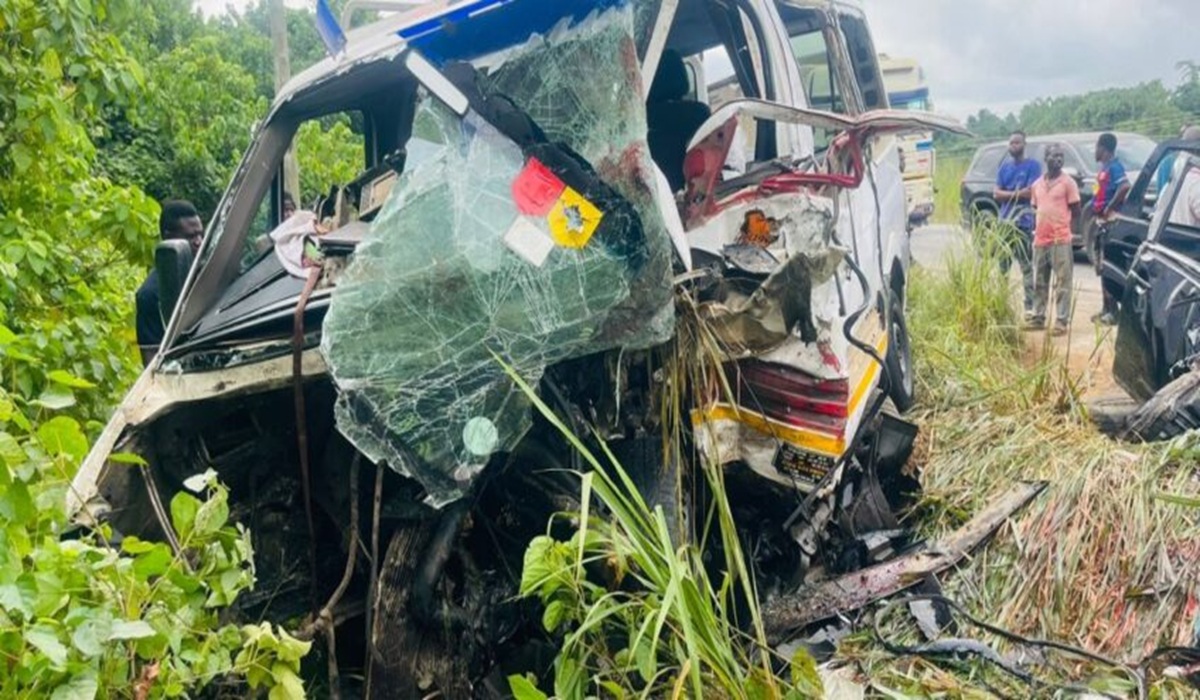
Three people were confirmed dead and 20 others sustained varying degrees of injury following a violent road accident on the Kumasi-Accra Highway on Sunday, May 10, 2026. The collision occurred near the Rider Iron and Steel Company at Odumasi-Ohene Nkwanta, a stretch known for high-speed transit between Ghana’s two largest cities.
The crash involved a Mitsubishi Outlander, reportedly driven by Richmond Kuman, and a Mercedes-Benz Sprinter bus. While the driver of the Outlander has been identified, the identity of the Sprinter driver remains unknown as authorities continue their sweep of the area. Emergency responders worked quickly to extricate victims from the wreckage, but three male passengers were pronounced dead at the scene.
Medical teams have since distributed the 20 injured survivors across several facilities, including Hope Care Hospital, Asante Akim Central Municipal Hospital, and RIS Hospital. As doctors work to stabilize the victims, the Motor Traffic and Transport Department (MTTD) of the Ghana Police Service has launched a full investigation to determine the exact cause of the tragedy.
What were the vehicles involved in the Odumasi-Ohene Nkwanta crash?
The accident involved a Mitsubishi Outlander with the registration number DV G8180 and a Mercedes-Benz Sprinter commercial bus with the registration number GE 6024-22. Initial reports suggest the vehicles collided near the industrial zone of Odumasi-Ohene Nkwanta, resulting in significant structural damage to both.
The Mitsubishi Outlander, bearing a “DV” (Dealer Vehicle) plate, was driven by Richmond Kuman at the time of the incident. The Benz Sprinter, which is a common mode of inter-city transport in Ghana, was carrying a large number of passengers, which explains the high number of injuries reported during the rescue operation.
The impact was severe enough to require specialized equipment to retrieve the deceased and assist those trapped. The MTTD is currently examining the tire marks and vehicle positions to understand if mechanical failure or human error—such as an unsafe overtaking maneuver—played a role in the collision.
Where were the injured victims taken for medical treatment?
The 20 injured survivors were transported to three primary medical facilities: Hope Care Hospital, the Asante Akim Central Municipal Hospital, and RIS Hospital. These facilities were placed on high alert to handle the influx of trauma patients, ranging from those with minor lacerations to victims requiring intensive care.
By spreading the victims across multiple hospitals, emergency services prevented any single facility from becoming overwhelmed. This allowed for faster triage and specialized attention for those with life-threatening injuries. Relatives of those traveling along the Kumasi-Accra route on Sunday have been urged to contact these hospitals for information on their loved ones.
As of Tuesday, May 12, several of the injured remain under close observation, while others have been treated and discharged. The cost of medical care for such road traffic accidents often falls under the National Health Insurance Scheme (NHIS), though the severity of some injuries may require specialized private interventions.
What is the current status of the police investigation?
The Motor Traffic and Transport Department (MTTD) has taken custody of the three deceased male victims and is conducting a thorough investigation into the crash’s circumstances. The primary focus is currently on identifying the driver of the Benz Sprinter and gathering witness statements from the surviving passengers.
Road safety experts often cite the Odumasi-Ohene Nkwanta stretch as a critical point on the Kumasi-Accra Highway due to its proximity to industrial sites and frequent heavy-duty truck movement. The police are investigating whether speed was a factor, especially given the “DV” status of the Mitsubishi involved.
Formal reports and a final docket will be prepared once all survivors are fit enough to provide statements. The Ghana Police Service continues to remind motorists to adhere to speed limits and exercise caution, particularly during the transition between the Ashanti and Eastern Regions, where traffic density is highest.
Factual Insights into Ghana Road Safety:
- High-Risk Zones: The Kumasi-Accra Highway is statistically the most dangerous road in Ghana, accounting for a significant percentage of annual road fatalities.
- Vehicle Type: Benz Sprinter buses are involved in a high number of road accidents in Ghana, often attributed to overspeeding and overloading.
- Response Time: Emergency response teams arrived at the Odumasi-Ohene Nkwanta scene within minutes, a critical factor in saving the 20 survivors.
- Fatality Demographics: In this specific incident, all three deceased victims were male, reflecting a broader trend where men are statistically more likely to die in road crashes.
- Registration Nuance: Vehicles with “DV” plates are often newer or being moved for sale, requiring specific insurance and speed regulations under Ghanaian law.
- Inter-Region Transit: Odumasi-Ohene Nkwanta sits in a strategic transit corridor between the Ashanti and Eastern Regions.
How can travelers stay safe on the Kumasi-Accra Highway?
To stay safe, passengers are encouraged to speak out against overspeeding and ensure they are wearing seatbelts, even in commercial vehicles like Sprinters. Drivers should avoid long-distance trips without adequate rest and must strictly obey the 100km/h speed limit set for most stretches of the highway.
The Ghana National Road Safety Authority (NRSA) frequently carries out “Stop and Educate” campaigns along this route. However, the ultimate responsibility lies with the drivers. Checking tire pressure and brake functionality before a trip from Accra to Kumasi can be the difference between a safe arrival and a tragic headline.
If you find yourself in a vehicle where the driver is behaving recklessly, do not hesitate to ask them to slow down or report the vehicle number to the police at the next checkpoint. Public pressure is often one of the most effective tools for curbing the culture of speed on Ghana’s major highways.
The loss of three lives at Odumasi-Ohene Nkwanta is a somber reminder of the dangers that still exist on Ghana’s most vital transport artery. While the 20 survivors continue their recovery, the nation mourns the victims and awaits the final results of the police investigation.
Infrastructure improvements, such as the proposed Accra-Kumasi Expressway, may eventually reduce such tragedies, but for now, safety remains a matter of human discipline. As the Mitsubishi and Sprinter wreckage is cleared, the goal for every Ghanaian motorist should be ensuring that no more families have to receive such devastating news.
Also Read: Dual Corridor Development: How the Accra-Kumasi Expressway Complements the Existing Highway