By Collins Sarkodieh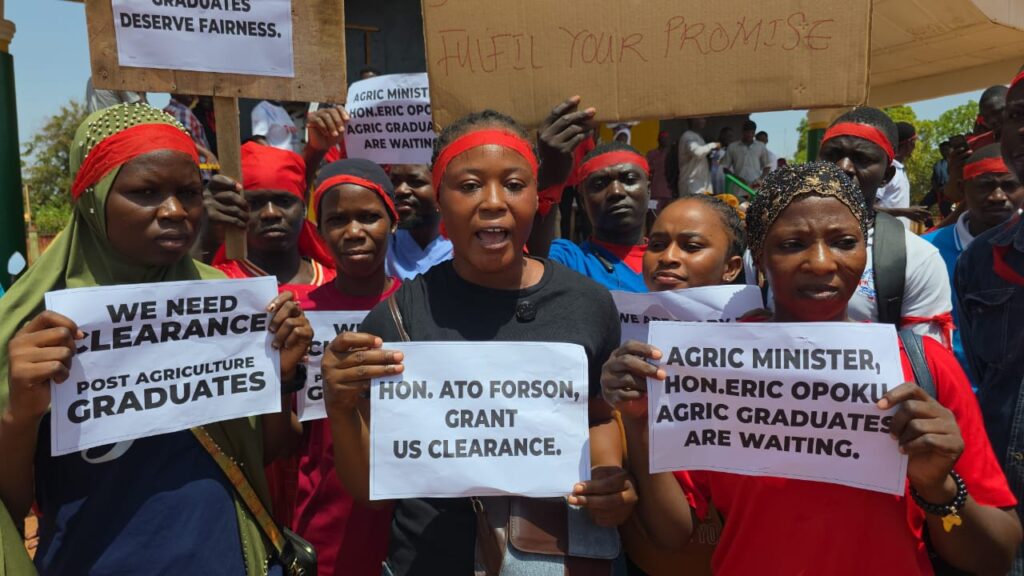
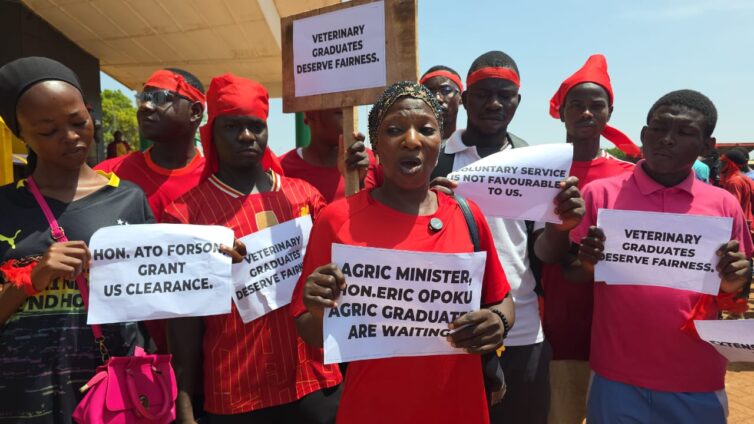
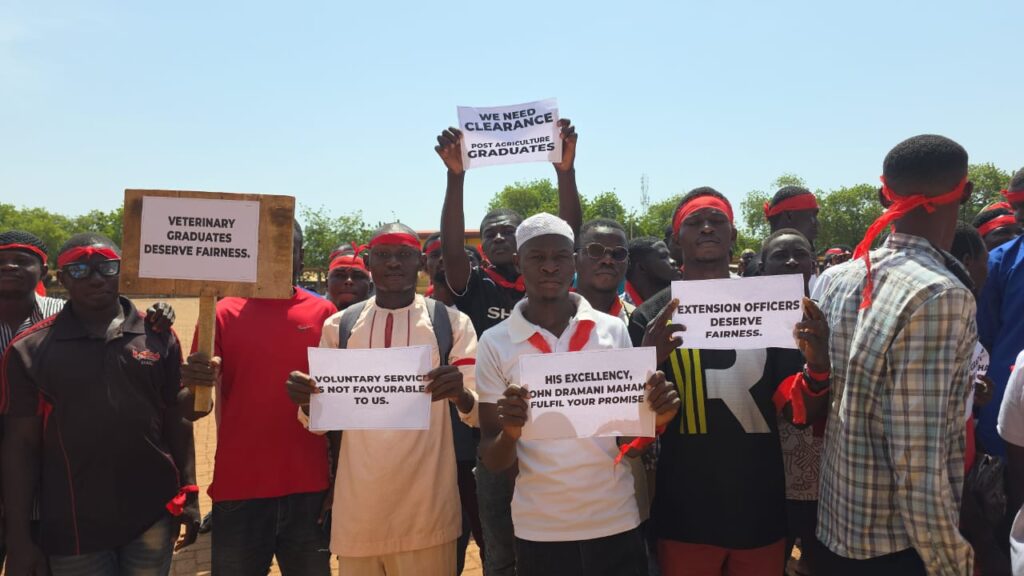
The Coalition of Unemployed Agricultural Graduates is urging the Ghanaian government to grant immediate financial clearance for the recruitment of over 5,000 trained professionals into the civil service. These graduates, specializing in veterinary science, agronomy, and agricultural economics, argue that their continued unemployment is severely weakening the nation’s extension and veterinary services.
Despite completing rigorous training at Ghana’s six public agricultural colleges, many of these skilled officers have remained jobless for up to seven years. The delay in recruitment persists even as the Ministry of Food and Agriculture (MoFA) faces a critical shortage of field officers, which is essential for supporting local farmers and ensuring food security.
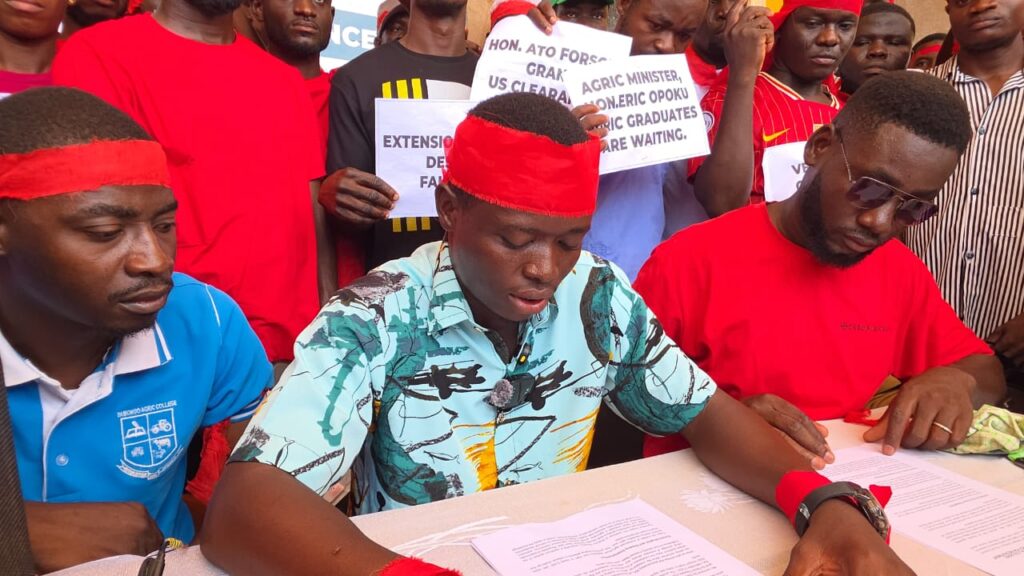
Coalition Secretary Mohammed Abubakari Sadik has called on President John Dramani Mahama and the Ministers of Agriculture and Finance to transition from temporary voluntary models to permanent employment. The group believes that the success of the Agricultural Transformation Agenda depends entirely on the deployment of these qualified experts to the field.
Why is there a backlog of 5,000 unemployed agricultural graduates?
The backlog exists because of a multi-year delay in granting financial clearance for permanent recruitment, combined with a reliance on temporary service models like the Feed Ghana Programme. While the government previously pledged to recruit 1,100 officers in 2022, only about half of that number has been successfully deployed, leaving thousands in a state of professional limbo.
Graduates from institutions such as the Animal Health and Production College in Pong-Tamale and the Kwadaso College of Agriculture find themselves caught between economic constraints and systemic bottlenecks. The International Monetary Fund (IMF) programme has imposed strict fiscal limits on public sector hiring, which the coalition argues has unfairly targeted the agricultural sector compared to health and education.
Furthermore, the Feed Ghana Programme, intended as a stop-gap measure, has faced significant implementation hurdles. Delays in allowance payments and the lack of official National Service Scheme (NSS) PIN codes for some participants have made the voluntary model unsustainable for graduates who need stable incomes to support their livelihoods.
How does the lack of extension officers affect Ghana’s food security?
The shortage of agricultural extension and veterinary officers directly hinders the transfer of modern farming techniques to rural farmers, leading to lower crop yields and higher risks of livestock disease. Extension officers act as the primary bridge between agricultural research and practical farming, and their absence leaves smallholder farmers without the expert guidance needed to scale production.
Without adequate staffing, government initiatives like the Agricultural Transformation Agenda struggle to gain traction on the ground. When specialized veterinary officers remain unemployed, the country’s ability to monitor and control zoonotic diseases is compromised, potentially affecting both animal health and public safety.
The coalition argues that “passion and skill” are being wasted in urban centers while rural farms suffer from a lack of technical support. For a country aiming for food self-sufficiency, leaving 5,000 “boots on the ground” in a state of unemployment is an economic paradox that requires urgent correction.
What are the primary challenges with the Feed Ghana Programme?
Graduates have cited several structural failures in the Feed Ghana Programme, including a three-month delay in allowance payments and a manual reporting system that requires physical travel to Accra. Additionally, some ministry offices have reportedly rejected posted personnel because of a lack of formal communication from the central government.
The requirement for physical report submissions is particularly criticized as being out of touch with modern digital standards. Graduates are often forced to spend a significant portion of their meager allowances on transportation to the capital just to hand in monthly paperwork, a process that could easily be handled through a digital portal.
This manual approach, combined with the absence of official NSS PIN codes for some graduates, has created an environment of frustration. The coalition maintains that while they initially supported voluntary arrangements during difficult economic times, the current model is broken and requires a transition to the “permanent employment” status enjoyed by teachers and health workers.
Factual Insights into Ghana’s Agricultural Workforce:
- Training Hubs: Ghana relies on six main public colleges for its agricultural workforce, including Ohawu, Ejura, and Wenchi Colleges of Agriculture.
- Recruitment Gap: While 1,100 officers were promised in 2021, a 50% deficit in actual postings remains as of early 2026.
- Extension Ratio: The FAO recommends an extension-to-farmer ratio of 1:500, but Ghana’s current ratio is estimated to be significantly wider, often exceeding 1:2,000 in remote areas.
- IMF Impact: Fiscal consolidation under Ghana’s IMF programme often requires “financial clearance” from the Ministry of Finance before any public sector hiring can occur.
- Veterinary Risks: Unemployed veterinary officers increase the response time to livestock outbreaks, which can impact the GH¢2.1 billion poultry industry.
- Sector Contribution: Agriculture contributes roughly 20% to Ghana’s GDP, yet the sector often sees slower recruitment cycles than the service sector.
What is the coalition’s “Recruitment Equality” demand?
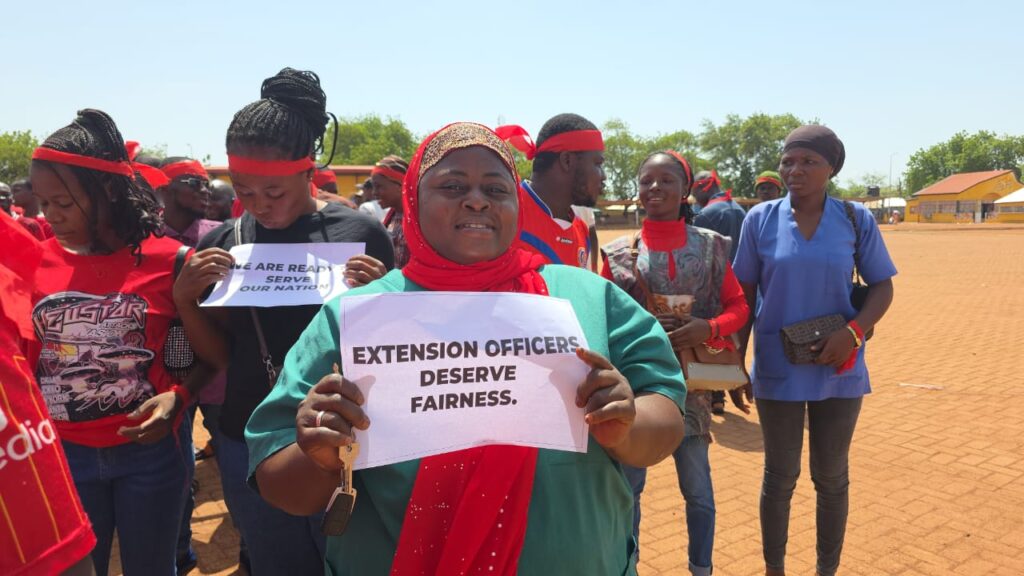
The coalition is demanding that the government adopt a recruitment model similar to those used in the education and health sectors, where graduates are posted almost immediately upon completion of their national service. They argue that agricultural graduates deserve “fair and equitable treatment” as essential service providers.
Also Read: How Agriculture Boosts Ghana’s Economy
Mohammed Abubakari Sadik emphasized that agronomy, horticulture, and animal science are just as critical to national development as nursing or teaching. The group believes that the “voluntary” label attached to agricultural service is a form of professional discrimination that devalues the complex technical training they underwent.
By calling for an automated, digital-first recruitment process, the coalition hopes to remove the “who you know” element from the hiring cycle. A transparent system would ensure that those who have been waiting for seven years are prioritized over fresh graduates, clearing the backlog systematically.
How can the government solve this agricultural employment crisis?
The immediate solution is for the Ministry of Finance, led by Dr. Cassiel Ato Forson, to grant financial clearance for the total backlog of 5,000 graduates. This would allow Minister for Food and Agriculture Eric Opoku to formally integrate these officers into the ministry’s payroll and deploy them to districts with the highest staffing deficits.
Beyond funding, the government needs to modernize its administrative protocols. Replacing physical reporting in Accra with a digital reporting system would immediately alleviate the financial burden on posted officers and improve the efficiency of data collection for the Ministry.
Finally, a long-term strategy must be developed to ensure that the “Feed Ghana” arrangements are truly a gateway to permanent roles. If the government can prove that a year of voluntary service leads directly to a secure job, it will restore the confidence of thousands of young Ghanaians currently pursuing agricultural degrees.
The Need for Urgent Action in the 2026 Budget
The plight of the 5,000 unemployed agricultural graduates is a significant bottleneck in Ghana’s path toward an “Agricultural Transformation.” As the government navigates its fiscal responsibilities, it must recognize that the cost of hiring these officers is an investment in the nation’s food security and rural economy.
With 2,303 centers of agriculture and thousands of farms needing expert help, the human resource is ready; only the “financial clearance” is missing. The coalition’s appeal to President Mahama and his ministers is a final call for the state to treat its agricultural experts with the respect and urgency their profession demands.
Also Read: Why NAFCO Needs GH¢770 Million to Save Ghana’s Surplus Rice Harvest