

 By Collins Sarkodieh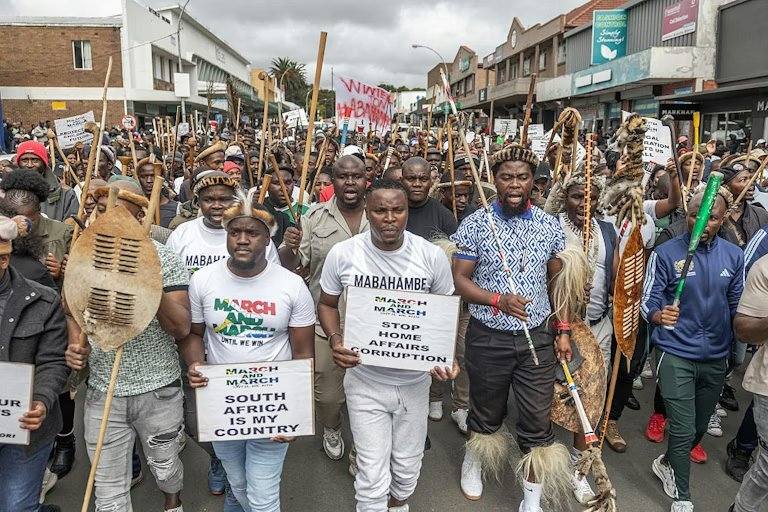
South Africa’s government has officially condemned the viral circulation of what it labels “fake videos and images” depicting alleged xenophobic attacks on foreign nationals. Minister in the Presidency Khumbudzo Ntshavheni clarified that while citizens are protesting against the illegal immigration crisis, there is no evidence of state-sanctioned or widespread violence against foreigners as suggested by some social media clips.
The government maintains that these digital recordings are being weaponized to tarnish South Africa’s international reputation and its “Better Africa” diplomatic agenda. While tensions have undoubtedly spiked, leading to diplomatic friction with nations like Ghana and Nigeria, South African officials argue that isolated incidents of harassment are being misrepresented as systemic xenophobic purges.
This diplomatic standoff comes at a time when the African Union (AU) is being pressured to intervene. As the continent watches closely, the distinction between legitimate protests against undocumented immigration and criminal xenophobic violence has become the central point of contention for President Cyril Ramaphosa’s administration.
Why is the South African government calling these videos “fake”?
Minister Khumbudzo Ntshavheni stated that many of the videos circulating online are either old, taken out of context, or completely fabricated to incite panic. The government believes these visuals are intended to undermine the country’s pursuit of continental unity and suggest a level of chaos that does not reflect the current reality on the ground.
By labeling the content as “fake,” the government is attempting to regain control of the narrative amidst a month of intense protests. While vigilante groups have been filmed challenging the status of individuals, officials argue that these do not represent a coordinated wave of “deadly attacks” similar to those seen in 2008 or 2015.
The strategy here is twofold: protecting the tourism sector and maintaining South Africa’s leadership role within the AU. If the world believes South Africa has descended into xenophobic warfare, the economic and political consequences would be catastrophic for the region’s largest economy.
What sparked the current diplomatic tension with Ghana and Nigeria?
The tension was ignited by several specific video clips that surfaced over a fortnight ago, including one where a Ghanaian national was reportedly harassed and told to “fix his country.” This led the Ghanaian government to write a formal letter to the African Union, describing the situation as a “serious risk to the safety and well-being” of Africans in South Africa.
Nigeria followed suit, offering to repatriate its citizens who feel unsafe, while Kenya, Malawi, Lesotho, and Zimbabwe issued official warnings to their nationals. These countries view the harassment not as “isolated criminality” but as a systemic failure to protect non-nationals under the principles of African solidarity and brotherhood.
South Africa’s response has been one of defensive transparency, claiming they have “nothing to hide.” However, the demand from Ghana for an AU fact-finding mission indicates a deep-seated lack of trust in South Africa’s internal reporting of these incidents.
Are South Africans within their rights to protest against illegal immigration?
Yes, the South African government has affirmed that citizens are within their constitutional rights to protest against what they call the “spiraling illegal immigration challenge.” Minister Ntshavheni noted that the grievances regarding the impact of undocumented migrants on jobs, housing, and crime are legitimate topics for public demonstration.
The current wave of protests has focused on demanding the mass deportation of undocumented foreign nationals. Unlike previous years, these demonstrations have been largely peaceful, with no official reports of widespread looting or physical violence against migrants.
However, the thin line between “peaceful protest” and “harassment” is where the controversy lies. While the state recognizes the right to march, it has condemned the actions of vigilante groups who take the law into their own hands by conducting “status checks” on the streets, which often escalates into verbal or physical abuse.
How does the African Union view the “solidarity” crisis?
The African Union is being asked to weigh in on whether South Africa’s current anti-immigrant sentiment violates the shared principles of continental unity. Ghana’s letter to the AU specifically highlights that the perceived xenophobia presents a challenge to “African solidarity” and the vision of a borderless, unified continent.
The AU has traditionally been slow to criticize South Africa, given its role as a major financial and political pillar of the organization. However, the collective pressure from multiple member states makes it harder for the continental body to ignore the requests for a fact-finding mission.
The situation creates a paradox for the AU: how to balance a member state’s right to enforce its immigration laws with the overarching goal of “Pan-Africanism.” If South Africa is seen as hostile to other Africans, the AfCFTA and other unity projects could face significant friction.
Is South Africa truly “xenophobic” or just dealing with criminality?
President Cyril Ramaphosa’s administration firmly rejects the “xenophobic” label, characterizing the country as warm and welcoming. Officials argue that when foreigners are victims of crime, it is a result of South Africa’s high general crime rate rather than a targeted campaign of hate against non-nationals.
Minister Ntshavheni echoed this, stating that there are “no xenophobic attacks” currently happening. This distinction is crucial for the government’s legal and diplomatic defense. If the violence is categorized as “general criminality,” it remains a domestic policing issue. If it is labeled “xenophobia,” it becomes a human rights violation subject to international scrutiny.
Critics, however, argue that this is a semantic dodge. They point out that when a victim is specifically targeted because of their nationality as seen in the “fix your country” video it moves beyond “general crime” and into the territory of hate-motivated violence.
Factual Insights into South Africa’s Immigration and Social Landscape:
- Population Statistics: South Africa is home to an estimated 3.9 million migrants, making it one of the largest host countries in Africa (Statista, 2024).
- Historical Context: Major xenophobic outbreaks occurred in 2008 (62 deaths) and 2015 (7 deaths), setting a high bar for what the government considers a “crisis.”
- Economic Drivers: South Africa’s unemployment rate remains one of the highest in the world, hovering around 32%, which often fuels resentment toward perceived competition from migrants (StatsSA, 2026).
- Digital Disinformation: The World Economic Forum identifies “misinformation and disinformation” as the top global risk, which aligns with the SA government’s claims about viral fake videos.
- Repatriation Offers: Nigeria has a history of “Air Peace” evacuations, having repatriated hundreds of citizens during previous South African unrest.
- Constitutional Rights: Chapter 2 of the South African Constitution guarantees the right to peaceful assembly and protest, regardless of the topic.
- Diplomatic Pressure: Ghana’s request for a fact-finding mission is a rare and significant diplomatic escalation within the AU framework.
How is the government attempting to quell continental concerns?
South Africa has stepped up its diplomatic “charm offensive” to reassure its neighbors. Presidential spokespeople and ministers are holding briefings specifically for the international press to emphasize the country’s commitment to Pan-Africanism and the “Better Africa” agenda.
The government is also engaging with the embassies of the affected nations. The goal is to provide a counter-narrative to the social media frenzy by showing that the police are actively monitoring protests and that the state is not endorsing vigilante behavior.
Despite these efforts, the “fake video” defense is a risky one. If a single verified video of violence emerges, it could invalidate the government’s entire claim of “isolated criminality” and leave them looking like they were attempting a cover-up.
What is the “Better Africa” agenda and why does it matter?
The “Better Africa” agenda is a cornerstone of South African foreign policy, focusing on peace, security, and economic development across the continent. It positions South Africa as a benevolent leader that invests in other African nations and hosts their citizens.
When allegations of xenophobia arise, they strike at the heart of this agenda. It makes South Africa look like a hypocrite preaching unity on the global stage while its citizens demand mass deportations at home. This disconnect makes it difficult for South Africa to secure support for its candidates in international organizations like the UN Security Council.
For the South African government, proving that the current unrest is not “xenophobic” is essential for maintaining its moral authority in Africa. Without that authority, its ability to mediate conflicts in places like the DRC or Sudan is significantly diminished.
Also Read: Ghana Relocates Citizen After Xenophobic Attack in South Africa: The Story of Emmanuel Asamoah
Can the police distinguish between protest and vigilante harassment?
The police are under immense pressure to maintain order without infringing on the right to protest. Minister Ntshavheni stated that while violence is unacceptable, the “spiraling illegal immigration challenge” justifies the demonstrations. The challenge for the South African Police Service (SAPS) is intervening before a verbal “status check” turns into a physical assault.
Vigilante groups often operate in the shadows of larger, legal protests. By the time police arrive at a scene shown in a viral video, the perpetrators have often vanished. This makes it difficult for the state to provide “official reports” of violence, even when evidence of harassment is clearly visible to the public via social media.
The state’s reliance on “official reports” to deny xenophobia is a point of contention for human rights groups. They argue that many victims are too afraid of their own undocumented status to report harassment to the police, creating a “data gap” that the government uses to claim the situation is peaceful.
What are the long-term risks of this social media “war”?
The long-term risk is a permanent fracture in African diplomatic relations. If the “fake video” narrative is perceived as a lie by the rest of the continent, South Africa risks becoming a pariah state in the eyes of its neighbors. This could lead to trade retaliations, boycotts of South African companies (like MTN or Shoprite), and the isolation of South African travelers.
Furthermore, the internal pressure on the South African government to “do something” about immigration is not going away. With elections and economic stagnation looming, politicians are often tempted to use immigration as a scapegoat. If the rhetoric doesn’t cool down, the ” largely peaceful” protests of 2026 could easily ignite into the deadly violence of previous years.
Digital literacy is the second major risk. As AI and deepfakes become more sophisticated, distinguishing between a “fake video” and a real human rights violation will become nearly impossible for the average citizen. This creates a fertile ground for bad actors to incite violence for political gain.
The Path Forward for South Africa and Its Neighbors
South Africa finds itself in a delicate balancing act: addressing the legitimate economic frustrations of its citizens while protecting the lives and dignity of the foreign nationals within its borders. While the government is right to caution against the dangers of “fake news” and viral disinformation, it cannot ignore the genuine fear felt by the migrant community.
The diplomatic fallout with Ghana, Nigeria, and others suggests that words alone will not be enough to fix South Africa’s reputation. A transparent, cooperative approach perhaps even welcoming the AU fact-finding mission might be the only way to prove that the country has “nothing to hide.”
As the protests continue, the world will be watching to see if South Africa remains a “welcoming country” or if the “Better Africa” agenda is sacrificed at the altar of domestic populist pressure.
source – bbc