

 By Collins Sarkodieh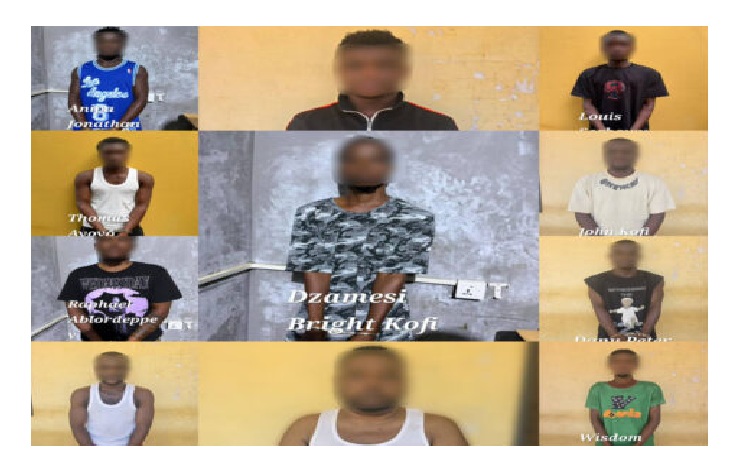
The Ghana Police Service’s Cyber Vetting and Enforcement Team (CVET) recently arrested 11 individuals for using advanced AI deepfake technology to impersonate President John Dramani Mahama. This coordinated sting operation took place between May 1 and May 4, 2026, across multiple locations in the Volta Region, uncovering a sophisticated network of cybercriminals aiming to defraud the public.
The suspects, a mix of Ghanaian and Nigerian nationals, allegedly created high-fidelity, AI-generated videos of the President to solicit money and harvest sensitive personal data from unsuspecting victims. By leveraging “deepfake” technology, which uses artificial intelligence to replace the likeness and voice of one person with another, the group managed to bypass the skepticism of many internet users.
This case marks a significant milestone in Ghana’s fight against digital disinformation and financial fraud. As AI tools become more accessible, the IGP’s Cyber Vetting and Enforcement Team is proving that the state is actively monitoring the digital frontier to protect high-profile personalities and the general public from sophisticated social engineering.
Who was arrested in the IGP’s Cyber Vetting operation?
The police arrested 11 suspects in total, including 32-year-old Raphael Ablordeppey, 23-year-old Anipah Jonathan, and 35-year-old Dzamesi Bright Kofi, among others. The arrests were made in two phases, targeting cells in Sogakope, Dabala, Tongu, Akatsi, and the border town of Aflao.
The first group of five Ghanaians was apprehended following intelligence regarding their role in creating and circulating the fraudulent videos. Shortly after, on May 4, a second operation in Aflao led to the arrest of five Nigerian nationals Bishop Esiri, Wisdom James, Ali Lucky, Edwin Edos, and John Kofi Darlington—alongside one Ghanaian accomplice, Danu Peter.
In a court appearance on Wednesday, May 6, 2026, nine of these suspects were remanded into police custody until May 25. Two younger suspects, Thomas Ayoyo and Louis Segbawu, were granted bail under strict conditions. This diverse group highlights the cross-border nature of modern cybercrime in West Africa.
How did the suspects use AI to impersonate President Mahama?
The suspects utilized AI-generated deepfake content to create realistic videos where “President Mahama” appeared to be endorsing financial schemes or requesting personal information. These digital forgeries were shared across social media platforms to build a false sense of trust and urgency among supporters and the general public.
Preliminary investigations by the CVET team revealed that the goal was purely financial gain. By mimicking the voice, mannerisms, and facial expressions of the President, the fraudsters were able to trick individuals into sending money or revealing passwords and ID details. This type of “Identity-as-a-Service” fraud is becoming a top priority for global intelligence agencies.
The police established that these 11 individuals are not isolated actors but part of a wider network. This network specializes in creating “fraudulent digital contents” specifically designed to impersonate high-profile personalities, ranging from politicians to religious leaders, to exploit their influence for illicit profits.
What evidence was retrieved during the Volta Region raids?
During the coordinated operations, the police retrieved high-end laptop computers, mobile phones, internet routers, and 120 pre-registered SIM cards used to facilitate the scams. Additionally, a Nigerian-registered ML 350 Mercedes-Benz (Lagos LSR 138HR) was seized, which investigators believe was purchased with the proceeds of their fraudulent activities.
The presence of 120 pre-registered SIM cards is a major red flag for investigators. These cards allow criminals to create multiple “anonymous” social media and mobile money accounts, making it harder for traditional tracking methods to pinpoint their location or identity.
By analyzing the data found on the seized laptops, the CVET team hopes to trace the origin of the AI models used. This forensic trail is essential for dismantling the larger “content factory” that provides these deepfake templates to low-level scammers across the sub-region.
Factual Insights into Deepfakes and Cyber Enforcement:
- Technology Growth: The World Economic Forum identifies “AI-generated misinformation” as the top global risk for 2024–2026.
- The 120 SIM Rule: Ghana’s National Communications Authority (NCA) has been aggressively pushing for SIM re-registration to stop exactly the kind of fraud witnessed in this case.
- Deepfake Speed: Current AI tools can generate a realistic video from just 60 seconds of reference audio and a single high-resolution image.
- Regional Cooperation: This arrest involved the collaboration between Ghanaian intelligence and cross-border tracking of Nigerian nationals in Aflao.
- Legal Precedent: Under Ghana’s Cybersecurity Act, 2020 (Act 1038), impersonation and the dissemination of false information carry significant prison sentences and fines.
- Cyber Vetting Success: The CVET was specifically established to proactively monitor social media for “high-harm” digital content before it goes viral.
- Vulnerability: Statista reports that over 40% of internet users struggle to distinguish between a real video and a high-quality deepfake.
Why are deepfakes a threat to national security?
Deepfakes pose a national security threat because they can be used to incite social unrest, manipulate elections, or destroy the reputation of national leaders in seconds. If a deepfake video of a President “declaring an emergency” or “insulting an ethnic group” goes viral, the real-world consequences can be violent and immediate.
In this instance, the threat was centered on financial stability and public trust. When people lose money to a “President” in a video, they lose faith in both the political office and the digital platforms themselves. This erosion of trust is exactly what cyber-vetting teams are designed to prevent.
The IGP’s team is now treating digital impersonation with the same severity as physical assassination attempts on a leader’s character. By arresting these individuals, the Ghana Police Service is sending a clear message: the digital space is no longer a lawless vacuum where “untraceable” AI can be used to hide criminal intent.
Also Read: Impersonation Scandal: Suspects Arrested for Posing as Ghana Immigration Service Officers
How can the public identify a deepfake video?
The public can identify deepfakes by looking for “glitches” in the video, such as unnatural blinking, blurred edges around the mouth, or a metallic, robotic tone in the voice. Often, the lighting on the face doesn’t match the background, or the movements appear slightly jerky when the person turns their head.
Another key “tell” is the source of the video. If a high-profile personality is making an unusual request—like asking for money or private ID numbers it is almost certainly a scam. Official announcements from the President of Ghana are always shared through verified government channels and major news outlets, never through random direct messages or unverified TikTok accounts.
The Ghana Police Service encourages citizens to “verify before you share.” If a video looks suspicious, it should be reported to the CVET or the National Cybersecurity Authority rather than being forwarded to friends and family, which only helps the scammers’ reach.
What are the next steps for the 11 suspects?
The nine remanded suspects are scheduled to reappear in court on May 25, 2026, while the police continue their “cyber field tracking” to find the masterminds behind the network. The two suspects on bail, Thomas Ayoyo and Louis Segbawu, remain under police surveillance as the investigation widens.
The prosecution is currently compiling a comprehensive digital evidence folder, which will include the metadata from the seized laptops and the transaction records from the pre-registered SIM cards. This data is expected to lead to further arrests in neighboring regions and potentially across the border in Nigeria.
This case serves as a landmark “test case” for Ghana’s cybersecurity laws. A successful prosecution will set a precedent that will discourage other “tech-savvy” criminals from using AI to target national figures. As the IGP’s team continues its work, the focus remains on ensuring that the 2026 political landscape remains untainted by AI-driven fraud.
Also Read: Five Men Arrested for Posing as National Security Agents and Robbing Mining Site