

 By Collins Sarkodieh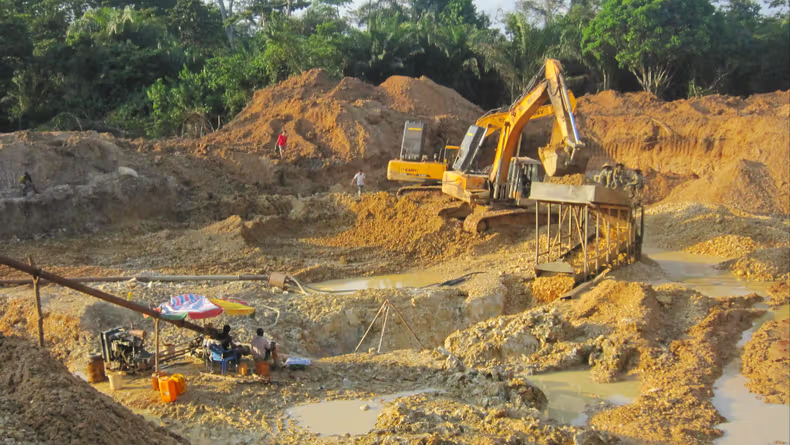
Ghana has officially set a December 2026 deadline for major foreign mining firms, including Newmont, AngloGold Ashanti, and Zijin Mining, to transition their primary operations to local contractors. This directive is part of a strategic national push to increase indigenous participation in the lucrative gold sector and ensure that a larger share of mineral wealth remains within the Ghanaian economy.
Under the new regulatory framework introduced by the Minerals Commission, surface mining operations must be conducted exclusively by companies 100% owned by Ghanaian citizens. For underground mining, foreign firms are required to ensure at least 50% local ownership in their contracting partnerships. While many international operators have already adapted to this contract-mining model, the remaining “Big Three” have been given until the end of 2026 to comply or face significant regulatory sanctions.
Why is Ghana forcing foreign miners to use local contractors?
The primary objective is to deepen “local content” and ensure that the expertise and financial benefits of gold extraction are not exported along with the ore. By mandating local contracting, the government aims to stimulate the growth of Ghanaian engineering firms, create high-skilled domestic jobs, and retain more value from Africa’s top gold producer.
This policy shift reflects a broader continental trend where resource-rich nations are tightening their mining codes to reclaim control over natural assets. Governments are no longer satisfied with just royalties and taxes; they want a seat at the operational table. In Ghana, the Minerals Commission believes that after decades of hosting global giants, the domestic private sector is now mature enough to handle complex mining logistics and surface operations.

What are the specific requirements for surface and underground mining?
For surface mining, the law is absolute: the operator must be a 100% Ghanaian-owned entity. In the case of underground mining, the policy allows for more technical collaboration, requiring at least 50% local ownership to account for the higher capital intensity and specialized technology often needed for deep-shaft extraction.
The distinction between surface and underground requirements acknowledges the varying levels of domestic capacity. Surface mining, which involves large-scale earthmoving and pit operations, is a sector where Ghanaian firms like Engineers & Planners have already demonstrated world-class competence. By locking these tiers to local ownership, the state effectively creates a protected market for indigenous businesses, forcing foreign investors to become partners rather than sole operators.
How are Newmont, AngloGold Ashanti, and Zijin Mining responding?
While these firms initially requested more time to transition their internal workforces to a contract-based model, they are now actively preparing tenders and technical frameworks to meet the 2026 deadline. Zijin Mining’s Ghana unit, for instance, has been engaging with authorities since late 2025 to ensure their transition plans align with the new Mineral Commission rules.
For these companies, the shift involves a massive administrative and logistical overhaul. They must move from “owner-miner” status to “contract-manager” status, which changes their liability profiles and operational control. However, the risk of losing their mining leases or facing heavy fines makes compliance the only logical path forward. The regulator has been firm, issuing notices in October and January to emphasize that the December 2026 window is the final extension.
What does the Damang Gold Mine decision tell us about the future?
The recent decision to hand over operations at the Damang gold mine to Ibrahim Mahama’s Engineers & Planners signals that the government is willing to reject lease renewals for foreign firms in favor of local ones. When Gold Fields’ application for a lease renewal was rejected, the Lands Minister, Emmanuel Armah-Kofi Buah, made it clear that only 100% Ghanaian-owned firms would be eligible for that specific asset.
This was a watershed moment for the industry. Historically, long-standing foreign operators could count on renewals as a formality. The Damang case proves that the “Local First” policy is not just a suggestion but a mandatory operational shift. It serves as a stern warning to other foreign players that the state is prepared to “re-indigenize” assets if the transition to local contracting is not handled with the required urgency.
How does Ghana’s mining policy compare to other African nations?
Ghana’s stance mirrors aggressive regulatory updates in countries like Mali, where the government recently resolved a major dispute with Barrick Gold over a new mining code. Across the continent, governments are leveraging high global gold prices to renegotiate terms that favor domestic populations and state-run enterprises.
The era of “Enclave Mining,” where foreign companies operated in isolation from the local economy, is effectively ending. African nations are now using their status as top producers to demand technology transfers and local equity. Ghana, as the leader in gold production on the continent, is setting the pace, showing that it is possible to maintain foreign investment while strictly enforcing indigenous ownership of the operational chain.
What are the factual insights driving this policy change?
To understand the scale of this transition, one must look at the economic data and the strategic milestones achieved by the Minerals Commission over the last 24 months.
- Top Producer Status: Ghana remains Africa’s largest gold producer, consistently outperforming South Africa in total yearly output.
- Economic Retention: Statistics suggest that local contracting can increase the percentage of mining revenue retained in the country from 15% to over 35%.
- Ownership Tier: The “100% Ghanaian ownership” rule for surface mining is one of the strictest local content laws in the global mining industry.
- Transition Period: The current deadline of December 2026 follows nearly two years of dialogue and preliminary “soft” enforcement started in January 2025.
- Zijin Engagement: Zijin Mining has officially entered the “tendering phase” for local partners to meet the technical frameworks required by the state.
- Damang Precedent: The Damang mine is currently the largest asset to be fully transitioned from foreign management to a 100% Ghanaian-owned contractor.
What are the risks of a rapid shift to local contractors?
The primary risk involves a potential temporary dip in production efficiency if local contractors struggle with the scale or capital requirements of the “Big Three” sites. There are also concerns about “fronting,” where a company appears to be 100% Ghanaian-owned but is secretly controlled or funded by foreign interests to bypass the law.
To combat this, the Minerals Commission has introduced rigorous auditing processes and beneficial ownership transparency requirements. Logic suggests that for the policy to succeed, the government must also ensure that local firms have access to affordable credit and equipment financing. If the local contractors are well-supported, the transition will be a net positive; if they are undercapitalized, the industry could face “growing pains” that might impact national tax revenue in the short term.
Also Read: Engineers and Planners Wins Damang Mining Lease in $500 Million Battle
How will this reshape the Ghanaian mining landscape by 2027?
By 2027, the “landscape” will likely be dominated by a hybrid model where foreign firms provide the capital and global marketing, while Ghanaian firms provide the labor, equipment, and on-site management. This creates a more integrated economic ecosystem where the mining sector is no longer an “island” but a driver for domestic industrial growth.
The “Big Three” Newmont, AngloGold, and Zijin will essentially become the “Anchor Investors” rather than the “Sole Operators.” This allows them to de-risk their operations from local labor disputes while fulfilling their Environmental, Social, and Governance (ESG) goals by supporting host-country businesses. For Ghana, it means the birth of a new class of “Mining Millionaires” and a more resilient, locally-anchored financial system.
Why is Ibrahim Mahama’s Engineers & Planners a key player?
Engineers & Planners (E&P) has become the “poster child” for the success of this policy after successfully taking over the Damang mine. As a firm led by a prominent Ghanaian businessman, E&P proves that domestic companies can manage the heavy-duty logistics and engineering required for world-class mining operations.
Their success at Damang provides the “proof of concept” that the Minerals Commission needs to push back against skeptics. It shows that Ghanaian firms can meet the rigorous safety and productivity standards expected by the international market. As more assets transition to local hands, E&P and similar firms will likely become the primary partners for any foreign entity looking to enter the Ghanaian gold sector in the future.
What should investors look for in the December 2026 deadline?
Investors should monitor the “Compliance Progress Reports” issued by the Minerals Commission throughout 2025 and 2026. Any sign of non-compliance by major firms could lead to stock volatility or “Force Majeure” declarations, although the current cooperative tone of the firms suggests a smooth transition is more likely.
The 2026 deadline is not just a date; it is a test of Ghana’s “Regulatory Will.” If the government stays firm on its sanctions, it will solidify the country’s reputation as a sovereign power that prioritizes its citizens. If it wavers, the policy may lose its teeth. However, given the current political climate and the “Damang Precedent,” all signs point toward a strict enforcement of the December deadline.
The shift toward indigenous control of the mining sector is a bold move that redefines the relationship between global capital and national resources. Ghana is proving that being a “Top Producer” is not enough; one must also be a “Top Owner.”
As December 2026 approaches, the world will be watching to see if this model of “Resource Nationalism” can provide a blueprint for other African nations. For the people of Ghana, the goal is clear: a mining industry that doesn’t just extract gold from the ground, but injects prosperity into every corner of the nation.
Also Read: Nzema Communities Protest Adamus Mining, Issuing Urgent Plea to Lands Minister
Do you believe that forcing foreign miners to hand over operations to local contractors will truly benefit the average Ghanaian worker, or will the wealth simply shift from foreign elites to local elites?