

 By Collins Sarkodieh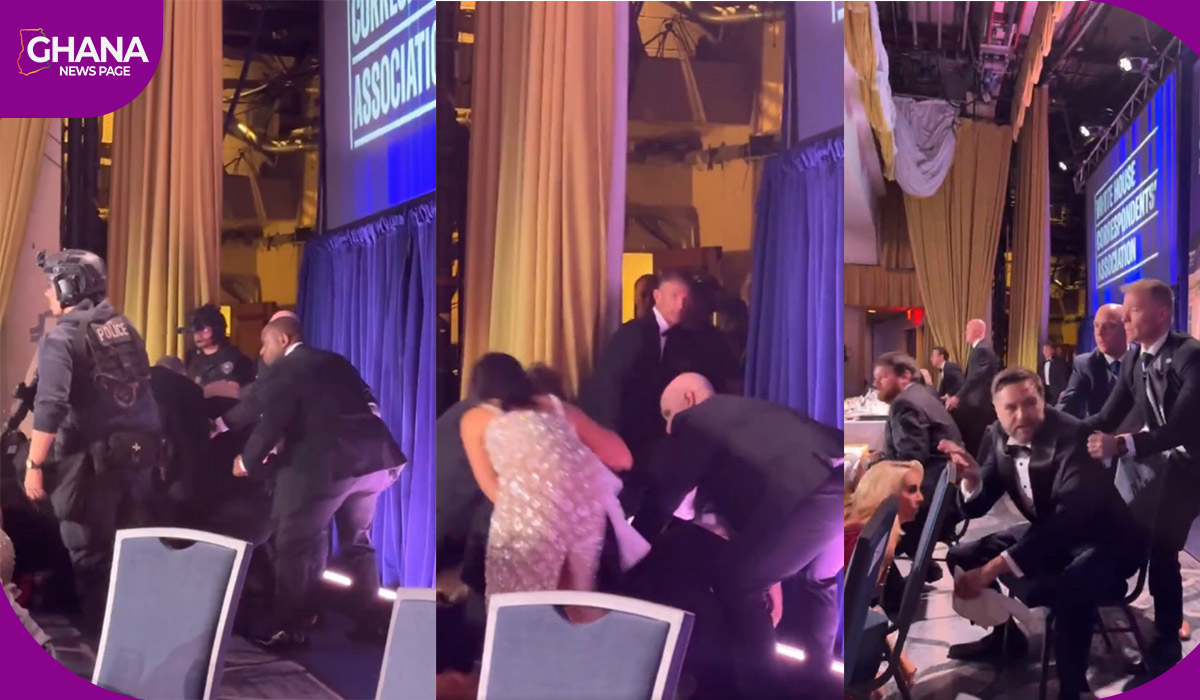
Vice President JD Vance was abruptly escorted out of the Washington Hilton by the Secret Service, followed immediately by agents forming a protective ring around President Donald Trump during a security disturbance at the White House Correspondents’ Dinner (WHCD). The incident occurred mid-event on Saturday night, leading to a temporary lockdown of the ballroom and a surge in global concerns regarding executive safety.
The White House Correspondents’ Dinner is typically a night of lighthearted roasts and journalistic celebration, but the 2026 gala will be remembered for a chilling security breach. While the specifics of the threat remain under investigation by federal authorities, the swift and coordinated response by the Secret Service was visible to the hundreds of journalists, celebrities, and politicians in attendance. Security protocols for the President and Vice President are designed for immediate “evacuation and cover” during any unverified perimeter breach or internal disturbance, and those protocols were executed with precision as the room fell silent in shock.
Why was JD Vance escorted out of the WHCD by the Secret Service?
Vice President JD Vance was moved to a secure, undisclosed location as a precautionary measure following an unidentified security “incident” near the main dais. This “split-evacuation” strategy is standard protocol to ensure that the two highest-ranking members of the executive branch are not compromised simultaneously in a single location.
In high-threat environments, the Secret Service operates on a “zero-margin-for-error” logic. If a threat is detected, the primary goal is to separate the President and Vice President to maintain the continuity of government. Witnesses noted that Vance was calm as he was led through a side exit, while agents simultaneously reinforced the perimeter around President Trump. This maneuver suggests that while the threat may not have been directed at a specific individual, the proximity was close enough to trigger a “Tier 1” extraction sequence.
How did the Secret Service react to protect President Trump?
Agents immediately surrounded President Trump, forming a human shield known as a “protective circle” while assessing whether to evacuate him or secure the room. Unlike the Vice President’s immediate exit, Trump remained at the head table for several minutes under heavy guard before he was eventually moved to a fortified area within the Hilton.
The optics of the event shifted instantly from a tuxedo-clad gala to a high-stakes security operation. Logic dictates that when an incident occurs in a crowded ballroom, moving the President through a narrow exit can sometimes be more dangerous than securing him in place, depending on the nature of the threat. The Secret Service uses “advanced surveillance and tactical communication” to decide in milliseconds whether the President is safer in a “hardened” room or in a moving armored motorcade. On this night, they chose a layered defense that kept the President on-site but inaccessible.
What was the cause of the security incident at the 2026 Dinner?
While the Secret Service has yet to release a full forensic report, preliminary reports suggest the disturbance was caused by an unauthorized individual attempting to bypass the secondary security screening near the VIP entrance. This triggered a silent alarm that alerted the Presidential Protective Division (PPD) to initiate emergency extraction procedures.
Washington D.C. events of this scale involve multiple layers of security, including magnetometers, K-9 units, and plainclothes agents. Any breach of the inner perimeter, whether by an armed individual or a protester with an unknown object, is treated as a lethal threat until proven otherwise. The “Better Safe Than Sorry” approach is the reason for the dramatic reaction seen on the live broadcast. In a polarized political climate, the Secret Service does not wait for a visual of a weapon before acting; they respond to the “violation of space” itself.
What is the protocol for the White House Correspondents’ Dinner security?
The WHCD is designated as a National Special Security Event (NSSE), which puts the Secret Service in charge of all security planning, often months in advance. This includes air space restrictions, background checks for every waiter and guest, and the presence of a “Counter Assault Team” (CAT) nearby.
The logic behind such heavy security is that the event gathers the entire executive branch, the diplomatic corps, and the nation’s most influential media figures in one room. This makes it a “high-value target.” Protocols include “Safe Room” identification and “Extraction Routes” that are rehearsed multiple times. The fact that JD Vance and Donald Trump were handled differently shows that the Secret Service had a pre-planned “Split-Ex” (Split Extraction) order ready for use, ensuring that at least one leader is always mobile and secure.
Factual Insights on Presidential Security and the WHCD:
- Security Designation: The WHCD is one of the few private events that can be elevated to a National Special Security Event status due to the presence of the President.
- Continuity of Government: Protocols are designed to ensure the President and Vice President are never in a position where both could be incapacitated.
- The “safe” room: The Washington Hilton, often called the “Hinckley Hilton,” has a specially designed, fortified underground entrance and holding area for the President.
- Response Time: A standard Secret Service extraction from a dais takes less than 15 seconds from the moment a threat is confirmed.
- Personnel Count: There are typically over 100 federal agents, including the uniformed division and tactical teams, present at the WHCD.
- Recent History: This is the most significant security interruption at the dinner since the 1981 assassination attempt on Ronald Reagan, which occurred outside the same hotel.
- Technological Shield: Signal jammers are often deployed in the immediate vicinity of the President to prevent remote-controlled threats.
How did the media and journalists in the room react?
The reaction inside the ballroom was a mix of confusion and professional instinct, as hundreds of journalists began live-tweeting and reporting from their tables. The “blackout” of information during the first ten minutes of the incident led to significant speculation, but the crowd remained largely orderly as the hotel staff and agents gave instructions.
Journalists are used to being near power, but seeing that power suddenly shielded by submachine guns and tactical gear is a jarring experience. Logic tells us that in a room full of reporters, an incident like this will be documented from every angle. This actually helps the Secret Service later during “After Action Reviews” (AAR), as they can use the various media feeds to triangulate exactly what happened and how the crowd responded. Most attendees were impressed by the speed of the agents, even as the “sweet spot” of the evening’s entertainment was permanently lost.
Also Read: Trump Warns ‘A Whole Civilization Could Die Tonight’ as US Strikes Iran’s
What happens after a “Code Red” extraction like this?
Following the event, the Secret Service enters a period of “Threat Assessment and Review” to determine if there was a failure in the initial screening layers. President Trump and VP JD Vance undergo a debriefing, while the individual involved in the disturbance is handed over to federal prosecutors for questioning.
The goal of the post-incident phase is to “patch the hole.” If someone bypassed a checkpoint, the Secret Service must figure out if it was a human error or a technical failure. For JD Vance and Donald Trump, life returns to the standard protective bubble, but with “heightened awareness” for the next several weeks. The logic of the Secret Service is that one breach often emboldens others, so the visible presence of security around the executive branch will likely increase in the coming days as a deterrent.
Will the 2027 White House Correspondents’ Dinner be canceled?
There is currently no indication that future dinners will be canceled, but the “Secret Service escorted out” headline will certainly lead to more restrictive entry requirements next year. Many are calling for the event to be moved to a more “secure” location, such as a military installation, though the tradition of the Hilton is likely to remain.
The White House Correspondents’ Association (WHCA) and the Secret Service will have to balance the “openness” of the dinner with the “reality” of modern threats. If the event becomes too much like a fortress, it loses its spirit of camaraderie. However, after the 2026 incident, the “Winning Language” of the organizers will be safety-first. Expect fewer guests, more magnetometers, and perhaps a larger distance between the press tables and the Presidential dais in the future.
The 2026 White House Correspondents’ Dinner ended not with a joke or a toast, but with the sobering image of a Vice President being ushered to safety and a President shielded by his protectors. It served as a stark reminder that in the world of high-level politics, the distance between a celebration and a crisis is measured in seconds.
As the investigation into the Hilton disturbance continues, the professionalism of the Secret Service remains the primary takeaway. While the “jeopardy” of the moment was high, the system worked exactly as it was designed to. In the unpredictable landscape of 2026, the only certainty is that the “Mecca of Washington Socializing” will never look at security the same way again.
Also Read: Trump and Iran Strike Two-Week Ceasefire Deal to Avoid All-Out War
Do you believe that the President and Vice President attending such large, public social events is an unnecessary security risk in today’s climate, or is their presence essential to maintaining the traditions of American democracy and press freedom?