

 By Collins Sarkodieh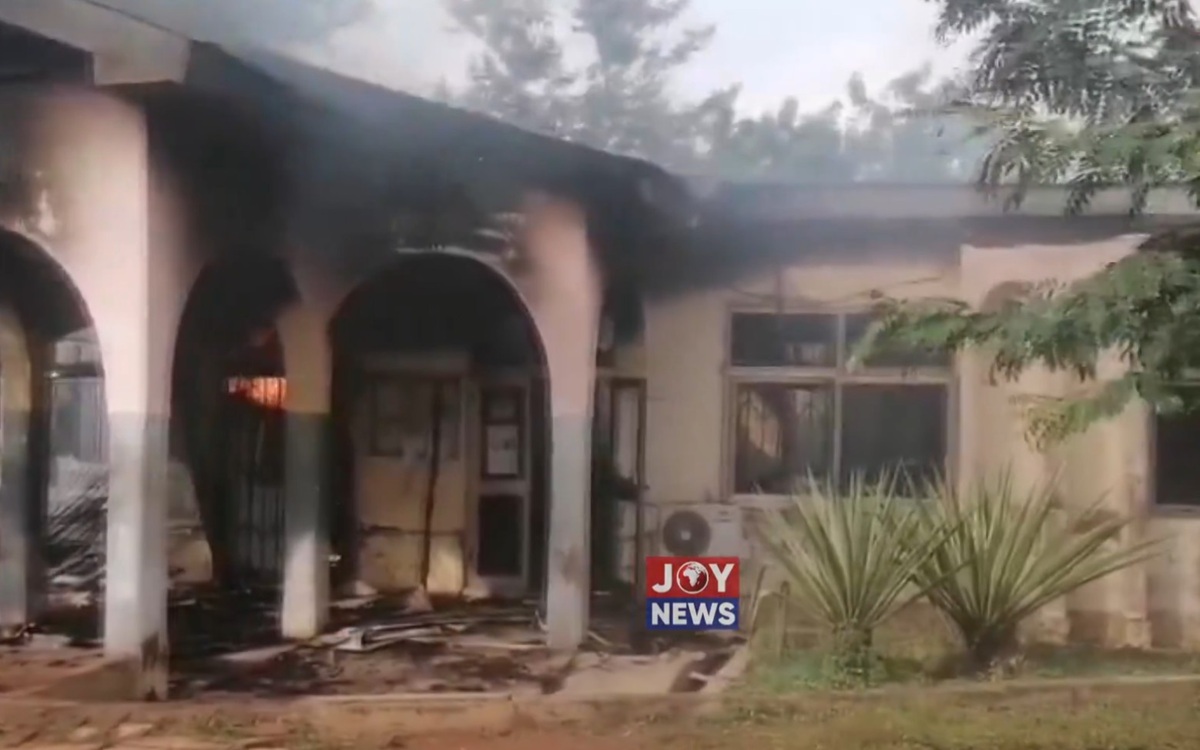
A devastating fire outbreak has completely razed District Magistrate Courts “A and B” in Sunyani, resulting in the total loss of critical judicial documents, computers, and essential office materials. This incident has brought legal proceedings to a standstill in the Bono Region, creating a significant vacuum in the local administration of justice.
The fire, which reportedly started in the early hours, swept through the court premises before fire service personnel could contain the blaze. Because the Sunyani Magistrate Courts serve as the primary point of entry for many criminal and civil cases in the region, the loss of physical dockets and digital backups stored on-site is being described by legal experts as a “judicial emergency.” Officials are currently assessing the extent of the damage to determine how many pending cases will be affected by the disappearance of these irreplaceable records.
How did the fire outbreak affect judicial administration in Sunyani?
The fire has dealt a major blow to judicial administration by erasing the entire paper trail of ongoing litigation, including witness statements, evidence, and court orders. Without these documents, judges cannot proceed with scheduled hearings, leading to an indefinite postponement of justice for hundreds of residents in the Bono Region.
The Sunyani District Magistrate Courts “A and B” are the workhorses of the local legal system, handling everything from land disputes to minor criminal offenses. The destruction of computers means that even the digital scheduling and case management systems are offline. Logic suggests that this will lead to a massive backlog of cases, as lawyers and court clerks will now have to manually reconstruct files using copies held by private legal chambers, a process that could take months or even years.
What critical materials were lost in the Sunyani Court fire?
Beyond the structural damage, the fire claimed all desktop computers, printers, and the physical archives of both Court A and Court B. Critical materials such as original case dockets, evidence exhibits stored in the registry, and official stamps were reduced to ashes during the inferno.
In the legal world, an “original document” is the gold standard for evidence. The loss of these materials creates a high risk for the “miscarriage of justice,” as defendants might now challenge the validity of proceedings without a complete record. The destruction of the computer systems also highlights a major vulnerability in the Bono Region’s judicial infrastructure: the lack of remote, off-site cloud storage for district-level courts. This fire has effectively “blinded” the local judiciary until new equipment can be procured and installed.
Is there a plan to recover the destroyed Sunyani court documents?
Recovery plans involve a painstaking process of “case reconstruction,” where the Judicial Service will ask all involved parties—including the Police, the Attorney General’s office, and private lawyers—to resubmit copies of their filings. This collaborative effort is the only way to rebuild the dockets, though it is limited to cases that were already in the active system.
The Judicial Service of Ghana has previously discussed the “E-Justice” project, which aims to digitize all court records. However, the tragedy in Sunyani reveals that many district courts still rely heavily on physical files and local hard drives. This incident will likely accelerate the rollout of centralized digital servers for the Bono Region to ensure that a future fire cannot wipe out the judicial history of an entire district. For now, the administrative staff is working from temporary locations to begin the clerical task of identifying which cases were “live” at the time of the fire.
How does this disaster impact the Bono Region’s legal system?
The Bono Region now faces a temporary collapse of its lower-tier judicial functions, meaning that new arrests may face delays in their first court appearances. This creates a potential human rights issue, as suspects cannot be held indefinitely without a magistrate’s order, yet the venues for these orders have been destroyed.
Sunyani, being the regional capital, handles a high volume of cases from surrounding districts. The loss of Courts A and B means that other nearby courts will likely be overwhelmed with “emergency transfers.” Logic dictates that the regional minister and the Chief Justice will need to designate a temporary building to house the Sunyani Magistrate Courts to prevent a total breakdown of law and order. The psychological impact on the court staff is also significant, as many have lost years of meticulous administrative work in a single night.
What caused the fire at the Sunyani District Magistrate Courts?
Initial reports from the Ghana National Fire Service (GNFS) suggest that the fire may have been caused by an electrical fault within the aging infrastructure of the court buildings. However, a full forensic investigation is currently underway to rule out any possibility of arson, given the sensitive nature of the documents stored on the premises.
Court buildings often house old wiring that struggles to support modern office equipment like heavy-duty printers and air conditioning units. The GNFS has frequently warned public institutions in the Bono Region about the importance of regular electrical audits. If the investigation confirms a fault, it will raise serious questions about the maintenance budget and safety protocols of judicial buildings across the country. Regardless of the cause, the result remains the same: a massive setback for the “Helpful Content” of the law in Sunyani.
Factual Insights on Judicial Infrastructure in Ghana 2026:
- Digital Gap: While the Supreme Court and High Courts in Accra are largely digitized under the E-Justice system, many District Magistrate courts still operate with 70% to 80% physical paper records.
- Fire Frequency: Public building fires in Ghana are frequently linked to “voltage fluctuations” and outdated wiring systems in structures built before the year 2000.
- Bono Region Caseload: The Sunyani Magistrate Courts A and B collectively handle an estimated 1,200 to 1,500 cases per year.
- Insurance Coverage: Most government buildings in Ghana are covered by a “State Insurance” policy, though this typically covers structural replacement rather than the “intellectual property” or records lost inside.
- Response Time: The Ghana National Fire Service aims for a response time of under 10 minutes in regional capitals, but access to water hydrants remains a challenge in many commercial areas.
- Case Reconstruction Precedent: In previous instances of court fires, it has taken between 6 and 18 months to resume 100% of the judicial activities previously active at the site.
- Judicial Service Budget: The 2026 budget for the Judicial Service includes an increased allocation for “Infrastructure Safety and Fire Prevention” following similar incidents in other districts.
What are the immediate next steps for litigants in Sunyani?
Litigants and lawyers with pending cases at Courts A and B are advised to wait for an official directive from the Registrar of the Sunyani High Court. They should immediately begin organizing their own duplicate files and receipts to assist the Judicial Service during the upcoming reconstruction phase.
It is likely that a “Temporary Registry” will be established within the next 48 hours to handle urgent bail applications and remands. If you have a case coming up, do not simply show up at the charred remains of the building; instead, monitor the news for the location of the substitute courtroom. The “Winning Language” here is preparation: the more documents you can provide from your own records, the faster your case can get back on the docket.
How can Sunyani prevent another judicial fire in the future?
Logic suggests that the government should also consider relocating sensitive archives to fireproof safes. While the cost of retrofitting old buildings is high, the cost of losing the Bono Region’s judicial history is significantly higher. This disaster should serve as a “wake-up call” for the municipal assembly to inspect all public buildings in Sunyani for fire readiness. After all, justice shouldn’t just be blind; it should also be fireproof.
Also Read: Tragic UMaT Student Suicide: The Hidden Dangers of Student Debt and Betting