

 By Zobia Zulfqar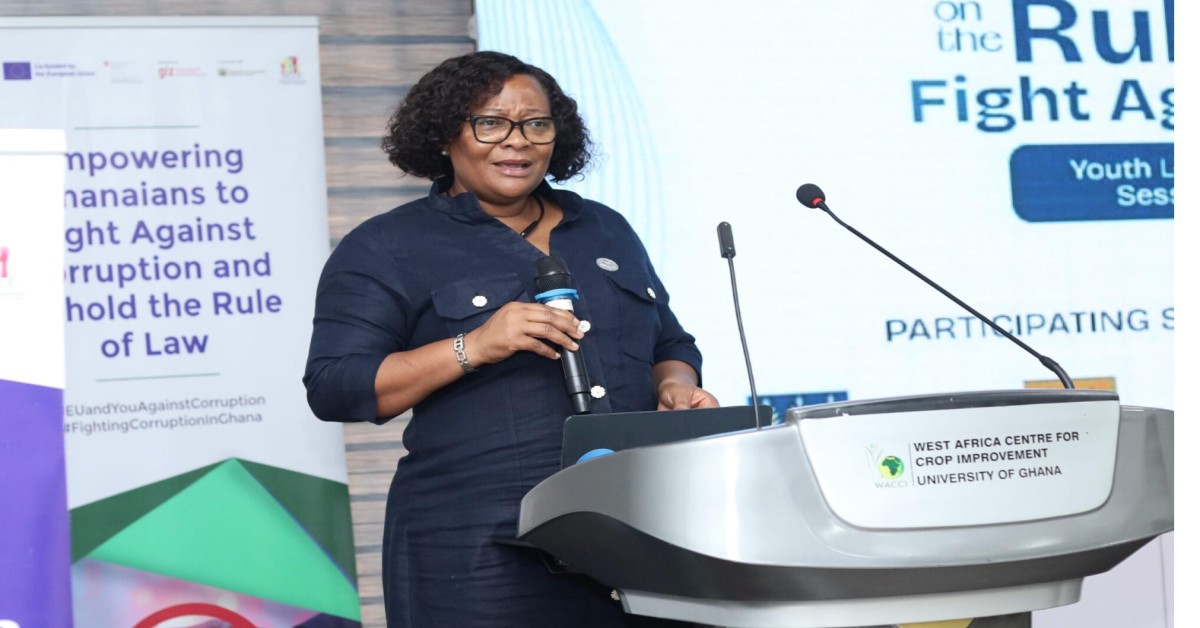
Transparency International-Ghana (TI-Ghana) has called for sustained and stronger action against corruption, warning that Ghana’s progress in combating the practice remains inconsistent.
The Executive Director of Transparency International-Ghana, Mrs Mary Addah, said the country needed to intensify efforts to fight corruption and strengthen integrity in public life.
She said Ghana’s performance on the Transparency International Corruption Perceptions Index (CPI) remained below the level required to achieve meaningful and sustained improvements in the fight against corruption.
Mrs Addah made the remarks at a Youth-Led Dialogue Session organised by the National Commission for Civic Education (NCCE) in Accra on Friday.
According to her, Ghana’s performance over the years showed periods of improvement and decline, rather than a consistent upward trend in the country’s efforts to address corruption.
She explained that Ghana’s CPI score reached 48 points in 2014 before declining to 40 points in 2017.
The score later recovered to 43 points in 2020 and remained at 43 through 2023. It subsequently fell to 42 points in 2024 before marginally recovering to 43 points in 2025.
Mrs Addah said the figures demonstrated that Ghana had not made the sustained progress required to significantly improve its position in the fight against corruption.
She stressed that the country was not collapsing as a result of corruption, but the available evidence showed that progress remained too limited and inconsistent.
“Ghana is not collapsing in any way. We are not saying that we are doing so badly that nobody can come and learn anything good from us. No, that is not the case. But then it is not making any sustained progress,” she said.
Her comments highlight the importance of maintaining consistent efforts to strengthen transparency, accountability and integrity within public institutions.
The CPI, published annually by Transparency International, measures perceptions of public sector corruption across countries. A country’s score provides an indication of how corruption is perceived in its public sector, with stronger scores generally reflecting better perceived performance in controlling corruption.
Ghana’s recent scores, as cited by Mrs Addah, show that the country has experienced difficulty in maintaining the improvements recorded in earlier years.
The decline from 48 points in 2014 to 40 points in 2017 marked a significant setback. Although the score later improved to 43 points, the country has remained around the same level in recent years.
Mrs Addah’s assessment suggests that isolated improvements are not enough to produce lasting changes in the country’s approach to corruption.
Sustained progress requires continued attention to accountability and stronger efforts to ensure that public institutions operate transparently and responsibly.
The role of young people is also important in strengthening the fight against corruption. The youth-led dialogue provided a platform for participants to discuss issues surrounding civic responsibility, accountability and the need for citizens to play an active role in promoting integrity.
Engaging young people in discussions about corruption is important because they form a significant part of Ghana’s population and will increasingly assume leadership and decision-making responsibilities in public and private institutions.
Building a culture of accountability therefore requires more than government action alone. Citizens, civil society organisations, public institutions and other stakeholders all have roles to play in demanding transparency and responsible use of public resources.
TI-Ghana’s call also points to the need for Ghana to move beyond short-term responses and focus on measures capable of producing lasting improvements.
A consistent approach to fighting corruption would help strengthen public confidence in institutions and promote greater accountability in public life.
The organisation’s concerns come as Ghana continues to assess its performance against international indicators of transparency and integrity.
The movement in the country’s CPI score over the years demonstrates the challenges involved in achieving sustained progress.
Mrs Addah’s remarks therefore serve as a call for renewed commitment from institutions and citizens to address corruption and strengthen accountability mechanisms.
For Ghana to improve its performance over time, efforts to combat corruption will need to be consistent and supported by effective institutions and active civic participation.
The latest CPI figures provide an important measure of the progress made so far, but they also highlight the work that remains.
TI-Ghana is urging stakeholders to maintain pressure for stronger accountability and ensure that anti-corruption efforts translate into measurable and lasting improvements.
The organisation believes sustained action remains essential if Ghana is to strengthen integrity in public life and achieve meaningful progress in its fight against corruption.
Also Read: Thomas Partey Denied Canada Entry and Will Miss World Cup Opener Against Panama