

 By Collins Sarkodieh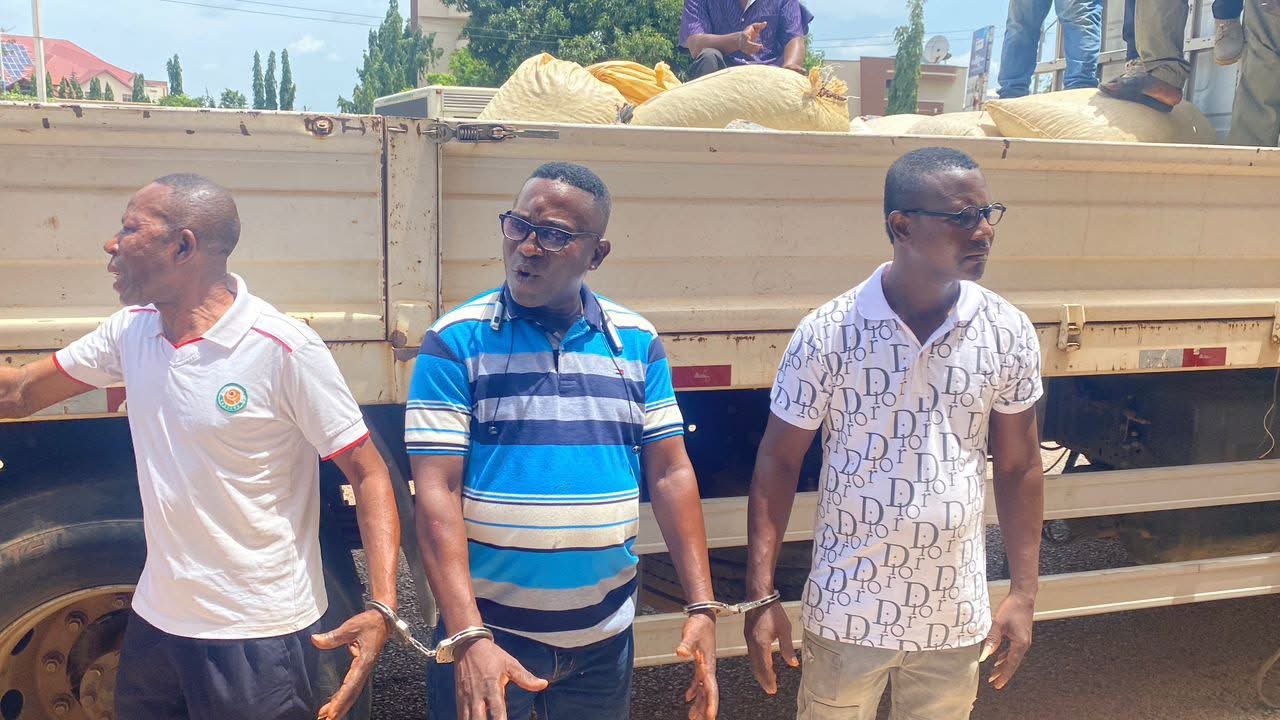
The Ghana Cocoa Board (COCOBOD) anti-smuggling unit, in a coordinated operation with national security agencies, has successfully intercepted and arrested several suspects attempting to smuggle over 100 bags of cocoa beans. In a surprising reversal of typical regional smuggling trends, the contraband was being moved from Côte d’Ivoire into Ghana to take advantage of higher domestic producer prices and the stability of the Ghanaian cocoa purchasing system.
This operation highlights the rigorous enforcement of cross-border trade regulations by the Ghanaian government to protect the integrity of the local cocoa industry. While smuggling usually flows outward from Ghana during periods of currency fluctuation, the current economic landscape has made Ghana an attractive destination for “imported” contraband beans. Security agencies have intensified patrols along the Western border to curb these illegal activities, which threaten to dilute the quality of Ghana’s premium cocoa exports and disrupt the national supply chain.
Why was cocoa being smuggled into Ghana from Côte d’Ivoire?
The primary driver for smuggling cocoa into Ghana is the significant difference in the farm-gate price offered to farmers in the two neighboring countries. When Ghana’s producer price is higher than that of Côte d’Ivoire, smugglers move beans across the border to secure a larger profit margin through Ghana’s licensed buying companies.
Ghana’s cocoa pricing is determined by a Producer Price Review Committee, which often includes a “Living Income Differential” to support farmers. If the Ivorian government sets a lower seasonal price or if their local currency, the CFA Franc, experiences specific market pressures against the Ghanaian Cedi, the incentive to move beans eastward increases. Logically, smugglers are always looking for the “highest bidder,” but this practice is illegal because it bypasses the regulatory oversight of COCOBOD and compromises the traceability of the beans.
How did the COCOBOD anti-smuggling unit execute the arrest?
The arrest was the result of a “sting operation” involving intelligence gathering and roadblocks set up by the COCOBOD anti-smuggling unit in collaboration with the Ghana Police Service. Acting on a tip-off, the team intercepted a vehicle carrying the 100+ bags of cocoa, which were concealed under other agricultural produce to evade detection at the border.
Security agencies have recently adopted more sophisticated surveillance techniques, including the use of localized intelligence networks and enhanced border monitoring technology. This specific arrest took place in a border community in the Western North Region, a known hotspot for cross-border agricultural trade. The suspects are currently in custody and are expected to face charges under the 1968 Cocoa Industry Regulation Act, which carries heavy penalties for the illegal purchase or transport of cocoa beans.
What is the impact of cocoa smuggling on Ghana’s economy?
Cocoa smuggling undermines Ghana’s national budget by distorting production figures and placing an undue financial burden on the state-funded cocoa subsidy programs. When beans are brought in illegally, they are often mixed with Ghanaian beans, which can lower the overall quality grade of the country’s exports and damage the “premium” reputation of the Ghana brand.
Ghana is the world’s second-largest producer of cocoa, and the sector contributes significantly to the country’s Gross Domestic Product (GDP) and foreign exchange earnings. If the market is flooded with lower-quality smuggled beans, it could lead to “price docking” by international buyers. Logic dictates that for Ghana to maintain its E-E-A-T (Experience, Expertise, Authoritativeness, and Trustworthiness) in the global chocolate industry, it must maintain a “closed” and highly regulated supply chain that accounts for every bag produced locally.
Is smuggling into Ghana more common than smuggling out?
Historically, smuggling out of Ghana (to Togo or Côte d’Ivoire) has been more prevalent when the Ghanaian Cedi is weak or when neighboring prices are higher. However, the 2025/2026 season has seen a rare shift where Ghana’s aggressive pricing strategy and prompt payment systems have made it the preferred “market” for smugglers operating in the sub-region.
The “smuggling direction” acts as a barometer for the health of a country’s cocoa sector. When beans flow in, it suggests that the local government is doing a better job of compensating its farmers than its neighbors. While this is a sign of a strong domestic policy, it creates a “policing nightmare” for security agencies. They must ensure that the high prices meant to benefit Ghanaian farmers are not instead lining the pockets of international smugglers who did not contribute to the local agricultural infrastructure.
Factual Insights on Ghana’s Cocoa Industry 2026:
- Production Rank: Ghana consistently ranks as the second-largest cocoa producer globally, trailing only Côte d’Ivoire.
- Economic Contribution: The cocoa sector supports the livelihoods of over 800,000 farm families in Ghana.
- Premium Quality: Ghana cocoa is often used as a “blender” for lower-quality beans globally due to its high fat content and consistent flavor.
- Price Setting: The Ghanaian government increased the cocoa producer price by nearly 58% in the 2024/2025 season to combat the rising cost of living.
- LID Policy: Ghana and Côte d’Ivoire jointly implement a $400 per tonne Living Income Differential (LID) to tackle farmer poverty.
- Traceability Laws: New EU regulations (EUDR) require all cocoa imported into Europe to be “deforestation-free” and fully traceable to the farm of origin.
- Smuggling Penalties: Under Ghanaian law, those found guilty of cocoa smuggling can face prison terms ranging from 5 to 10 years and the forfeiture of their vehicles.
What happens to the intercepted 100 bags of cocoa?
Once cocoa is seized during a smuggling arrest, it is typically confiscated by the state and handed over to the Quality Control Company (QCC) of COCOBOD for testing. If the beans meet the rigorous Ghanaian standards, they are integrated into the national stock, though the proceeds from their sale are often diverted into a dedicated fund for border security and agricultural development.
The beans undergo a “cut test” to check for fermentation quality, moisture content, and the presence of pests. Smuggled beans are often not as well-cured as those produced under the supervision of COCOBOD’s extension officers. This is a critical step because a single bag of “poor” Ivorian beans could contaminate a whole shipment of “Grade A” Ghanaian cocoa. The logic is to protect the collective wealth of Ghanaian farmers by ensuring that no sub-standard product enters the official export silos at Tema or Takoradi.
Also Read: How Agriculture Boosts Ghana’s Economy
How can the Ghana-Côte d’Ivoire border be better secured?
Securing the porous border requires a combination of “physical boots on the ground” and “digital surveillance.” Experts suggest that Ghana should increase the number of permanent border posts and integrate drone technology to monitor the “unapproved routes” that smugglers frequent under the cover of night.
Beyond physical security, “price harmonization” between the two nations is the most effective long-term solution. If Ghana and Côte d’Ivoire coordinate their seasonal price announcements more closely, the “profit incentive” for smuggling vanishes overnight. Until then, the COCOBOD anti-smuggling unit remains the “thin blue line” protecting the nation’s most valuable crop. The recent arrests prove that while the border is wide, the reach of the law is becoming increasingly long.
What should the public do if they suspect smuggling?
The Ghanaian public, especially those living in border communities, are encouraged to report any suspicious movement of heavy trucks or unusual storage of cocoa bags in non-designated warehouses. COCOBOD has established hotlines for whistleblowers, and there are often incentives for information that leads to a successful arrest and seizure.
Community members are the “eyes and ears” of national security. Smugglers rely on the silence of locals to move their goods through bush paths. Logic suggests that a community that protects its local cocoa industry is protecting its own roads, schools, and hospitals, which are funded by cocoa revenue. The “Winning Language” here is collective responsibility; the state cannot be everywhere at once, but the citizens are.
The interception of 100 bags of cocoa by the COCOBOD anti-smuggling unit is a significant victory in the ongoing battle to stabilize the West African agricultural market. It sends a clear message that Ghana is no longer a “soft target” for those looking to exploit its superior purchasing system.
As we look toward the future of the 2026 season, the focus must remain on the twin pillars of “security and sustainability.” By weeding out smugglers and protecting the quality of the “Ghanaian gold,” the government is ensuring that the hard work of local farmers continues to pay off. The “Krakens” of the cocoa world may be crafty, but with the right intelligence and the support of the public, they are finding it increasingly difficult to swim in Ghanaian waters.
Also Read: Ghana Cedi Exchange Rate Outlook: Live Rates and Market Analysis for April 2026
Do you believe that the Ghanaian government should implement a more permanent “digitized tracking system” on every bag of cocoa from the farm to the port to eliminate the possibility of smuggling once and for all, or would the cost of such a system be too high for the average farmer to bear?