

 By Collins Sarkodieh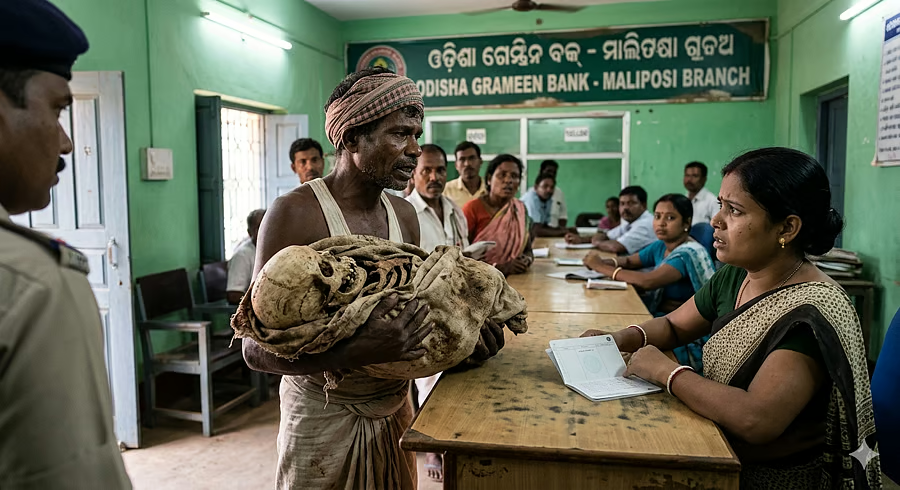
In a tragic and surreal turn of events in Odisha’s Keonjhar district, a tribal man named Jeetu Munda carried the skeletal remains of his deceased sister to a bank to withdraw her savings. This desperate act, occurring at the Maliposi branch of the Odisha Grameen Bank, was born out of a struggle to access a modest sum of 20,000 Rupees required for basic survival and burial rituals.
The local administration and police have since intervened to ensure that the legal and humanitarian rights of the survivor are upheld. While the sight of a skeleton in a public financial institution shocked the local community, it has highlighted the severe bureaucratic barriers that often trap marginalized citizens in a cycle of poverty. Jeetu Munda, as the sole claimant to the account, has been promised a fast-tracked resolution to his request, reflecting a shift from rigid banking protocols to compassionate governance in the face of absolute necessity.
Why did Jeetu Munda bring his sister’s skeleton to the Odisha Grameen Bank?
Jeetu Munda brought his sister’s skeleton to the bank because he lacked the formal documentation required to prove her death and his status as her legal heir. Desperate to withdraw the 20,000 Rupees in her account, he believed that physical evidence of her passing was the only way to satisfy the bank’s demands for proof of death.
For many living in remote tribal villages like Dianali, the paperwork we take for granted death certificates, succession affidavits, and legal heirship certificates can be nearly impossible to obtain. When the bank reportedly asked for proof to process the claim, Munda, aged 50, took a literal approach to a bureaucratic problem. Logically, if the bank needed to know she was dead, he would show them. This heartbreaking logic demonstrates a profound disconnect between formal financial systems and the realities of those living outside the digital and administrative reach of the state.
How did the bank and local authorities react to the skeleton?
The initial reaction at the Maliposi branch was one of shock and alarm, but the situation quickly shifted toward a humanitarian intervention led by the local police and Block Development Officers. After the police arrived, they calmed the situation, facilitated the re-burial of the remains, and ordered the bank to prioritize the fund release to Munda.
The local administration has directed the bank officers to waive certain rigid requirements to ensure that Jeetu Munda gets the money as soon as possible. The police even accompanied Munda back to the graveyard to ensure the skeleton was re-buried with dignity. In this instance, logic and empathy trumped the standard operating procedures. The authorities recognized that the “legal claimant” was in a state of extreme distress and that the bank’s role in the 24-hour economy must occasionally yield to the survival needs of the most vulnerable.
What are the legal rules for withdrawing money from a deceased person’s account in India?
Under standard Indian banking regulations, a claimant must usually provide a death certificate, a letter of administration, or a succession certificate to withdraw funds from a deceased relative’s account. However, if a “Nomination” was made on the account, the process is significantly faster, requiring only a death certificate and proof of the nominee’s identity.
In cases involving small amounts or marginalized communities, the Reserve Bank of India (RBI) encourages banks to adopt a simplified approach to minimize hardship. Unfortunately, if there is no nominee listed, the legal hurdles can cost more than the amount sitting in the account. Jeetu Munda’s struggle for 20,000 Rupees (roughly $240) highlights why “Financial Inclusion” must go beyond just opening accounts; it must also include simplifying the “exit” or inheritance of those funds for illiterate or rural survivors who cannot navigate the court system.
Is this a failure of the rural banking system or a social issue?
The Odisha skeleton incident is a complex mix of both a failure in bureaucratic flexibility and a deeper social crisis involving tribal isolation. While the bank was following the “letter of the law” regarding fraud prevention, the lack of a proactive social safety net meant that Munda felt his only option was this extreme public display.
- Bureaucratic Rigidity: Banks are terrified of “wrongful payment” lawsuits, which often makes them insensitive to the context of a claimant’s life.
- Documentation Gap: Many tribal citizens do not have their births or deaths registered in real-time, making the “legal” path a dead end.
- Poverty Pressure: 20,000 Rupees is a life-changing amount for a man in Dianali village, representing food, debt relief, and the ability to honor the dead.
Solving this requires more than just a one-time intervention for Munda; it requires “Mobile Administrative Camps” that go into Keonjhar’s villages to settle these claims on-site. Logic suggests that if we want people to trust banks, the banks must be reachable in their moments of greatest grief, not just their moments of deposit.
Also Read: The Final Split: Why Peter Okoye Changed His Birthday and What It Means for P-Square
Factual Insights on Tribal Life and Banking in Odisha:
- Keonjhar Demographics: Keonjhar is one of India’s leading districts for mineral production, yet it remains home to some of the most economically disadvantaged tribal communities.
- Odisha Grameen Bank: This Regional Rural Bank (RRB) was established to serve the specific needs of Odisha’s rural population, often operating in areas where private banks won’t go.
- Financial Literacy: According to 2024 reports, while bank account ownership in rural India has soared, the understanding of “Nomination” and “Succession” remains under 30% in tribal blocks.
- RBI Guidelines: The RBI has a standing mandate that banks should not cause “undue hardship” to survivors for accounts with small balances.
- Tribal Land Rights: Many tribal families in Keonjhar rely on government schemes (like DBT) where funds are deposited directly into bank accounts that they may not know how to manage.
- Mortuary Services: In remote areas of Patana block, access to formal mortuary or forensic services is extremely limited, leading to traditional burial practices that can be easily disturbed.
What happened to the skeleton after the bank incident?
Following the incident, the local police took charge of the situation and ensured the skeletal remains were returned to the graveyard. The remains were re-buried in the presence of police and village elders, restoring a sense of sanctity to the deceased sister after the traumatic events at the bank.
This re-burial was an essential step in de-escalating the public’s shock and restoring the man’s dignity. The police didn’t just see a “legal case”; they saw a grieving brother who had been pushed to his breaking point. By facilitating the burial, they allowed Munda to return to his village while they handled the administrative “fight” with the bank. It is a rare example of the state acting as a “protector” rather than a “prosecutor” in a highly irregular situation.
How can the government prevent such incidents in the future?
The government can prevent these tragedies by implementing “Automatic Heirship” protocols for accounts below a certain threshold or by integrating death registries with banking databases. If the local panchayat (village council) records a death, that data should theoretically flow to the bank to lock the account and alert the legal heir.
We often talk about “AI in banking” or “Digital India,” but for Jeetu Munda, the digital world was a wall. A “Human-Centric Design” approach to rural banking would involve local officials visiting the bereaved to help them fill out forms at home. If the administration had been proactive when his sister first died, Munda would never have had to pick up a shovel to prove his loss. The logic is simple: the more “remote” a village is, the more “present” the government needs to be.
What is the current status of Jeetu Munda’s money?
As of the latest updates, the local administration has confirmed that Jeetu Munda is the “only claimant” to the account according to the rules. The bank has been ordered to process the 20,000 Rupees withdrawal immediately, and Munda is expected to receive the funds to help stabilize his life and cover the costs associated with the final rites.
This resolution is a victory for common sense, but it remains a “reactive” victory. Munda had to do something unthinkable to be heard. While he will get the money, the psychological impact of the struggle and the public exposure of his sister’s remains is a high price to pay. The “Winning Language” here shouldn’t be about the bank’s “generosity,” but about the systemic failure that required such a sacrifice.
The story of Jeetu Munda is a haunting reminder that behind every bank balance is a human life and sometimes, a human death that the system refuses to see. It is a tale of a brother’s desperate love and a system’s cold indifference, finally resolved by the intervention of local leaders who saw the man behind the “claimant number.”
As we advance toward a more “automated” future, let us hope the lesson from Keonjhar is not forgotten. We must build systems that are strong enough to protect our money, but flexible enough to recognize our humanity. Jeetu Munda’s sister is back at rest, and hopefully, with the funds finally in hand, her brother can find some peace as well. In the end, 20,000 Rupees couldn’t buy her life back, but it could finally buy him the dignity he was so nearly denied.
Also Read: The 2026 Guide to Securing Your Mobile Money: How to Outsmart the Latest “Double Your Cash” Scams
Do you believe that banks should be legally allowed to release “small balances” (under 25,000 Rupees) to immediate family members based on a simple community verification from a village head, or does the risk of fraud justify the rigid documentation that leads to incidents like the one in Keonjhar?